Letoon Sanctuary: Religious Center of Lycia in Türkiye


Site at a Glance
- Rating
- 4.5
- Popularity
- Medium
- Country
- Turkey
- Primary era
- Classical
- External website
- Open
- Eras represented
- Iron Age, Classical
- Civilizations
- Lycian, Roman
- Site type
- Religious
- Remains
- Sanctuary
On this page17 sections
History
Letoon Sanctuary Place is an ancient Lycian sanctuary in Türkiye, located at Kumluova near Seydikemer in Muğla Province. Dedicated to Leto and her divine twins Artemis and Apollo, it served as the principal sanctuary of Leto and as a religious center for Xanthos and the Lycian League, the political confederation of Lycian cities. The sanctuary was occupied from at least the eighth century BC through the end of the Roman period, and its surviving remains reflect Lycian, Hellenistic, Roman, and Early Christian phases.
Early Lycian worship
Letoon stood beside the Xanthos River, about 4 kilometres southwest of ancient Xanthos. Occupation began no later than the eighth century BC and may have started earlier. Finds from at least the sixth century BC show that religious activity at the site predates Greek cultural dominance in Lycia. The earliest deity worshipped there was probably a local Anatolian mother goddess rather than Leto, whose name appears at Letoon from the fourth century BC.
The change in the sanctuary’s religious identity formed part of the political and cultural Hellenization of Lycia under the dynast Arbinas. An inscription states that Arbinas consulted the oracle at Delphi, established the cult of Leto, and constructed or reconstructed her temple. Two inscribed bases found at the sanctuary also record his achievements and his association with the foundation of the Leto cult. Leto, Artemis, and Apollo became the national gods of the Lycians, while the nymphs were honored in connection with the springs and water cult at the site.
Persian, Hellenistic, and Lycian League rule
Under Achaemenid rule, Lycia retained a degree of autonomy while its dynasts remained subject to the Persian Great King. After a Lycian revolt against the satraps in the fourth century BC, the region came under Carian control during the period associated with the satrap Pixodaros. Following Alexander the Great’s death, Lycia was ruled for several decades by the Ptolemies, the Greek dynasty that governed Egypt, and later by Rhodes.
In the second century BC, Roman protection helped the Lycians regain independence within a renewed Lycian League. Letoon played a public as well as religious role in this political system. Inscriptions indicate that Lycian rulers proclaimed their decisions at the sanctuary, which was linked with Xanthos by a road running south toward Patara. Its temples and civic spaces therefore served a community extending beyond the immediate settlement.
Roman and Christian transformations
The sanctuary remained active during the Roman period. Emperor Hadrian, who ruled from AD 117 to 138, visited Letoon, and an imperial-cult hall was built near the altar of Leto and the nymphs. An imperial cult involved the worship or ceremonial commemoration of the emperor within a religious setting. The hall included an inscription honoring Hadrian and formed part of a Roman complex associated with the nymph sanctuary.
The sacred character of Letoon also appears in a tradition concerning Mithridates VI of Pontus, a king and major opponent of Rome in the first century BC. During his siege of Patara, he reportedly intended to cut trees from the sanctuary’s sacred grove for military purposes. A dream warning him against the sacrilege is said to have stopped the plan.
After pagan worship was prohibited in AD 380, the temples were destroyed. A small Early Christian basilica was then built on the altar esplanade, probably reusing the cella, or principal enclosed room, of the Temple of Leto as a baptistery. After the seventh century, during the period of Arab incursions, the surrounding region was inhabited largely by Yörük communities, traditionally pastoral and often seasonally mobile groups of Anatolia.
Excavation, restoration, and protection
When the Austrian archaeologist Otto Benndorf visited Letoon in 1884, the theatre and only a few walls were visible. Systematic excavation began in 1962 under Henri Metzger and continued through successive French archaeological missions directed by Christian Le Roy, Jacques des Courtils, Didier Laroche, and Laurence Cavalier. Turkish teams from Başkent University worked at the site between 2011 and 2019, and a new campaign opened in 2025 under Hasan Kasapoğlu of Atatürk University, with work focused partly on the theatre sector and the sanctuary’s origins.
Excavation has revealed most of the ruins, although the high groundwater table near the Xanthos River has complicated the work. A restoration program begun in 2000 reconstructed part of the Temple of Leto from original excavated pieces. By 2005, stonecutters from the Fondation de l’Œuvre Notre-Dame in Strasbourg had participated in rebuilding part of the temple, and restoration also addressed the theatre and imperial-cult hall. The Temple of Leto was reconstructed in its original setting between 2000 and 2007. Letoon and Xanthos were inscribed together as a UNESCO World Heritage Site in 1988 under criteria ii and iii. Letoon is also protected as a first-degree archaeological site, lies within an environmental protection zone, and is covered by a conservation plan approved in 2006.
Seasonal rises in the water table continue to threaten the remains, while surrounding greenhouses affect the visual setting. Water channels constructed in 2006 helped reduce the effects of rising water during excavation works.
Remains
Sanctuary layout and entrances
Letoon occupies a rectangular sanctuary beside the Xanthos River. Alluvial deposits carried by the river have extended the land around the site, which now lies about 15 kilometres from the sea. In antiquity, Strabo placed the sanctuary ten stades, or more than 1.6 kilometres, from the coast. Porticoes enclosed at least two sides of the sacred area, while the theatre to the north indicates that further buildings stood nearby.
Two excavated entrances clarify how the sanctuary was approached. The western propylea, a monumental entrance, formed the processional approach. A northern postern connected the sanctuary with the road toward Xanthos. The central sacred area contained three parallel Hellenistic temples oriented toward the south. Their construction is generally dated to the third century BC on the basis of their architectural style and building techniques.
The three Hellenistic temples
Temple of Leto
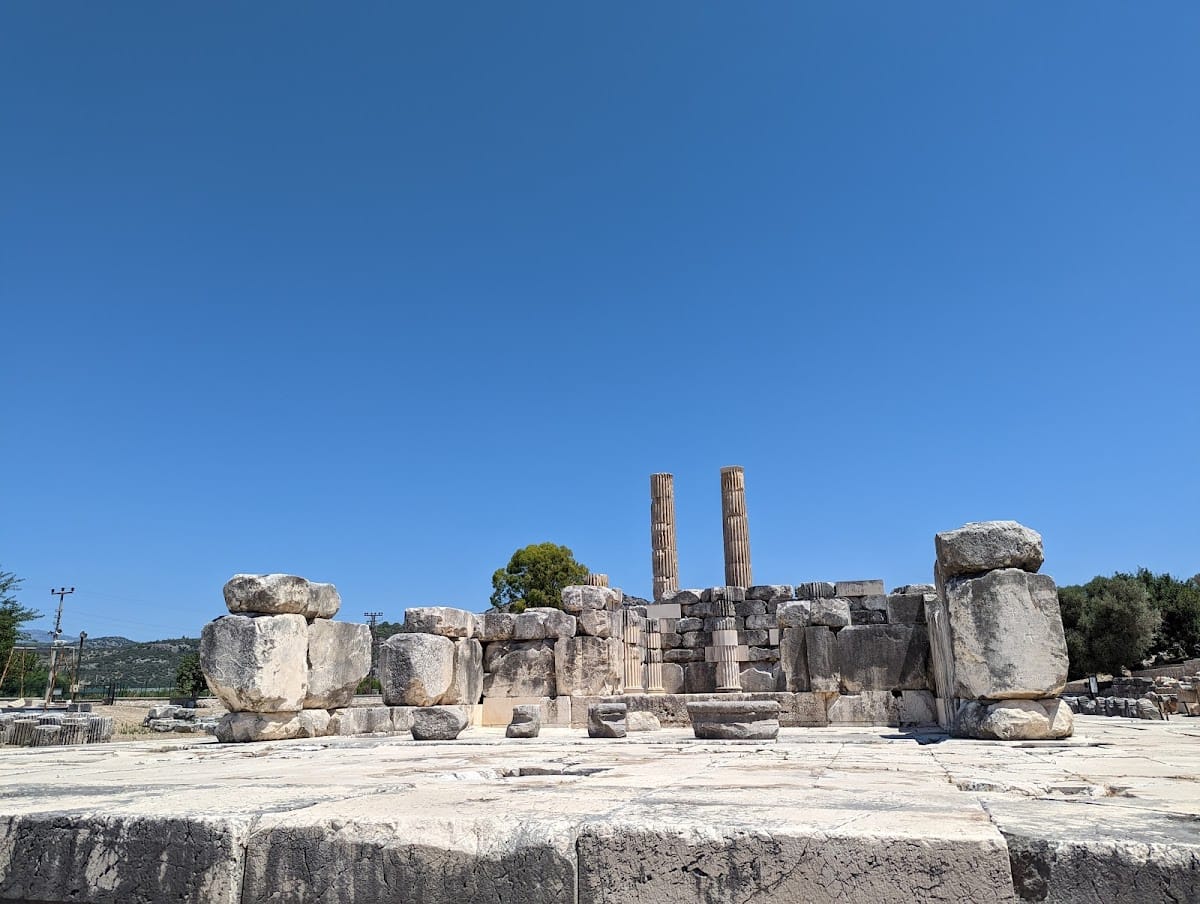
The western temple was dedicated to Leto. Its later structure preserved the remains of an earlier building, probably an earlier temple, within the newer construction. The temple is an Ionic peripteral building, meaning that a continuous external colonnade surrounds it. It had six by eleven columns and was built from marble-bearing limestone. Inside, the cella was decorated with engaged Corinthian columns, which were attached to the walls rather than standing freely. Part of the temple has been reconstructed using original excavated pieces.
Temple of Apollo
The eastern temple honored Apollo and incorporated the foundations of a very early wooden temple within its cella. The later building was constructed in the Doric order, one of the principal architectural systems of classical Greek temples. Its position alongside the temples of Leto and Artemis reflects the joint worship of the divine family associated with the sanctuary.
Temple of Artemis
The smaller central temple was dedicated to Artemis. Its cella incorporated a reshaped rock, an unusual arrangement within the building. Together with the temples of Leto and Apollo, it formed the central group of three parallel structures that defined the religious core of Letoon.
Water sanctuary and imperial complex
Nymphaeum and sanctuary of the nymphs
The nymphaeum, a monumental structure associated with a spring, supplied fresh water at Letoon. It occupied the site of a Hellenistic structure built over a spring, with water emerging from the monument. Two exedras, recessed or projecting seat-like spaces, flanked it. The visible remains date from the third century BC. The nymphaeum formed part of a sanctuary of the nymphs, whose worship was connected with the springs and water cult.
Imperial-cult hall
The Roman imperial-cult complex stood southwest of the main sanctuary. A square hall opened onto a semicircular portico aligned with the nymph sanctuary, and the large portico bordered a basin. An inscription in the hall honored Hadrian. The inscription was once surmounted by a statue of the emperor, while the reconstruction of the hall’s applied decoration remains under study.
Theatre and inscriptions
Hellenistic theatre
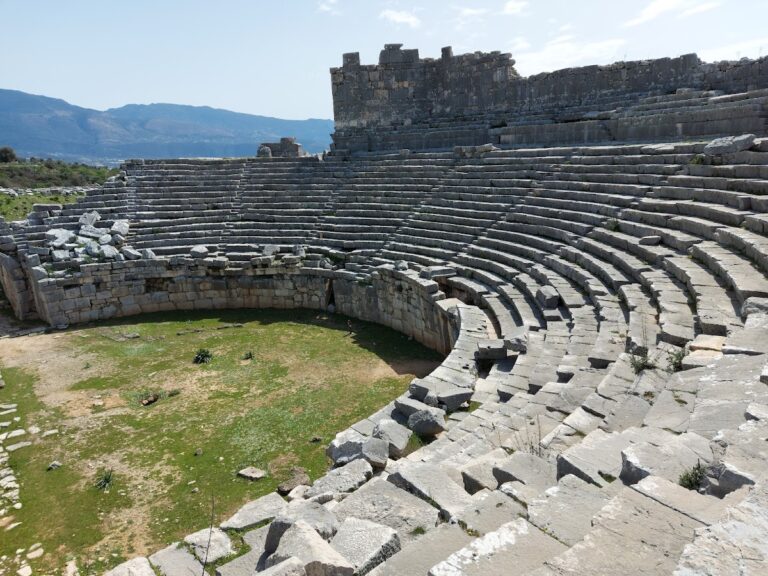
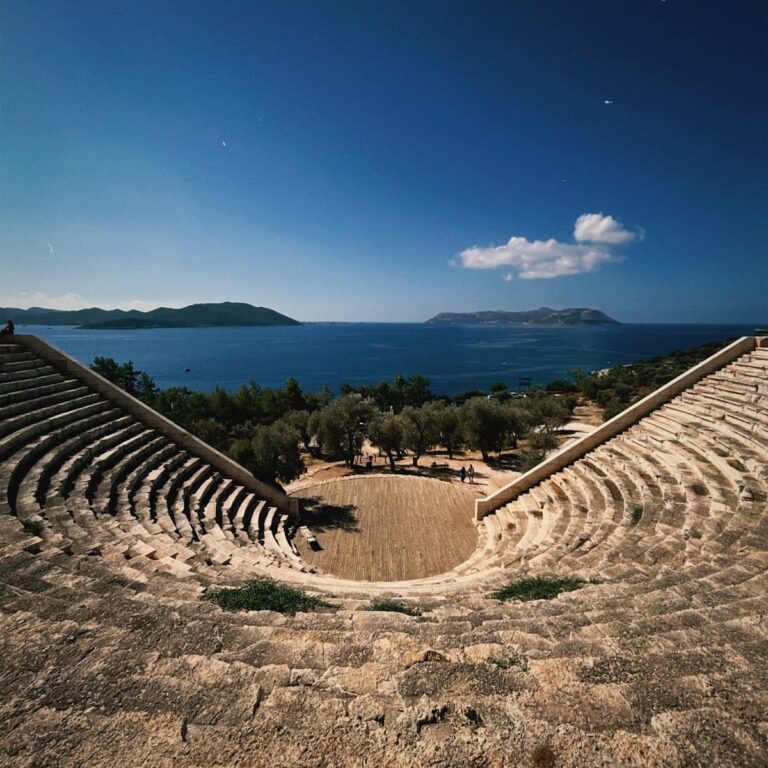
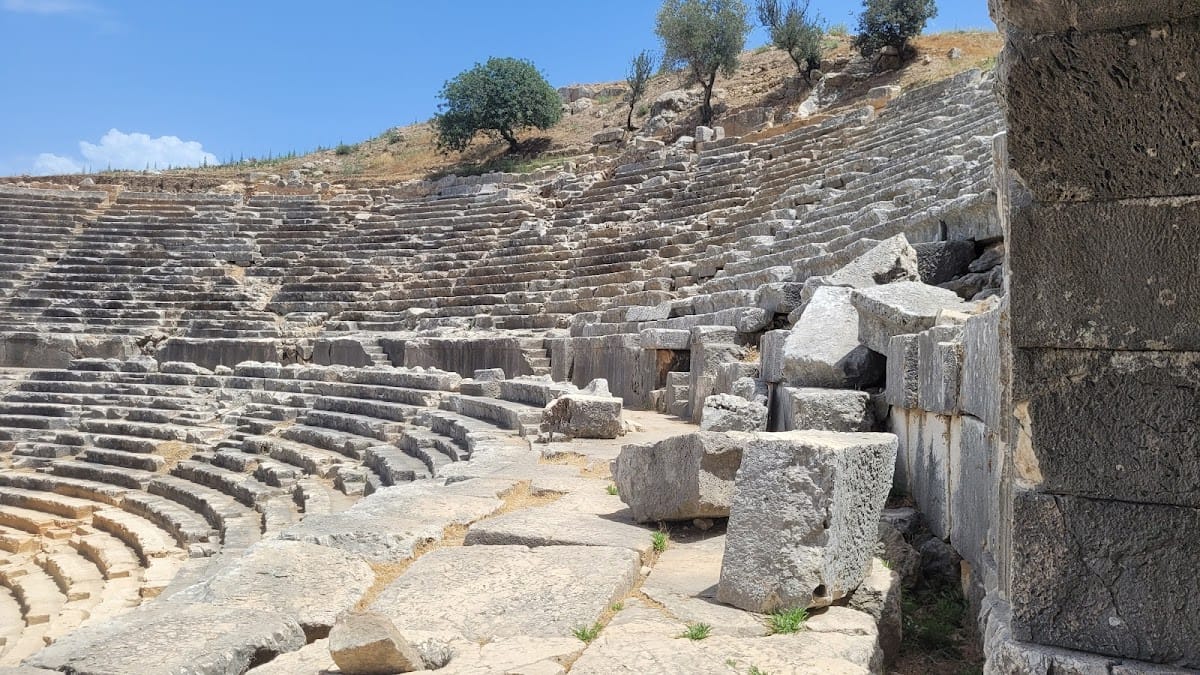
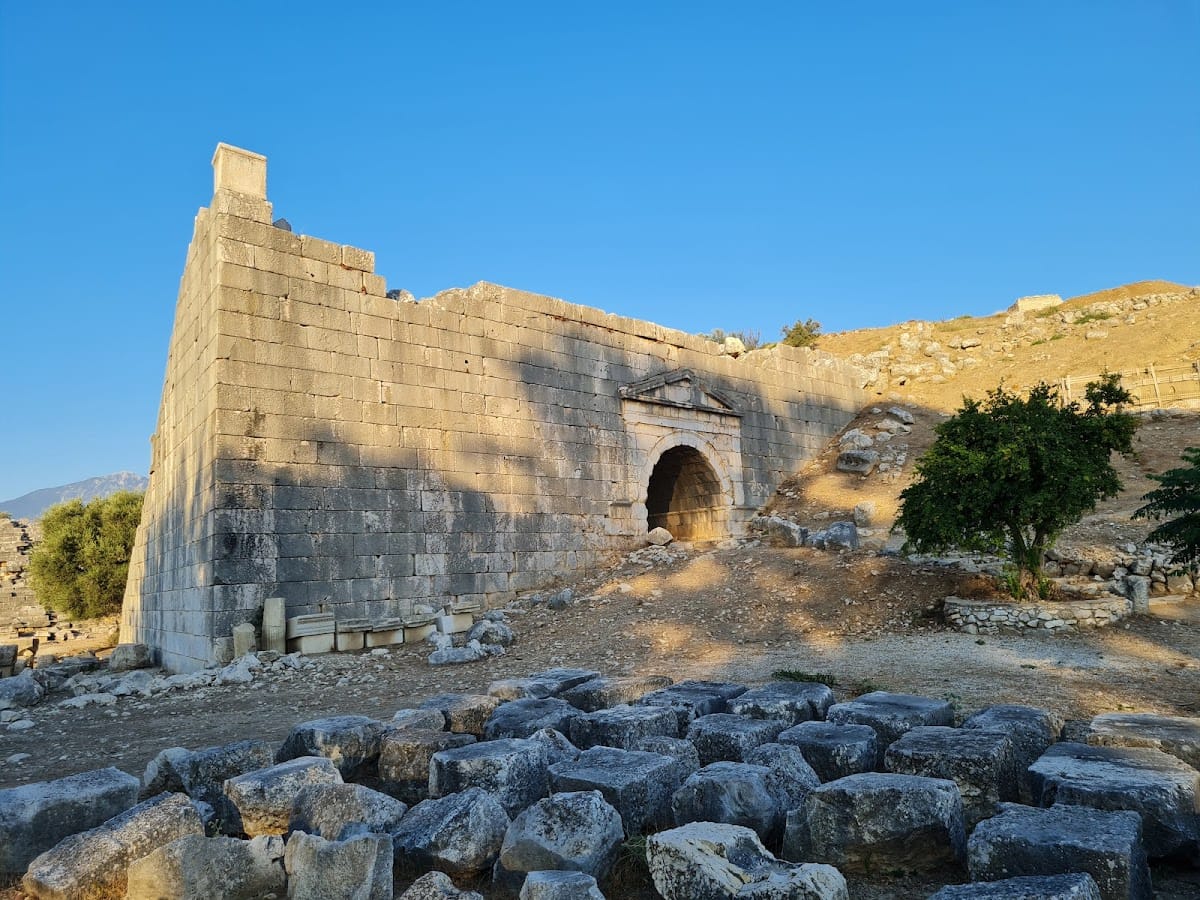
The theatre is generally dated to the second century BC. Its plan extends into a broad semicircle, a form typical of Hellenistic theatres. The central section was cut into the rock, while the wings were constructed. Two vaulted entrances with elaborately made doors served the building. The road through the sanctuary unusually crossed the theatre, and the northern door carried mask decoration. The theatre’s estimated capacity lies between 5,000 and 10,000 spectators. An inscribed stadium has not yet been located.
Trilingual stele and Lycian texts
A trilingual stele discovered at Letoon in 1973 carries texts in Lycian, Ancient Greek, and Aramaic. Probably dating to 338 or 337 BC, it records a decree establishing a cult for the King of Caunus and Arggazuma. Caunus was an ancient city in southwestern Anatolia. The stele is the longest known Lycian inscription and is conserved in the Fethiye Museum.
The trilingual text and other Lycian inscriptions from the sanctuary have contributed substantially to understanding the Lycian language. Two bases bearing inscriptions connected with Arbinas were also found at Letoon. Most of the ruins lie beneath or close to the water table, yet the surviving remains are largely intact and have been little affected by modern construction or tourism.