Château de Pouy-sur-Vannes: A Historic Château in France


Site at a Glance
- Rating
- 4.6
- Popularity
- Very Low
- Country
- France
- Primary era
- Early Modern
- External website
- Open
- Eras represented
- Early Modern
- Civilizations
- French
- Site type
- Domestic
- Remains
- Castle
On this page9 sections
History
Medieval Lordship and Earlier Fortification
The Château de Pouy-sur-Vannes is a historic château in France, built in the early seventeenth century on the site of an earlier fortified house. During the Middle Ages, the lordship of Pouy belonged to the Trainel family. By the beginning of the sixteenth century, it was held by Oger de Saint-Blaise, Baron of Troissy and lord of Brugny. He served as a man-at-arms in the king’s ordonnance companies, permanent royal military units whose members served as mounted soldiers.
The Saint-Blaise and Le Bascle Families
Hector de Saint-Blaise, lord of Pouy, built the present château in the early seventeenth century. He was married to Edmée Gaillard de Longjumeau, a granddaughter of Charles of Orléans. After Hector’s son Louis de Saint-Blaise died, the lordship passed in 1620 to the Le Bascle d’Argenteuil family.
The estate was first held by Patrice Le Bascle, Baron of Argenteuil and Moulins in the Tonnerrois, who died in 1631. His son Louis Le Bascle was an ordinary gentleman of the chamber of King Louis XIII and captain of a company of one hundred foot soldiers; he died in 1692. Louis was followed by his son François Le Bascle, lord of Argenteuil, and then by François’s son Jean-Louis Le Bascle, Marquis of Argenteuil. Jean-Louis served as lieutenant-general in Champagne and governor of Troyes, and died at Pouy in 1753.
Jean-Louis Le Bascle was succeeded by his son, Jean-Louis Nicolas Le Bascle, Marquis of Argenteuil, Baron of Épineuil and lord of Pouy. He also served as lieutenant-general in Champagne and died at Pouy in 1784. The estate then passed to his daughter, Marie Louise Victoire Le Bascle d’Argenteuil (1751–1829), who married Charles Joseph Fortuné d’Herbouville in 1788. She sold the Pouy estate to the Fortier family in 1805.
Modern Ownership and Preservation
The estate was resold in 1896 and transferred in 1971 to the Association for Mutual Assistance among Members of the Legion of Honour, a French charitable organization connected with France’s highest national order of merit. The association used the château to house and accommodate its members and as a retreat and conference venue.
Because maintaining the property had become too costly, the association put the château up for sale. Around 2012–2013, it was acquired by the Chilean-born American interior designer and architectural decorator Juan Pablo Molyneux and his wife. Molyneux redesigned the interiors by 2014 and began an important restoration campaign. Château de Pouy-sur-Vannes has been listed as a French historic monument since 1969, under an order dated 11 August of that year. This designation protects buildings and sites recognized for historical or architectural importance and supports their preservation and restoration.
Remains
Château and Water Defences
Square Pavilion
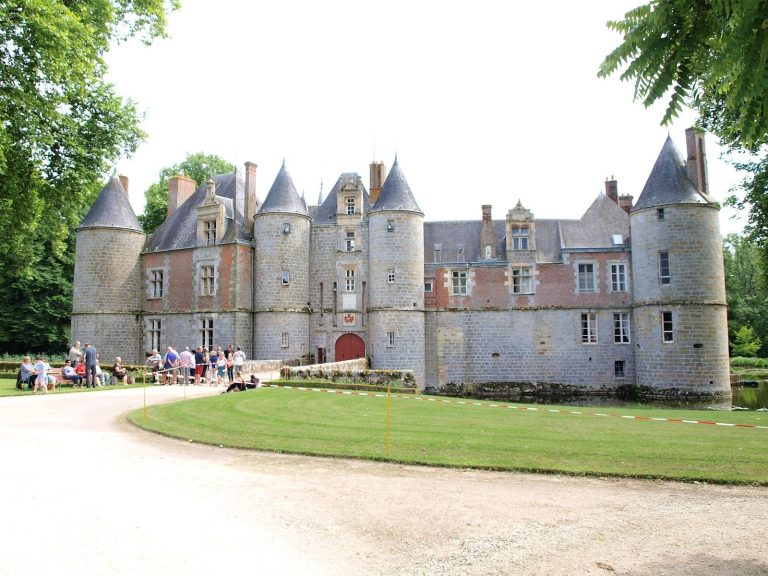
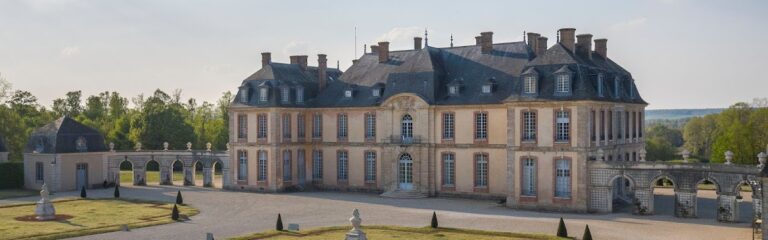
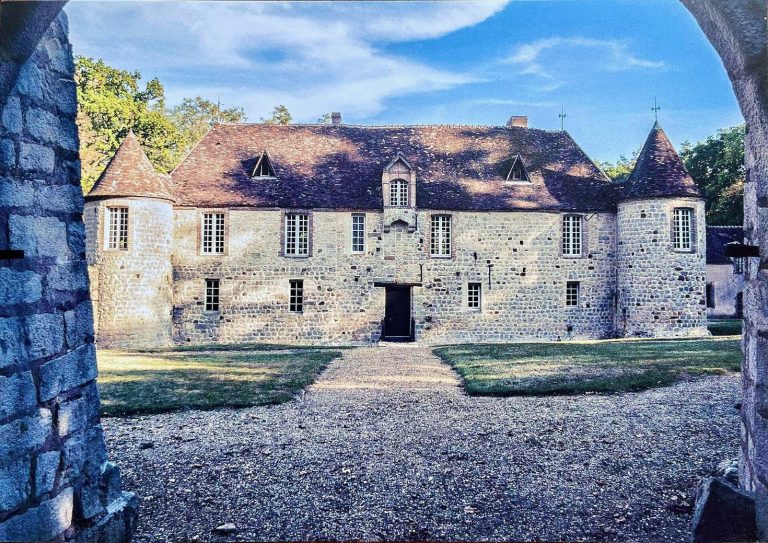
The château is formed by a massive pavilion on a square plan, set on a raised platform surrounded by water-filled moats. A tall pyramidal roof covered in slate crowns the building, while a circular turret flanks each corner. Together, the raised platform, surrounding water and corner turrets preserve the fortified character of the earlier site within the seventeenth-century structure.
Park and Outbuildings
Wooded Park
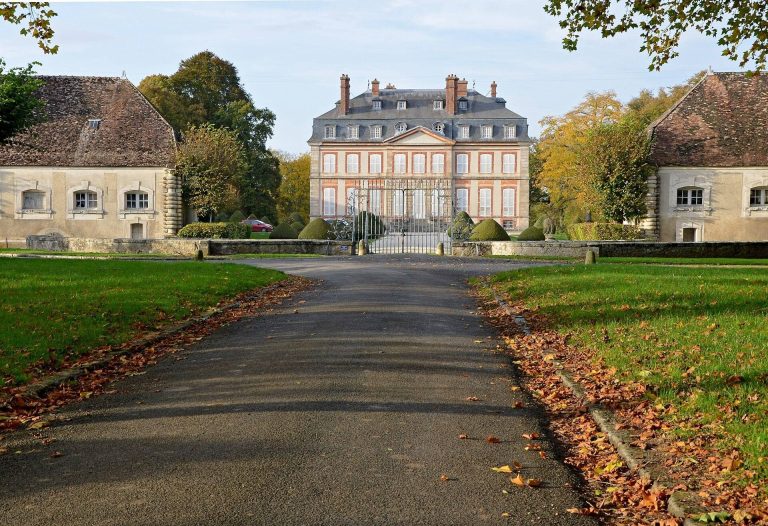
The outbuildings stand within a wooded park. Designed views, or perspectives, open on two sides of the park, linking the buildings to a deliberately arranged landscape. The park therefore forms part of the château’s surviving architectural setting, alongside the principal pavilion and its moats.