Castel Madruzzo: A Medieval Castle and Madruzzo Family Residence in Italy


Site at a Glance
- Rating
- 4.1
- Popularity
- Very Low
- Country
- Italy
- Primary era
- Medieval
- Eras represented
- Medieval, Early Modern
- Civilizations
- Holy Roman Empire
- Site type
- Military
- Remains
- Castle
On this page9 sections
History
Castel Madruzzo is a medieval castle in Italy, overlooking the hamlet of Castel Madruzzo in Trentino. Construction began in the twelfth century, and the castle gave its name to two successive noble families, the second of which shaped the political history of Trentino.
Origins and Medieval Lords
The earliest documents concerning Castel Madruzzo date to 1161, when Adalpreto II, Prince-Bishop of Trento, granted the castle as a fief to Gumpone and his nephew Boninsegna. A Prince-Bishop combined the religious office of bishop with the territorial authority of a prince. Gumpone and Boninsegna became the founders of the first Madruzzo family.
During the conflicts between the Guelphs and Ghibellines, rival political alignments in medieval Italy, the Madruzzo supported the bishops of Trento. The Guelphs generally favored the papacy, while the Ghibellines generally favored the Holy Roman Emperor. The Campo and Seiano families attacked and occupied the castle during these struggles, but it returned to the Madruzzo after the conflicts ended.
The male line of the first Madruzzo family ended in 1380. Following disputes over the inheritance, Castel Madruzzo passed to the Roccabruna in 1389. Their debts and the cost of administering the property led them to transfer it in 1441 to Sigismondo Stetten of Carinthia, captain of Segonzano Castle.
The Second Madruzzo Family
Sigismondo Stetten was also unable to sustain the castle’s financial demands. In 1447 he transferred it to Aliprando, son of Guglielmo of Denno-Nanno. Aliprando died without children, and his property passed to his nephew Giangaudenzio. Giangaudenzio adopted the Madruzzo name and a coat of arms modeled on that of the earlier family.
Giangaudenzio substantially improved Castel Madruzzo, making it more comfortable and adapting its defenses to firearms. His son Cristoforo Madruzzo initiated the Council of Trent, the Roman Catholic council held from 1545 to 1563 to address church doctrine and reform. Cristoforo also became the first Prince-Bishop of Trento from the second Madruzzo family.
The second Madruzzo family’s Prince-Bishops governed Trentino for more than a century. During their rule, Castel Madruzzo was repeatedly enlarged and embellished. It served as a residence for the Prince-Bishops and as a setting for festivities and important guests.
Destruction and Later Ownership
The death of Carlo Emanuele Madruzzo in 1658 ended the male line of the second Madruzzo family. Through marriage, the castle passed to the Lenoncourt in 1661. When that family became extinct, its properties passed in 1691 to the Carretto family of Genoa.
In 1703, during the invasion of Trentino in the War of the Spanish Succession, troops commanded by General Vendôme set Castel Madruzzo on fire. The War of the Spanish Succession was an early-eighteenth-century European conflict over the Spanish monarchy, with military campaigns in several regions, including Trentino. The fire left the castle almost completely destroyed.
Castel Madruzzo was rebuilt during the nineteenth century, but it soon fell into ruin, partly because of the Carretto family’s lack of interest. The Carretto sold the property in 1873. The Larcher family then acquired it and partially restored the castle, which also hosted Oreste Barattieri and Antonio Fogazzaro. The Montagna family of Milan bought the property in 1963. Castel Madruzzo is designated as Italian national heritage.
Remains
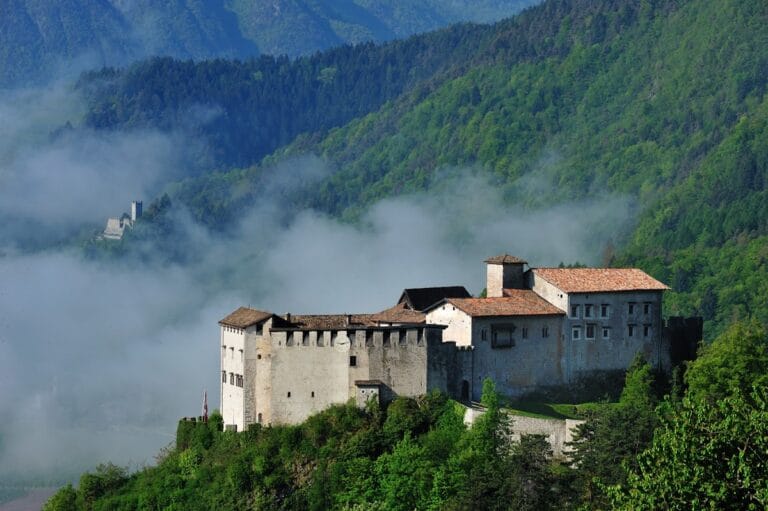
A curtain wall encloses the castle’s central courtyard, and the surrounding buildings open onto this enclosed space. The complex is divided into a southern habitable section, containing palaces mostly dating from the sixteenth century, and a northern section that remains partly ruined. A 12-hectare park extends around the castle.
Surviving Buildings
Southern Palaces
The southern section contains the habitable buildings and palaces that date mostly from the sixteenth century. They form part of the buildings arranged around the central courtyard within the curtain wall.
Northern Ruined Section
The northern section remains partly ruined and includes the keep. Its surviving fabric forms the ruined counterpart to the habitable southern part of the complex.
Park and Enclosure
The curtain wall defines the central courtyard and encloses the principal castle buildings. Around this fortified complex, the park extends across 12 hectares, providing the wider physical setting of the surviving site.