Chipchase Castle: A Jacobean Mansion with a Medieval Pele Tower


Site at a Glance
- Rating
- 4.5
- Popularity
- Very Low
- Country
- United Kingdom
- Primary era
- Early Modern
- External website
- Open
- Eras represented
- Medieval, Early Modern
- Civilizations
- English
- Site type
- Domestic
- Remains
- Castle
On this page7 sections
History
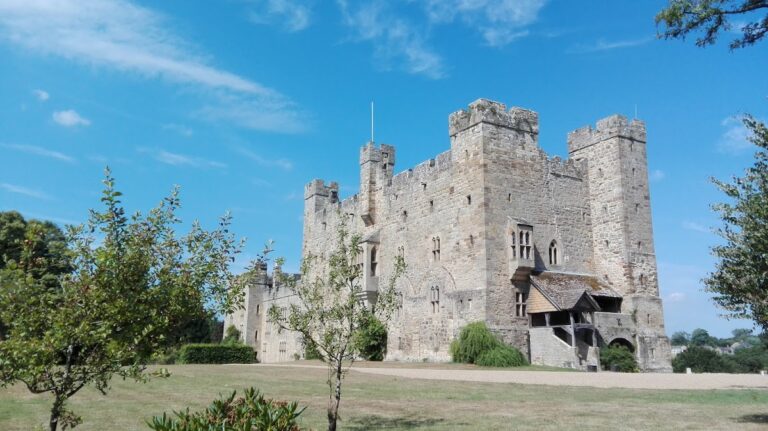
Chipchase Castle is a historic fortified residence in England, near Wark-on-Tyne in Northumberland, north of Hadrian’s Wall. Its surviving form combines a fourteenth-century pele tower, a fortified residential tower built for defence and habitation, with a seventeenth-century Jacobean mansion, an architectural style associated with the reign of James I.
Medieval Origins
The Heron family acquired the manor when Walter Heron married the Chipchase heiress. In the mid-fourteenth century, Walter Heron built a massive four-storey tower house with battlements on the site of an earlier house. The tower formed the defensive core of the later castle.
A survey made in 1541 described the property as a “fair tower” joined to a stone manor house. John Heron was the owner at that time, when the medieval tower and its associated residence remained the principal elements of the estate.
The Jacobean Residence
In 1621, Cuthbert Heron demolished the earlier manor house and constructed a new Jacobean mansion. He retained the medieval tower and incorporated it into the new residence. Cuthbert later held the office of High Sheriff of Northumberland in 1625. This historic senior royal and civic office represented the Crown in the county.
The Heron family remained connected with the political and military affairs of the period. Cuthbert Heron’s eldest son, George, was killed at the Battle of Marston Moor in 1644 while serving Charles I. His second son, also named Cuthbert, received a baronetcy from Charles II, a hereditary British title ranking below a baron. Financial difficulties eventually forced the family to sell the estate to George Allgood, a Newcastle merchant, in 1727.
Later Ownership
John Reed, a banker from Newcastle upon Tyne, bought Chipchase in 1734 and made major alterations to the building. After his family bank failed, his descendants sold the estate to the Greys of Backworth in 1821 to settle debts. The Greys later sold it to Hugh Taylor in 1861.
Chipchase Castle remains privately owned. It is associated with the author Paul Torday, who lived there with his second wife, Penelope Taylor, who inherited the estate. He reportedly contributed substantially to its management. The castle is a Scheduled Ancient Monument, meaning that it has national protection as an archaeological or historic site in England, and it is also a Grade I listed building, the highest category of statutory protection for listed buildings in England.
Remains
Chipchase Castle stands in a valley at approximately 113 metres above sea level. Its surviving composition is formed by a substantial medieval tower attached to the later mansion, preserving the physical relationship between the fortified residence of the fourteenth century and the country house built in 1621.
Medieval Pele Tower
The medieval tower is a massive, four-storey structure with battlements. Built as a pele tower, it provided both accommodation and defence in the border region of northern England. The tower was left standing when the Jacobean mansion was constructed and remains attached to it as an integral part of the castle.
Jacobean Mansion and Classical Alterations
The seventeenth-century mansion is the principal later architectural addition. It was built in 1621 in the Jacobean style and incorporated the older tower into the new residence. During John Reed’s eighteenth-century alterations, a classical facade was added to the old tower, changing its external appearance while retaining the medieval structure within the enlarged architectural composition.