Burgruine Granegg: Medieval Castle Ruins in Germany


Site at a Glance
- Rating
- 4.8
- Popularity
- Very Low
- Country
- Germany
- Primary era
- Medieval
- Eras represented
- Medieval
- Civilizations
- Holy Roman Empire
- Site type
- Military
- Remains
- Castle
On this page9 sections
History
Burgruine Granegg is a medieval noble castle ruin in Germany, on the Schlossfelsen west of Egesheim in Baden-Württemberg. The Lords of Michelstein built the castle around 1100, and it was first recorded in 1102 when Reginhard of Michelstein witnessed a donation.
The Lords of Michelstein
The family continued to shape the castle’s identity for centuries. Agnes of Michelstein, mentioned in 1305, was the last recorded member of the family, yet the castle retained the name Michelstein until the sixteenth century.
The castle may have suffered partial destruction in an earthquake in 1356. In 1377, the imperial city of Rottweil destroyed Castle Michelstein and the village of Bubsheim during the War of the Cities, a late-medieval conflict between self-governing imperial cities and territorial lords in the German lands. Sections of the walls and part of the main defensive tower, or bergfried, survived the attack.
Later Lords and the Granegg Name
In 1483, Duke Sigmund of Austria granted the ruin as a fief, a possession or right held from a superior in return for obligations, to Bertold of Balgheim. The fief passed to the Stain von Steinegg family in 1489. From 1536 to 1792, it was held by the Ifflinger von Granegg family, whose name gave the castle its later designation.
In 1792, Karl-Alexander sold his possessions in Fridingen, including the Michelstein castle ruin, to Emanuel and Michael Levi of Hechingen for approximately 95,000 gulden, a historical gold or silver currency used in German-speaking lands. Karl von Ifflinger bought the ruin back in 1831.
Protection of the Ruin
The tower ruin belonged to the Catholic church administration of Rottweil in 1923. In 1931, it passed to the Swabian Alb Association, a regional organization concerned with the area’s cultural and natural heritage. The association then undertook measures to secure the surviving structure.
Remains
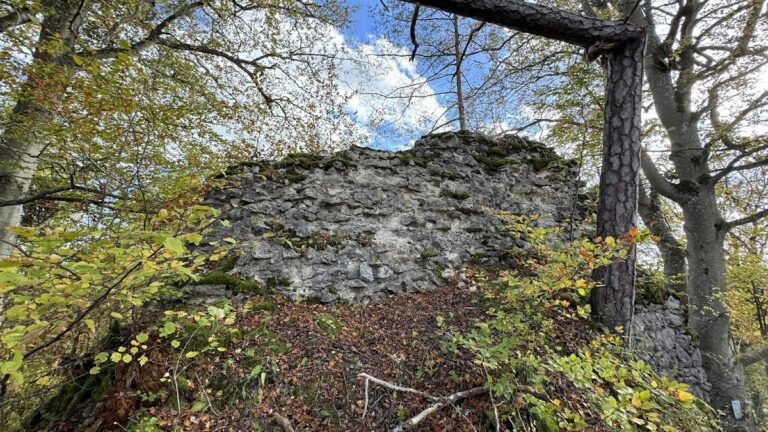
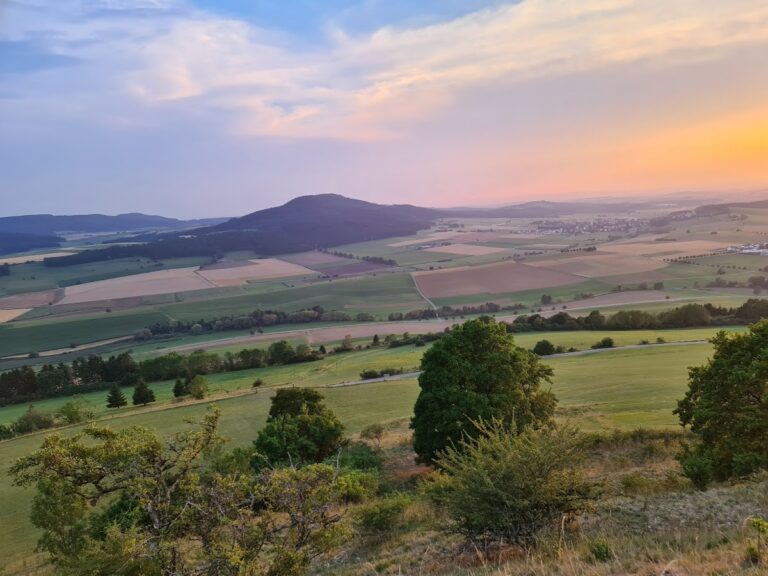
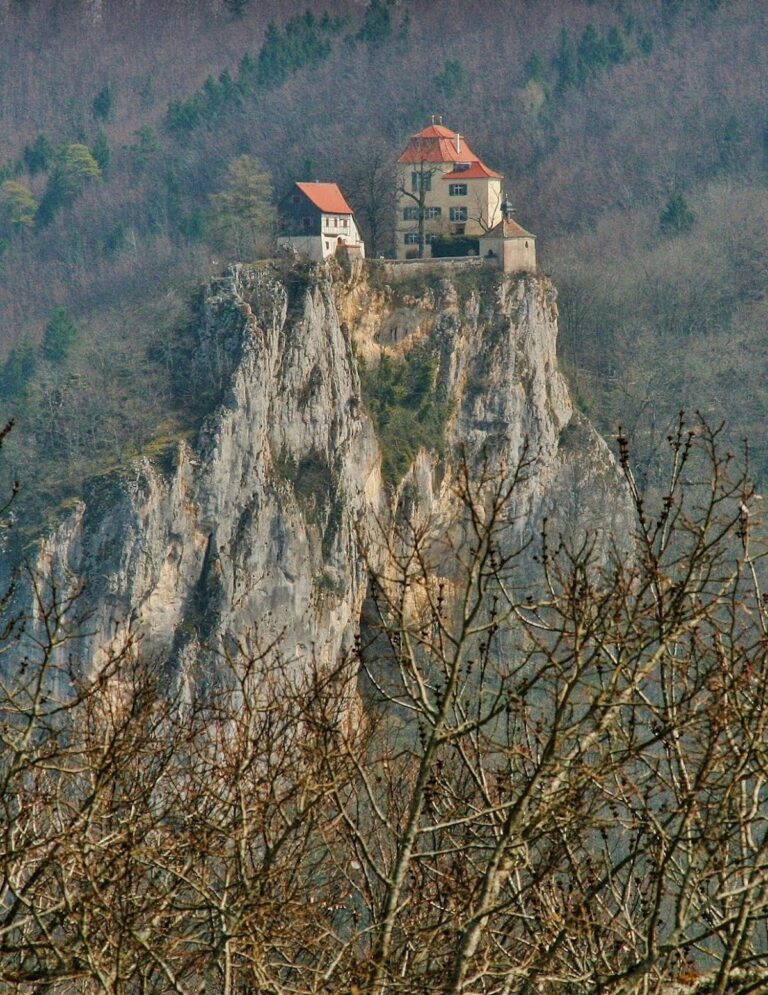
Burgruine Granegg occupies a rocky hilltop setting on the Schlossfelsen at approximately 921 metres above sea level. The surviving fabric consists of wall sections and part of the castle’s principal defensive tower, preserving elements of the medieval fortification in its elevated rocky setting.
Walls and Masonry
Rubble and Bossed Ashlar
Sections of the castle walls survive in rubble masonry and bossed ashlar. Bossed ashlar uses carefully shaped stone blocks with raised, roughly finished outer faces. These masonry remains form part of the visible structure around the principal tower ruin.
The Castle Tower
Bergfried Ruin
Part of the bergfried, the principal defensive tower of a medieval German castle, remains at Burgruine Granegg. Such a tower could serve as a strongpoint, lookout, and refuge. The tower ruin is the principal visible remnant of the castle and was among the structures secured during the twentieth-century conservation measures.