Burg Vlatten: A Medieval Moated Castle in Germany

Site at a Glance
- Rating
- 4.4
- Popularity
- Very Low
- Country
- Germany
- Primary era
- Medieval
- Eras represented
- Medieval, Modern
- Civilizations
- Holy Roman Empire
- Site type
- Military
- Remains
- Castle
On this page8 sections
History
Burg Vlatten is a former moated lowland castle in Germany, in Vlatten, now a district of Heimbach, whose surviving Upper Castle complex was established in the fourteenth century. It was one of two medieval castles located near a Carolingian royal palace beside the Vlattener Bach, placing it within a landscape that had served royal and forest-administrative purposes for centuries.
The royal estate and the Upper Castle
The nearby royal palace was a residence of Louis the Pious, a Carolingian emperor who ruled the Frankish Empire, in 838, and of his son and successor Lothair I in 846. The palace continued as a centre of forest administration, but its importance declined after Henry IV, a medieval German king and Holy Roman Emperor, granted the southern and most valuable part of the forest district to Anno, Archbishop of Cologne.
Johann I of Vlatten-Merode acquired the Upper Castle, the southern of the two medieval castles, in 1331. His branch of the Merode family later adopted the name von Vlatten from this new seat. Johann or one of his heirs established the fourteenth-century castle complex represented by the surviving remains.
Inheritance and noble ownership
The Upper Castle remained with the von Vlatten-Merode family into the fifteenth century. After Reiner I of Vlatten died in 1448, his widow Ida Schall von Bulich married Sybert von Schwarz-Bongard and made an inheritance agreement with her children from her first marriage. The Upper Castle was consequently divided between the von Vlatten and von Schwarz-Bongard families.
During the first half of the sixteenth century, Katharina von Vlatten, Sybert’s only child, married Werner von Gymnich, transferring the Vlatten share to the von Gymnich family. In 1705 Anna Maria Amalia von Gymnich married Johann Arnold von Bocholtz zu Lobberich. Part of the Upper Castle thereby passed to the von Bocholtz family, while the other half was held by the von Syberg family.
The Bocholtz share passed by marriage to the von Mirbach-Harff family in 1729, and the other half passed to the von Bentinck family in 1739. Johann Wilhelm von Mirbach-Harff and Maximilian von Bentinck sold the Upper Castle in 1787 to Clemens August von Syberg zu Eicks, who reunited the estate.
Ruin, estate, and twentieth-century residence
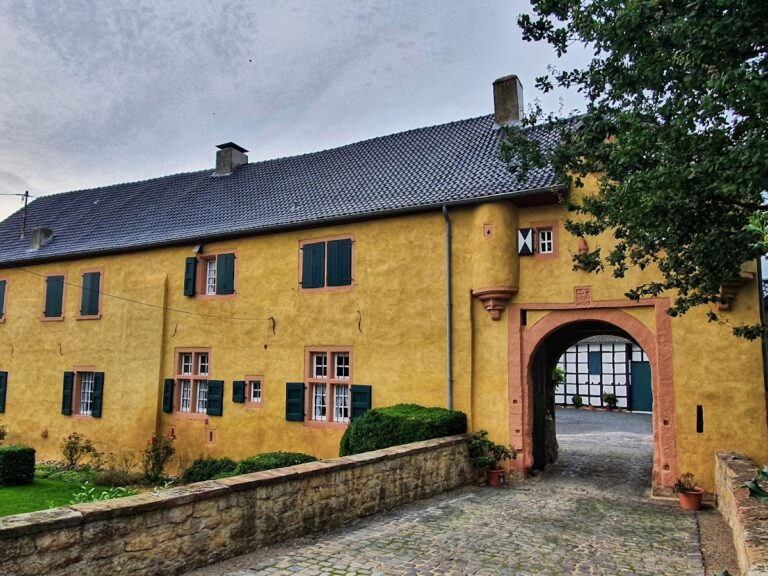
The main castle appears to have fallen into ruin as early as the eighteenth century. Although dilapidated, the medieval complex remained largely unchanged until the first half of the nineteenth century, when it was converted into a representative farm estate. Parts of the outer bailey, a subsidiary enclosure for service and economic buildings, were incorporated into the new farm complex.
Peter Brewer of Cologne acquired the estate in 1808 and sold it back to Clemens August von Syberg in 1833. Heinrich Floer of Düren and Johann Engelbert Hahn of Merzenich bought it in 1834, and Floer became its sole owner in 1835. The indebted estate was auctioned to Julius Rütgers of Berlin in 1882.
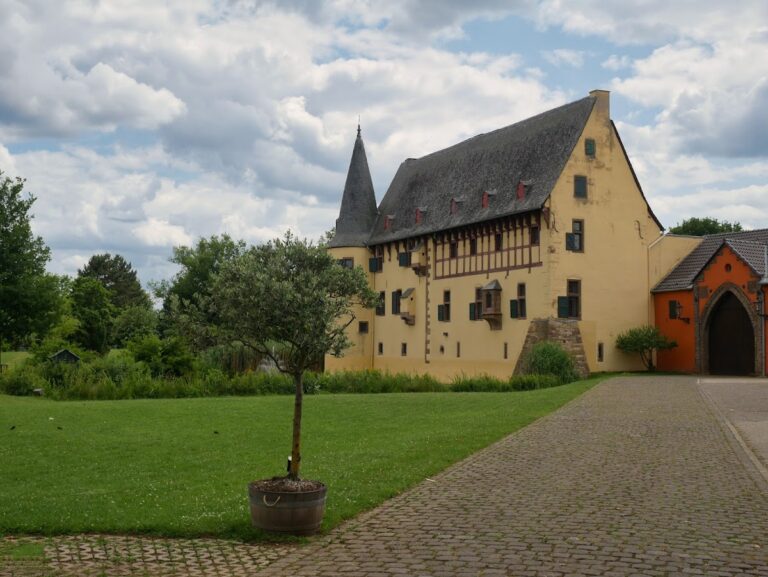
Rütgers gave the estate to his daughter Emilie, who was married to Major General Ernst Baron von Gagern. Because the owners no longer lived in the Upper Castle, the estate building served as a tenant’s residence until the end of the nineteenth century. The von Gagern family then reshaped the complex as their residence by separating the residence from the farmyard, converting the tenant’s house into a representative two-winged residence, and adding a square historicizing tower to its east side in 1908. A partition wall divided the farmyard and residence in 1913, and a new tenant’s dwelling was built on the farmyard grounds.
The estate remained with the von Gagern family until 2020, when Lydia Baroness von Gagern and Oliver Baron von Gagern acquired it at auction from the family’s community of heirs. Burg Vlatten is protected as an architectural heritage monument in North Rhine-Westphalia.
The Lower Castle
The Lower Castle first appears in records in 1401. It probably originated through an inheritance division of the older Upper Castle. In the fourteenth century, Balduin von Vlatten divided his Vlatten property between his children Konrad and Margaretha, and Margaretha married Johann Muyl von Sinzenich. The Lower Castle passed to Adam von Gymnich in 1605. Since he also owned the Upper Castle, the lower complex appears to have lost its importance and deteriorated into a ruin during the seventeenth century.
Remains
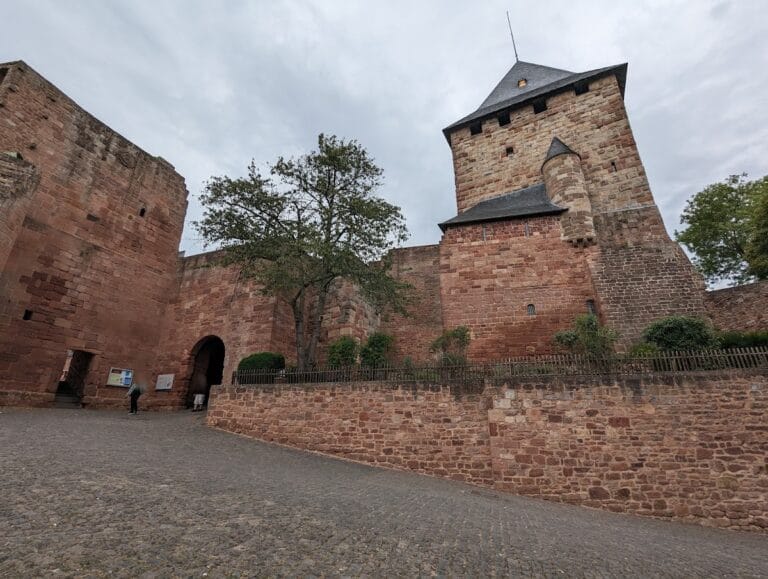
Burg Vlatten was a lowland castle enclosed by water-filled moats. The Upper Castle had a rectangular main castle reinforced with towers and an irregular outer bailey. Surviving medieval fabric includes sections of the enclosing walls, towers preserved to moderate heights, a two-storey round tower, and the barrel-vaulted lower level of a short building wing on the west side.
Upper Castle and estate complex
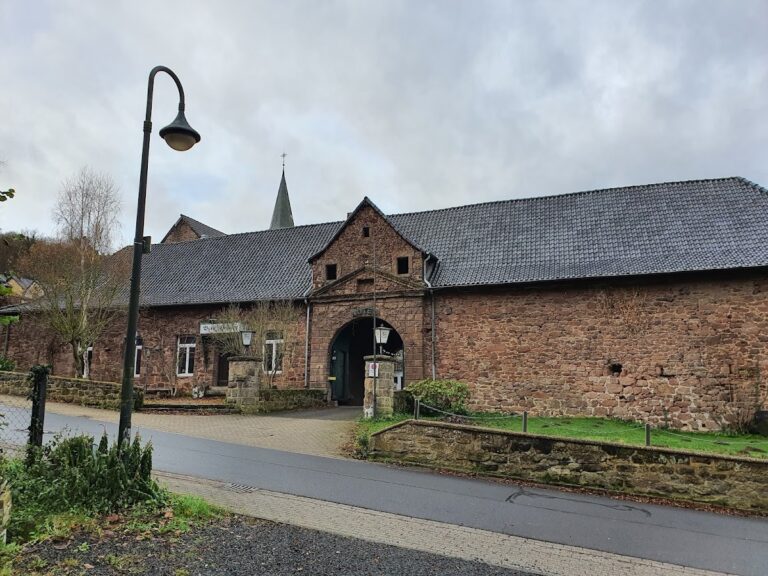
The nineteenth-century farm conversion incorporated parts of the former outer bailey into the estate complex. The residence occupied the southwest corner of the Upper Castle. Its earlier tenant’s house was later transformed into a representative two-winged residence, while a square historicizing tower was added on the east side in 1908. These later buildings stand alongside the surviving medieval walls and towers, linking the castle’s fortified layout with its subsequent agricultural and residential use.
Lower Castle
The Lower Castle survives only as a remnant of a tower wall. This fragment represents the second medieval castle associated with Vlatten and preserves a physical trace of the separate complex that had declined by the seventeenth century.