Castello di Mongialino: A Medieval Castle in Sicily


Site at a Glance
- Rating
- 4.4
- Popularity
- Very Low
- Country
- Italy
- Primary era
- Medieval
- Eras represented
- Medieval
- Civilizations
- Kingdom of Sicily, Norman
- Site type
- Military
- Remains
- Castle
On this page6 sections
History
Castello di Mongialino is a medieval castle in Italy, near Mineo in the Metropolitan City of Catania. Built during the late Norman period of Sicilian history, it occupies a hill that had already been inhabited during the Bronze Age, around the 12th century BC. Finds made in modern times indicate this earlier occupation.
Norman and Medieval Lords
From approximately 1150 to 1180, the castle was held by members of the Paternò family, including Costantino II Paternò, Count of Buccheri, Butera, and Martana. It later passed to the Norman-origin de Luci family. Count Bartolomeo de Luci held it, followed in 1199 by his daughter Margherita, while Manfredi di Mazzarino held the castle in 1200.
The castle came under royal control in 1287. In the following centuries, it was held by Blasco Lancia in 1320 and by Manfredi III Chiaramonte in 1355. These changes place Mongialino within the changing network of aristocratic and royal authority that shaped medieval Sicily.
Later History and Abandonment
Tommaso Fazello described Castello di Mongialino in De Rebus Siculis Decades Duae in 1558, and the abbot Vito Amico discussed it in Lexicon topographicum siculum in 1757. Both described the construction as largely intact in their respective periods. An effort was made to repopulate the surrounding area during the seventeenth century.
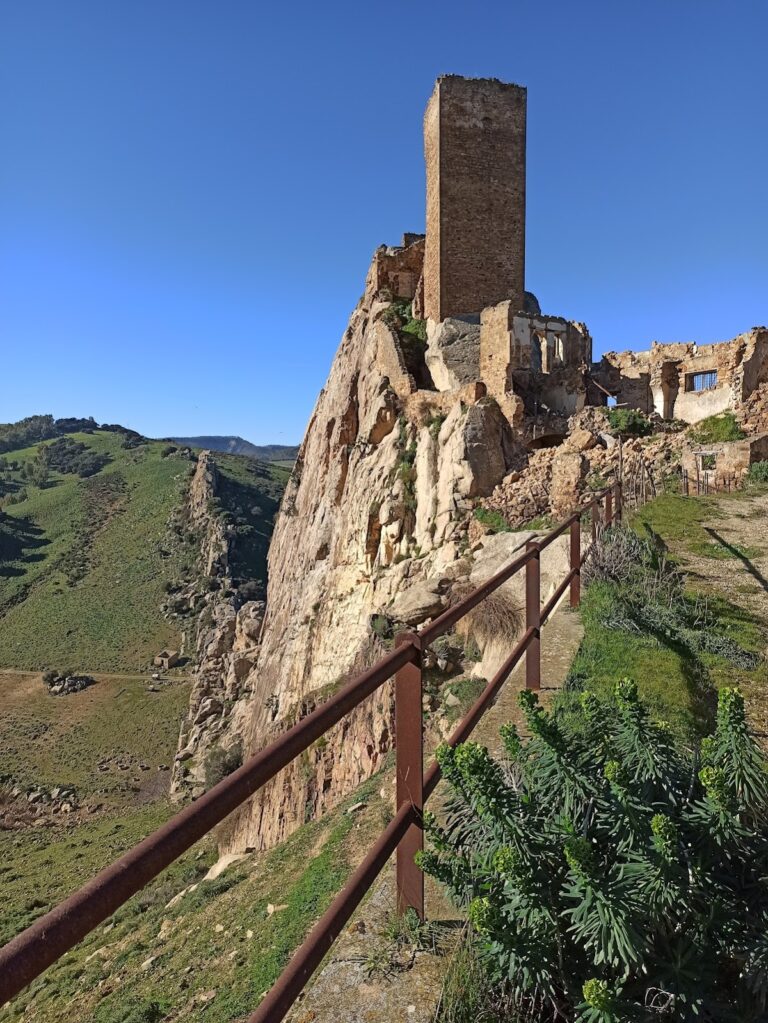
The castle is now completely abandoned. Deep cracks and unstable sections threaten its structure, while stones from the arches and roof are close to detaching. Urgent stabilization and infill measures are needed. The site has Italian national heritage designation.
Remains
The surviving complex consists of a massive ring-shaped donjon within a curtain wall that encloses an irregularly polygonal area. The castle stands in Contrada Montalfone, by the Pietrarossa River and close to the boundary with Enna Province. Its remains are severely deteriorated, with deep structural lesions and sections approaching collapse.
Ring-Shaped Donjon
The castle is dominated by a toroidal donjon, the principal fortified tower of a medieval castle, which could combine defensive, residential, and storage functions. Its ring-shaped form is described as unique in contemporary Sicilian architecture. The tower originally rose through four storeys connected by an internal staircase.
About half of the first level remains standing, while only a few ruins survive from the second. The central cylindrical core contains a large cistern in its basal section. Rainwater collected from the roof was directed into this reservoir, linking the tower’s construction with the practical needs of the fortified settlement.
Enclosing Wall
A curtain wall surrounds the irregularly polygonal castle area. A curtain wall is an enclosing defensive wall rather than a separate tower, and the surviving masonry retains traces of crenellation, the notched parapet formed by alternating raised sections and openings. The wall and donjon remain in ruin, with stones from arches and roofing at risk of falling away.