Castillo Vacar: A Medieval Fortress in Córdoba, Spain


Site at a Glance
- Rating
- 4.2
- Popularity
- Very Low
- Country
- Spain
- Primary era
- Medieval
- Eras represented
- Medieval
- Civilizations
- Umayyad
- Site type
- Military
- Remains
- Fort
On this page12 sections
History
Castillo Vacar is a medieval military fortress and settlement in Spain, located in the municipality of Espiel in Andalusia. Also known as Castillo de Mano de Hierro and Dar-al-Baqar, it is generally associated with the Caliphate of Córdoba, the Umayyad Islamic state that ruled much of al-Andalus from 929 to 1031. Claudio Sánchez Albornoz attributed its construction to the caliphal period, probably during the reign of al-Hakam II, who ruled from 961 to 976, while Rafael Gracia Boix considered an earlier date possible. A later, post-caliphal foundation has also been proposed.
The Caliphate and the crisis of 1010
The events of 22 May 1010 have been used to argue against a post-caliphal date. During the second restoration of Hisham II, the Umayyad caliph, Muhammad al-Mahdi, a great-grandson of Abd al-Rahman III, defeated an Amazigh revolt led by Sulayman al-Mustain. His forces included Catalan Christian troops commanded by Ramon Borrell, count of Barcelona, and his brother Ermengol I of Urgell. The army comprised 30,000 Muslims and 9,000 Christians.
After the battle, the people of Córdoba attacked Madinat al-Zahra, the tenth-century palatine city built near Córdoba by the Umayyad caliphate. They killed the Amazigh soldiers who remained there and plundered their houses. Muhammad II al-Mahdi entered Córdoba the following day and began his reign. These events connect Castillo Vacar with the political and military struggles surrounding the weakening of the Cordoban caliphate.
A nineteenth-century account by Ramírez de las Casas-Deza states that Hisham II took refuge at Castillo Vacar after being deposed and pursued, before eventually being imprisoned. Another interpretation places his refuge in Córdoba’s castle. Castillo Vacar’s elevated mountain position was considered a suitable setting for the episode, although the precise refuge remains disputed.
Almoravid conflict
In October 1134, during the Almoravid period, an Almoravid emir fought a Christian raid at the fortress. The Almoravids were a Berber Muslim dynasty that controlled much of al-Andalus during the late eleventh and twelfth centuries. The attack surprised the Muslim forces during the preceding night, before the agreed day of battle, causing heavy losses and forcing much of the army to leave the field. The episode shows that Castillo Vacar continued to be involved in regional warfare more than a century after the caliphate’s political crisis.
Modern protection
Castillo Vacar has been protected as an Asset of Cultural Interest since 1985. This status reflects the importance of its surviving fortress fabric and its place in the historical landscape of medieval Andalusia.
Remains
Mountain enclosure and defensive walls
Setting and plan
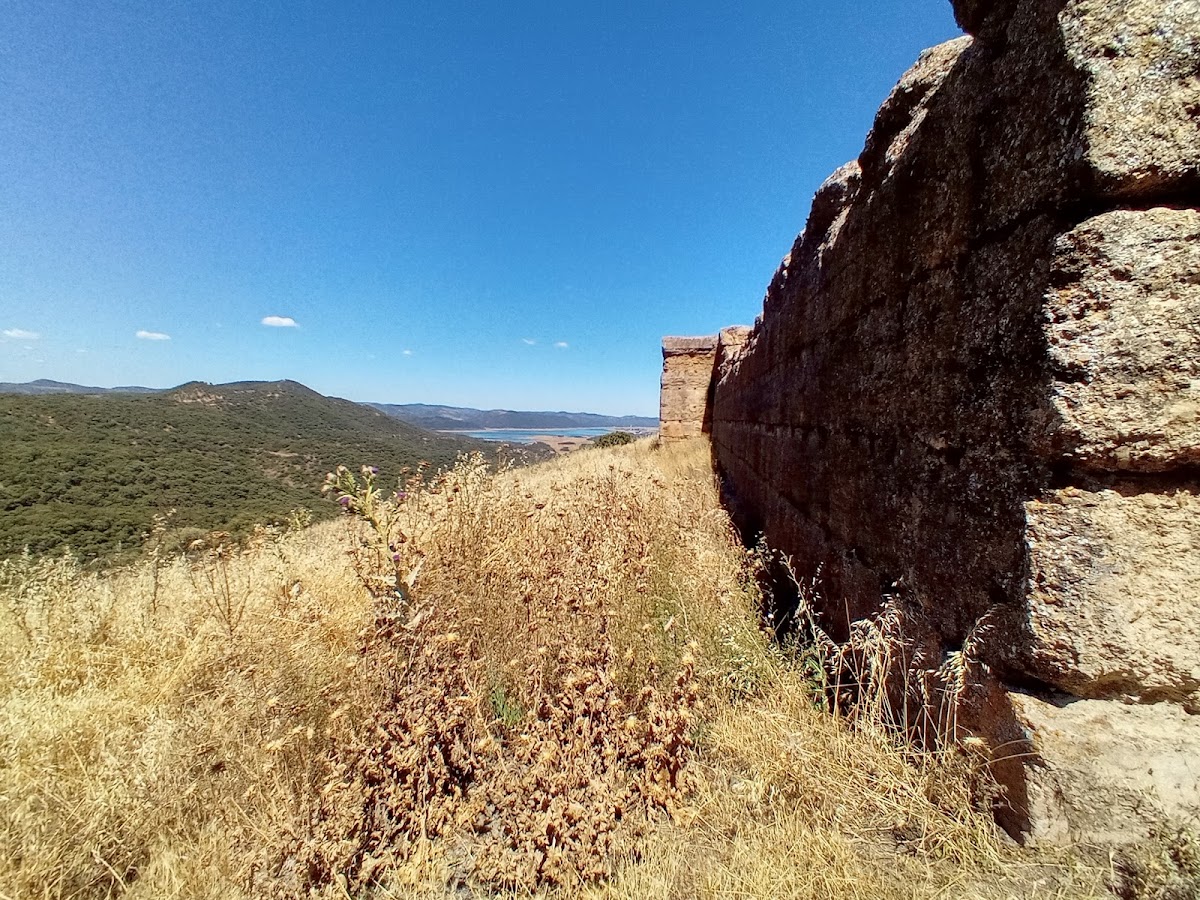
The fortress stands in the Sierra Morena at approximately 600 metres above sea level. It overlooks the valley of the Guadiato River, the present Puente Nuevo Reservoir, and its thermal power station, and can be seen from roughly 5 to 6 kilometres away. Its enclosure follows a quadrilateral polygonal plan. The interior measures about 65 metres along the east wall, 59.60 metres along the west wall, 50.10 metres along the north wall, and 49.50 metres along the south wall, providing approximately 3,132.50 square metres of usable internal space.
Rammed-earth construction
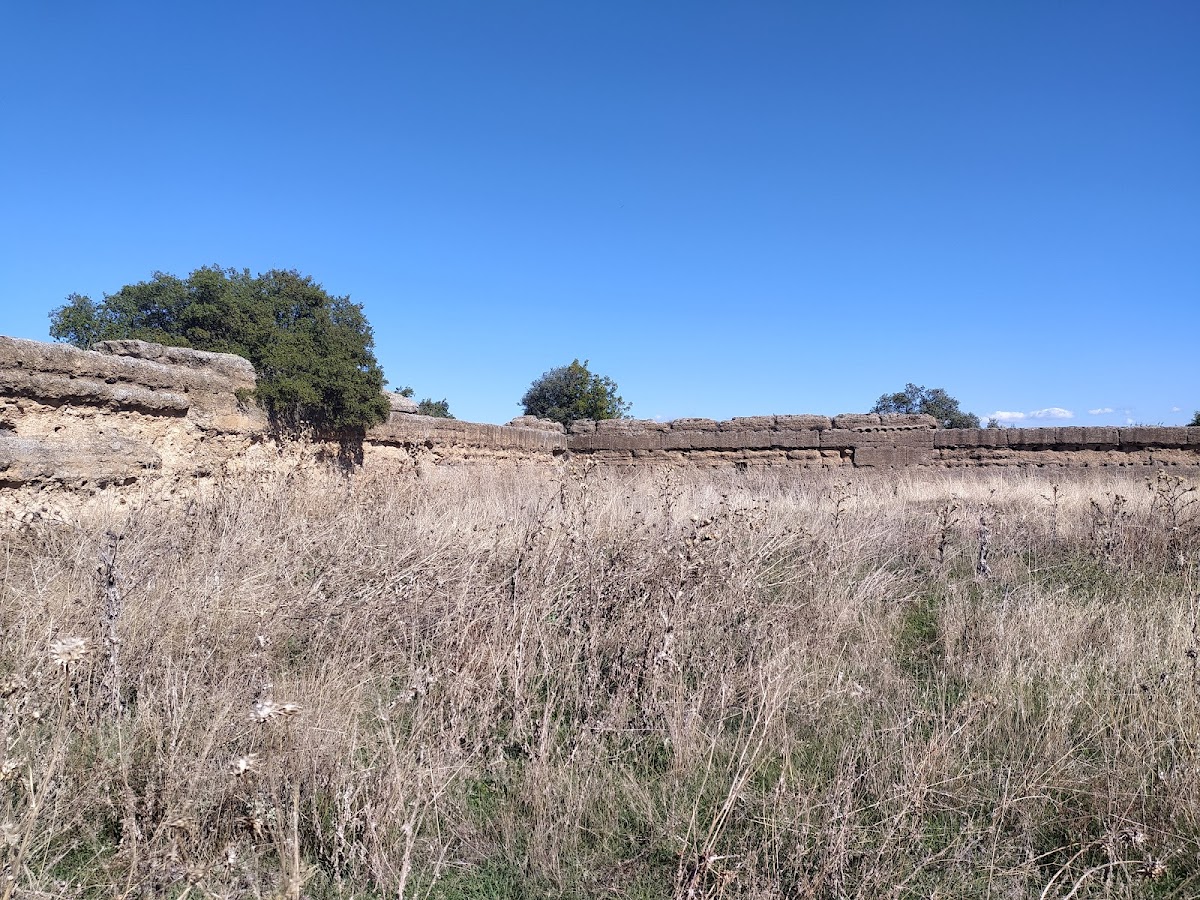
The walls were built from rammed earth, a technique in which a moist mixture is compacted in temporary formwork in successive layers. The material is rich in lime mortar and includes sand, gravel, and some ceramic rubble. The walls are approximately 1.70 metres thick and rest on foundations that extend 60 centimetres beyond their outer faces.
Construction proceeded by placing and compacting the mixture repeatedly within shuttering. Seven layers, each approximately 80 centimetres high, raise the walls to slightly more than 5.50 metres. The ground inside the enclosure lies about two metres above the exterior ground level, so four layers and part of a fifth are visible from within, where the walls reach a maximum visible height of about 3.50 metres.
Corner and intermediate projections
Solid cubical projections made from the same material reinforce the exterior corners and intermediate sections of the enclosure. Most measure approximately 3.80 metres on each side and extend beyond the corners. The projections on the southeast slope form an exception because that slope helps prevent falling and collapse. The other sections stand on levelled ground.
Openings and entrance works
Defensive openings
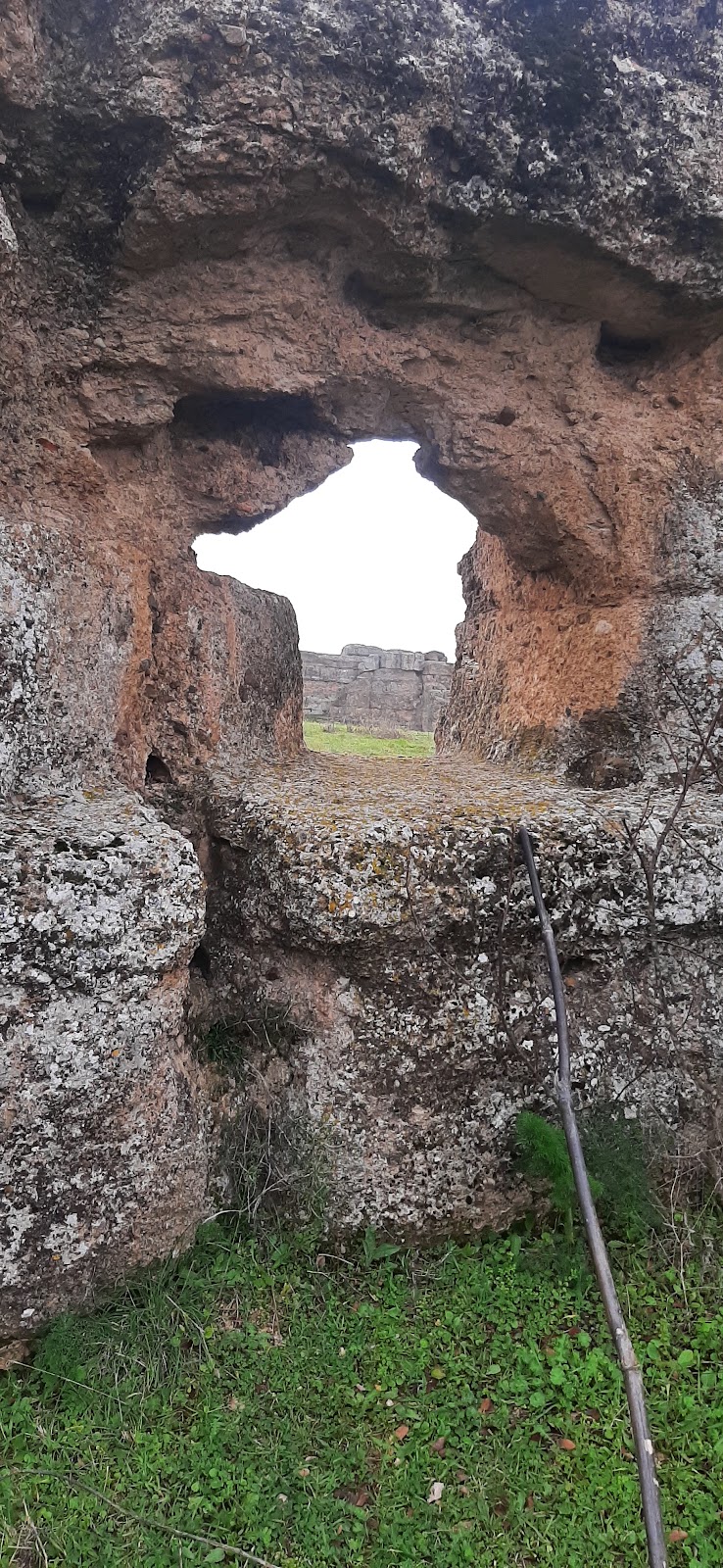
On the north side, the inner faces of the east and west walls contain four loopholes each. A loophole is a narrow opening in a defensive wall through which defenders could observe or use weapons. These openings are positioned about 30 centimetres above the ground and measure approximately 60 centimetres wide by 80 centimetres high.
The exterior faces were coated with lime mortar, painted ochre, and divided by white bands nearly two metres wide that imitated ashlar masonry. This treatment is characteristic of caliphal construction and also appears on the walls of Córdoba and Madinat al-Zahra. The distribution of the defensive openings concentrated them on particular wall faces, while the east and south sides, which faced gentler slopes and were considered more vulnerable, were arranged to avoid openings that might have helped attackers enter the enclosure.
Entrance and access structure
The entrance occupies the southern part of the west wall. Its original lintel or arch has not survived. Just beyond the entrance, the south wall is strengthened by a surviving structure about seven metres long and 1.20 metres wide. It was probably longer before being cut back and is thought to have formed an access stairway or ramp.
The position of this structure may have allowed defenders to reach the wall tops quickly during an alarm. Its relationship to the entrance and south wall therefore forms part of the fortress’s defensive arrangement, while the surviving rammed-earth enclosure preserves the principal physical evidence of Castillo Vacar’s medieval military character.