Castle of Venus: A Norman Fortress on Mount Erice

Site at a Glance
- Rating
- 4.4
- Popularity
- Very Low
- Country
- Italy
- Primary era
- Medieval
- External website
- Open
- Eras represented
- Medieval
- Civilizations
- Kingdom of Sicily, Norman
- Site type
- Military
- Remains
- Castle
On this page11 sections
History
Castle of Venus is a Norman fortress in Italy, located at Erice on the summit of Mount Erice. Built in the twelfth century on the ruins of an Elymian, Phoenician, and Roman sanctuary, it was ordered by Roger II of Sicily, the Norman ruler who became the island’s first king. The fortress occupied the southeastern corner of the summit and formed a citadel distinct from the settlement below.
The ancient sanctuary
The site’s earlier religious history extended across several peoples and periods. The Elymians associated the sanctuary with Astarte, a major Phoenician goddess linked with fertility and sexuality. In a later phase, the cult became associated with Venus Ericina, the local form of the Venus cult connected with Erice. The sanctuary was enclosed by fortifications and served as a defended citadel. Hamilcar Barca, the Carthaginian general and father of Hannibal, sacked it.
Diodorus Siculus, a Greek historian of the first century BC, preserved a foundation tradition in which Erice, the son of Butes and Aphrodite, built the temple for his mother and founded the city. By the early Middle Ages, the sanctuary had been greatly reduced. A small church dedicated to Saint Mary of the Snow was built in the area during the period when the Normans constructed the fortress, between the late eleventh and twelfth centuries.
Norman and later rule
After its construction, Castle of Venus served as a royal stronghold for the Aragonese viceroys, who governed Sicily on behalf of the Crown of Aragon, and for the Spanish Habsburgs, who ruled the island as part of the Spanish monarchy. Its military and political use continued until the sixteenth century. Under the Bourbons, the dynasty that later ruled the Kingdom of Sicily, the fortress was converted into a prison.
Municipal ownership and archaeology
In the first decades of the nineteenth century, the castle passed to the Municipality of Erice. At the end of that century, the municipality granted it to Count Agostino Pepoli in exchange for restoring the Balio Towers beside the fortress. Archaeological excavations directed by Cultrera in 1934–1936 sought the ancient temple, and many of the finds are preserved in the Pepoli Museum in Trapani. The site is now owned by the Municipality of Erice.
Remains
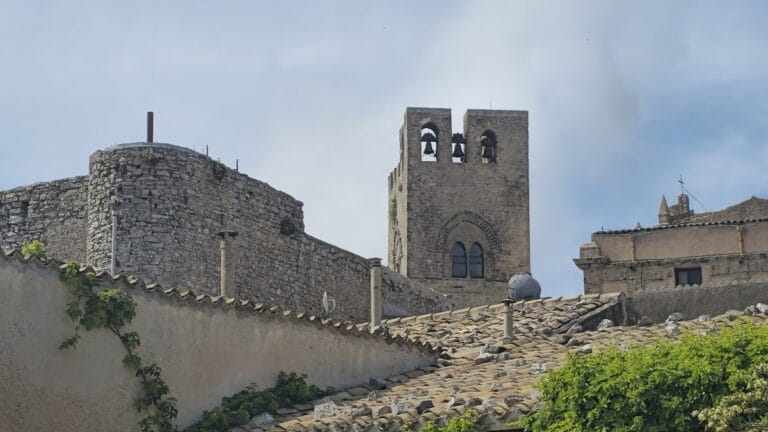
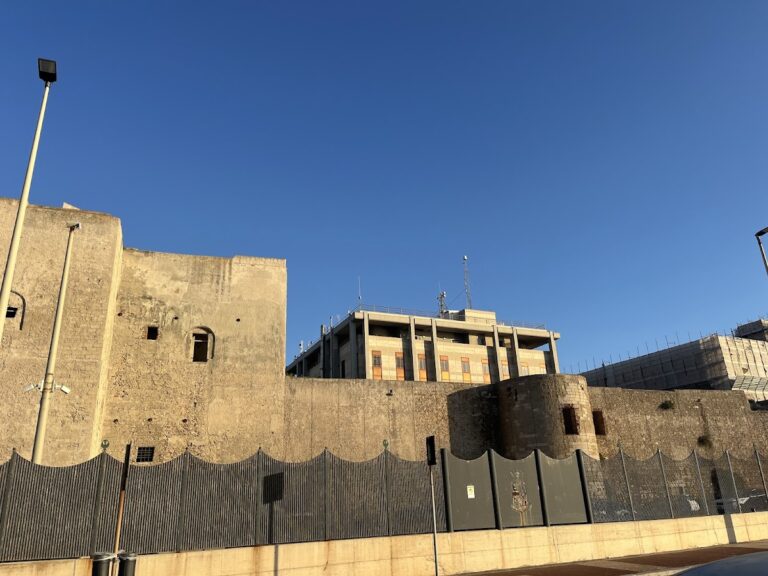
Castle of Venus stands on an isolated cliff at the southeastern edge of Mount Erice’s summit, with the Balio Towers beside it. The surviving fortress follows the shape of the rock, combining an enclosed defensive wall, projecting and recessed sections, towers, and remains of earlier sanctuary material reused in its construction.
Fortress walls and access
Castle enclosure
The west-facing facade is crowned with Guelph merlons, the regularly spaced raised sections of a battlement. The enclosure wall traces the cliff through alternating projections and recesses. The castle was once joined to the rest of the summit by a drawbridge, which was later replaced by the present staircase. Two towers also stood in connection with the castle through a drawbridge.
Secret gallery
An entrance to a secret gallery remains visible. The passage ran underground in relation to buildings that have since disappeared and led beyond the castle. Its surviving entrance preserves part of the fortress’s concealed circulation system.
Ancient masonry and reused remains
Northern rock-face wall
On the steep northern face of the rock is a wall traditionally attributed to Daedalus, the exceptionally skilled architect and craftsman of Greek mythology. It is formed from twelve horizontal courses of carefully squared stones laid in opus rectum, a masonry technique using regularly shaped blocks arranged in level courses.
Temple columns
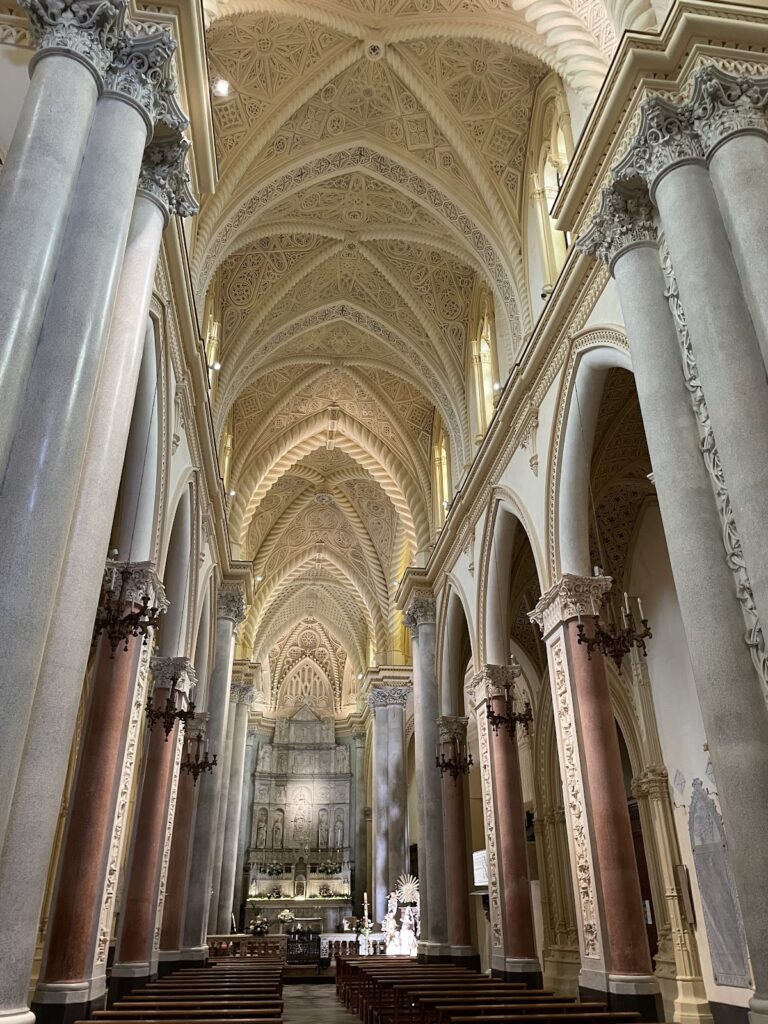
Fragments from the ancient sanctuary, including material from the Roman-period temple, were incorporated into the castle. Several fine-grained granite columns still found elsewhere in Erice are understood to have originally belonged to that ancient temple, linking surviving elements in the town with the earlier religious complex on the summit.