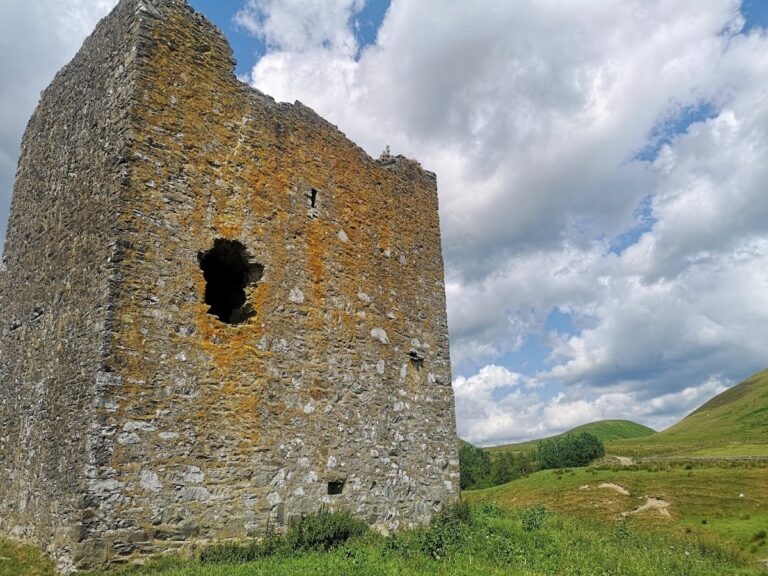
Newark Castle: A Royal Forest Tower House near Selkirk


Site at a Glance
- Rating
- 4.3
- Popularity
- Very Low
- Country
- United Kingdom
- Primary era
- Medieval
- External website
- Open
- Eras represented
- Medieval, Early Modern
- Civilizations
- Kingdom of Scotland
- Site type
- Military
- Remains
- Castle
On this page8 sections
History
Newark Castle is a fifteenth-century Scottish tower house in the United Kingdom, located west of Selkirk in the Scottish Borders. Built as a fortified residence and later used in the administration of the Royal Forest of Ettrick, it developed through Douglas, royal, and Buccleuch ownership before becoming a ruined historic site.
The New Wark and the Royal Forest
Around 1406, Archibald Douglas, 4th Earl of Douglas and Duke of Touraine, moved his principal residence in Selkirk Forest from Edibertshiels to a prominent position about 1 kilometre to the west. The new residence became known as the New Wark, while the former site fell into decay and acquired the name Auld Wark.
Newark was linked to the administration of the Royal Forest of Ettrick. Forest courts were held there twice a year, on 1 May and 1 November, to deal with offences such as illegal hunting and the destruction of woodland. John Turnbull became the first keeper of Newark Castle.
Construction and Crown control
The tower house was begun around 1423, and building continued until about 1475. After the forfeiture of the Black Douglases, a powerful branch of the Douglas family, in 1455, Newark passed to the Crown. Royal expenditure included repairs, and Thomas Joffrey served as master of the castle’s fabric during the 1460s.
In 1473, James III granted the estate to Margaret of Denmark, his wife. Newark then became the administrative centre of the Royal Forest of Ettrick. Alexander, Lord Home, held the keepership of the castle and forest from 1490.
Margaret Tudor and sixteenth-century conflict
On 1 June 1503, Margaret Tudor, wife of James IV and mother of James V, received Newark Tower, together with the lands and lordship of Ettrick Forest, as part of her marriage gift. She visited Newark in June 1532 to hold the Forest Court of Ettrick. When the Laird of Buccleuch initially refused to surrender the keys, James V confirmed Margaret’s authority while hunting at Cramalt in Meggotland. Margaret then gave the keys to her husband, Lord Methven.
An English army unsuccessfully besieged Newark in 1547, but the castle was burned the following year. Regent Arran, James Hamilton, 2nd Earl of Arran, stayed there from 30 September to 4 October 1548. In December 1573, Sir Walter Scott of Branxholme became keeper and captain of Newark, as well as baillie, a local judicial or administrative officer, and chamberlain, an official responsible for financial and estate affairs, of Ettrick Forest.
Seventeenth-century destruction and later use
After the Battle of Philiphaugh in 1645, during the Wars of the Three Kingdoms, the interconnected civil and religious conflicts fought across Scotland, England, and Ireland in the mid-seventeenth century, 100 royalist followers of the Marquis of Montrose were shot in Newark’s barmkin, an enclosed defensive courtyard. The castle was reportedly destroyed by Oliver Cromwell’s troops in 1650. Cromwell was an English military and political leader during the civil wars.
At the end of the seventeenth century, Newark was altered for Anne Scott, 1st Duchess of Buccleuch, and adapted as a hunting lodge. During the eighteenth century, the ruined castle was used as a quarry. Sir Walter Scott, the Scottish novelist and poet, visited Newark with William and Dorothy Wordsworth in 1831. Scott set part of The Lay of the Last Minstrel at the site.
Newark is a scheduled monument designated by Historic Environment Scotland. It stands within the Bowhill estate, associated with Bowhill House, which was built in 1812 and is owned by the Duke of Buccleuch. A local tradition says that the tower is haunted by the souls of women and children killed there after the Battle of Philiphaugh. The tradition gives their number as 300 and holds that their cries or howls are heard each year on 13 September.
Remains
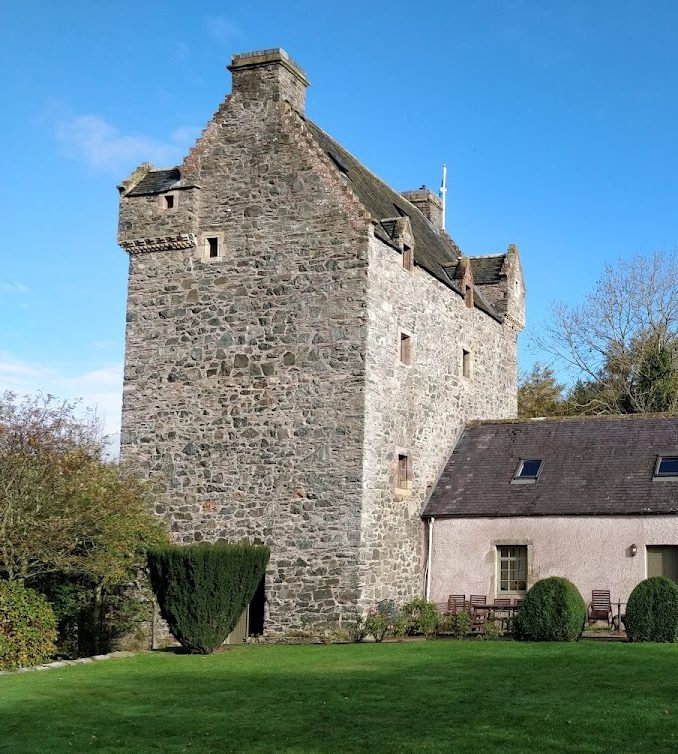
Newark Castle is a large ruined tower house in the grounds of Bowhill House, in the valley of the Yarrow Water, about 5 kilometres west of Selkirk. The surviving complex consists chiefly of a substantial rectangular tower, together with parts of its gatehouse and sections of the enclosing wall.
The tower house
The principal surviving building is a large, multi-storey rectangular tower constructed from rubble stone. It belongs to the fifteenth-century building campaign that began around 1423 and continued to about 1475. In the sixteenth century, the tower was enlarged at parapet level by the addition of two further floors. Royal arms associated with James III of Scotland remain visible on the west gable, providing a surviving reminder of the castle’s royal connections.
Enclosure and defensive features
Parts of the gatehouse and curtain wall survive around the tower. A curtain wall is an enclosing defensive wall that surrounds or connects fortified structures. The enclosure was added around 1550, while loopholes were introduced into the curtain wall during the late fifteenth century. The crenellations, the alternating raised sections and openings along the top of a defensive wall, and two square-plan caphouses date from approximately 1600. A caphouse is a small structure projecting at roof level, commonly associated with access, lookout, or defence. The tower, portions of the gatehouse, and sections of the enclosing wall now survive as a ruin.