Rosyth Castle: A Fifteenth-Century Tower House in Scotland


Site at a Glance
- Rating
- 3.8
- Popularity
- Very Low
- Country
- United Kingdom
- Primary era
- Medieval
- External website
- Open
- Eras represented
- Medieval, Early Modern
- Civilizations
- Kingdom of Scotland
- Site type
- Military
- Remains
- Castle
On this page7 sections
History
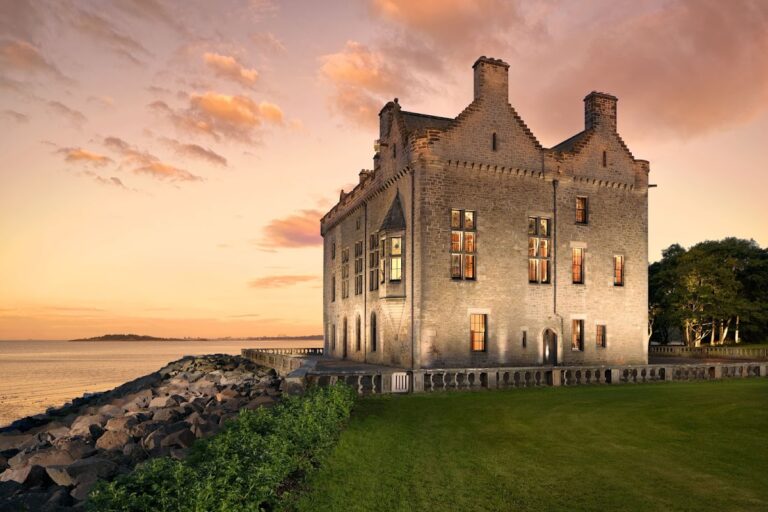
Rosyth Castle is a fifteenth-century tower house in Rosyth, United Kingdom, built around 1450 as a fortified residence for Sir David Stewart, a Scottish nobleman of the Stewart family. Stewart had received the Barony of Rosyth in 1428, and the castle combined domestic accommodation with defensive features. It originally stood on a small island in the Firth of Forth, the broad tidal estuary into which the River Forth flows.
Stewart Residence and Expansion
The castle remained in Stewart hands for several centuries. Its original tower house was enlarged during the sixteenth century and extended again in the early seventeenth century, reflecting the continuing development of the residence and its associated courtyard.
Attack, Occupation, and Later Ownership
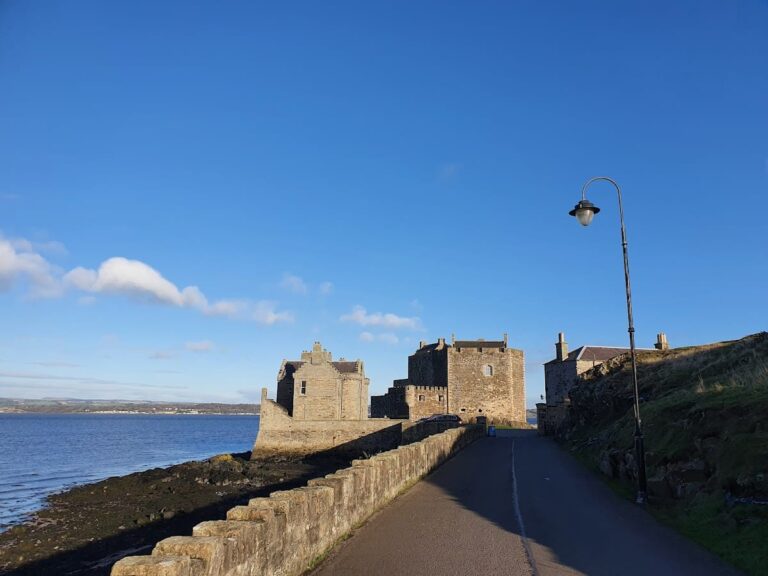
In 1572, men from Blackness Castle, a historic fortress on the southern shore of the Firth of Forth, attacked Rosyth Castle. Oliver Cromwell’s army occupied it in 1651 after the Battle of Inverkeithing, during the Wars of the Three Kingdoms, a series of conflicts involving the kingdoms of England, Scotland, and Ireland.
The castle was sold in the late seventeenth century to David Drummond of Invermay. It later passed to the Earl of Hopetoun, a Scottish peerage title, and remained unoccupied from the eighteenth century onward. As the building declined, substantial quantities of its masonry were reused in other buildings. Most of the courtyard buildings were demolished or reduced almost to ground level.
Dockyard Ownership and Protection
The Admiralty, the British government department responsible for administering the Royal Navy, acquired Rosyth Castle in 1903. Land reclamation removed the castle’s former waterfront setting and placed it within Rosyth Naval Dockyard, a naval shipbuilding and repair facility. Plans to restore and reuse the building were abandoned, and the ruin was secured in its existing condition. It later entered private ownership after substantial parts of the surrounding dockyard were sold.
Rosyth Castle and its associated dovecot were formerly listed as Category A historic buildings by Historic Scotland. Category A status identified buildings of national or exceptional architectural or historic interest, but the listing was removed in 2016. The castle and dovecot remain protected as Scheduled Monuments, a legal category for archaeological or historic sites considered nationally important. Rosyth Castle received this designation on 5 July 1995.
Remains
Rosyth Castle survives principally as a rubble-stone tower house and the northern wall of its courtyard. The tower originally rose about 17.4 metres, or 58 feet, and formed the main fortified residence. Sixteenth- and early seventeenth-century enlargement and extension altered the original fifteenth-century structure, while the later courtyard buildings were almost entirely demolished.
Tower House and Courtyard
The tower house is the principal above-ground survival. Its rubble-stone construction reflects the sturdy form of a fortified residence organized around a substantial tower. The northern courtyard wall also survives, preserving part of the enclosure associated with the expanded building. The ruin’s present form therefore combines the original tower with later additions and the fragmentary remains of its courtyard.
Dovecot
A well-preserved sixteenth-century dovecot stands about 800 metres, approximately half a mile, north of the castle. A dovecot housed and bred domestic pigeons. This building has crow-stepped gables, carved heads at two corners, and an internal barrel-vaulted ceiling, a ceiling formed by a continuous semicircular or near-semicircular vault.