Castle of Mota del Marqués: A Seigneurial Fortress in Valladolid


Site at a Glance
- Rating
- 4.3
- Popularity
- Low
- Country
- Spain
- Primary era
- Early Modern
- External website
- Open
- Eras represented
- Early Modern
- Civilizations
- Crown of Castile, Spanish
- Site type
- Military
- Remains
- Castle
On this page10 sections
History
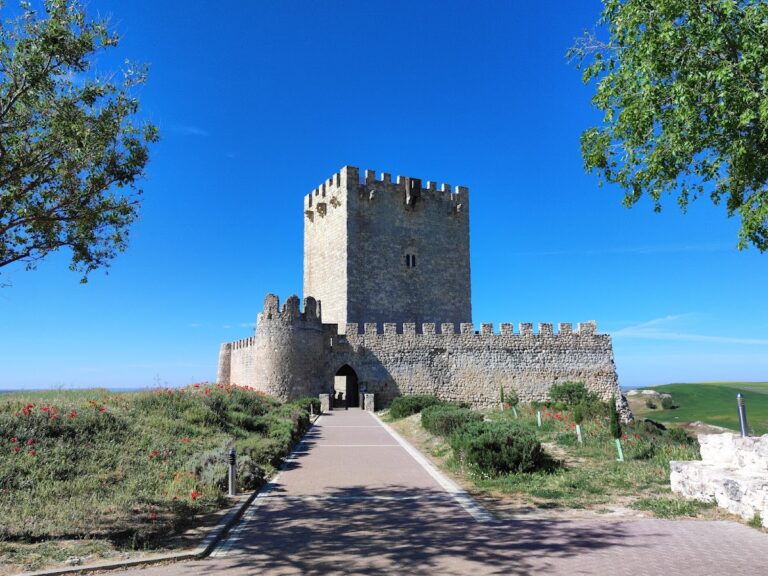
Castle of Mota del Marqués is a seigneurial fortress in Spain, built and rebuilt within the defensive line of the Montes Torozos. Its surviving fabric and cylindrical keep are generally assigned to the first third of the sixteenth century and to the transition from late Gothic to early Renaissance architecture, although earlier construction may lie beneath the present tower. The castle controlled an important route and frontier landscape, while its history reflects the changing authority of military orders, noble families, the Crown, and later private owners.
Early fortification and the Teutonic Knights
The first fortification at Mota has no certain date. A local hypothesis places an initial phase in the tenth century, during the repopulation associated with Alfonso III the Great, the Asturian king whose reign was linked to the expansion and resettlement of Christian territory in the northwestern Iberian Peninsula. Direct documentary evidence does not confirm this early phase.
In 1222, Beatriz of Swabia promoted the donation of Mota, then dependent on Toro, to the Teutonic Knights together with Morales, Benafarces, and Los Griegos. Fernando III, king of Castile and León, authorized the transfer in a diploma dated 5 May 1222. The Teutonic Knights were a German military-religious order founded during the Crusades. They held lordship over the fortress until the fourteenth century, but no known document proves that they built the castle.
Mota was the only stable commandery held by the Teutonic Knights in the Iberian kingdoms. A commandery was an administrative and economic jurisdiction governed by a military order. The order’s presence is materially associated with the Marian sanctuary now known as the Hermitage of Nuestra Señora de Castellanos. The connection between the Teutonic Knights and the castle itself was jurisdictional rather than demonstrably constructive.
Noble lordship and the War of the Castilian Succession
In the fourteenth century, Alfonso XI granted the town to Juan Alonso de Benavides. His descendants sold it during the following century, and the fortress eventually passed to the Manrique family. During the War of the Castilian Succession, fought from 1474 to 1479 over the Castilian crown, Juan de Ulloa, a supporter of Juana la Beltraneja, seized the castle.
The Catholic Monarchs, Isabel I of Castile and Fernando II of Aragon, recovered the fortress for the Manrique family. In 1478, the family sold it to Rodrigo de Ulloa, chief accountant of the Crown and governor of the fortress of Toro. The settlement then became known as Mota de Toro. In 1480, the Catholic Monarchs granted its council a tax-exempt market every Thursday to encourage local growth.
Destruction during the Comunero revolt
During the Revolt of the Comuneros, a Castilian uprising against the government of Emperor Carlos V in 1520 and 1521, the castle was the residence of Juan de Ulloa Castilla, third lord of Mota. After Comunero forces burned Medina del Campo on 21 August 1520, they assaulted the fortress and severely damaged it. The castle did not recover its full military function.
Juan de Ulloa later fought for the imperial side at the liberation of Tordesillas on 5 December 1520 and at the Battle of Villalar on 23 April 1521. At Villalar, he personally wounded the Comunero captain Juan de Padilla. These events placed the castle within the armed conflict that reshaped royal authority in Castile.
Sixteenth-century rebuilding and the marquisate
A building program carried out between 1524 and 1534 is attributed to the workshop of Juan de Álava, a major architect of the late Gothic and early Renaissance periods associated with Plateresque architecture. The attribution rests on a lawsuit preserved in the Archive of the Royal Chancery of Valladolid and brought to scholarly attention by Edward Cooper. The work coincided with Juan de Álava’s activity at the nearby fortress of Castrocalbón and at the chancel of the Church of San Francisco in Toro.
During the same period, the Teutonic commandery was held by Constantino del Castillo, commander of Santa María de Castellanos and a Lateran count appointed by Pope Leo X. Constantino del Castillo later financed the new parish church of San Martín, designed in 1540 by Rodrigo Gil de Hontañón and completed in 1558.
In 1575, Felipe II granted Rodrigo de Ulloa y Quiñones the title of Marquis of Mota. The town consequently became Mota del Marqués. The principal seigneurial residence moved to the Ulloa Palace in the town, and the castle was relegated to secondary uses, traditionally including use as a prison.
Decline, destruction, and conservation
Through successive marriages of the Ulloa family with the dukes of Veragua and, in the eighteenth century, with the Spanish branch of the Fitz-James Stuarts, the marquisate and lordship of Mota eventually passed to the House of Alba. During the same century, Mota del Marqués was separated administratively from Toro and incorporated into Valladolid Province.
French Napoleonic troops devastated the castle in 1810 during the Peninsular War. Most of the outer enclosure and residential buildings were demolished, and the ruins were increasingly used as a stone quarry. By the end of the nineteenth century, the castle was already described as being in lamentable condition. After the dissolution of the Marquisate of Las Casas de Alba, the urban and rural properties of Mota were sold to private parties. The castle ruins ultimately passed to the Hormias family, which remains the private owner.
The castle is protected as an Asset of Cultural Interest under the decree of 22 April 1949 concerning Spanish castles and under Spain’s Historical Heritage Law of 25 June 1985. It was included in the inventory of the Spanish Cultural Heritage Institute in 1968 and in heritage registers maintained by the Junta of Castile and León.
Hispania Nostra placed the castle on its Red List on 16 December 2007 because of progressive ruin and collapses. Torrential rains damaged the eastern wall in February 2010, prompting emergency works by the Junta of Castile and León in July of that year. These included a metal shoring system supporting the tower, after which the site was moved to Hispania Nostra’s Green List. Further detachments and cracks later developed in the walls and dome because no comprehensive restoration or regular maintenance plan followed. Hispania Nostra returned the castle to its Red List on 24 September 2021, an unusual reclassification for a property previously considered rehabilitated.
The buried parts of the enclosure have not yet been systematically assigned to a complete chronology. The castle therefore remains an open subject of study in military history, early Renaissance architecture in Castile, and the social history of lay and ecclesiastical lordship.
Remains
The surviving complex occupies a small, approximately circular hilltop, or teso, at 736 metres above sea level on the western edge of the Montes Torozos. Gentle slopes descend to the northeast, north, and northwest, while the southern side facing the town is steeper. The elevated position provided visual control over the former Madrid to La Coruña route, now represented by the A-6, and over the historic frontier between the medieval kingdoms of Castile and León. The hill lies a short distance from the Bajoz River.
Hilltop platform and enclosure
The fortified complex was arranged around an elliptical platform completely encircled by a dry moat, which still surrounds the summit. A fortified enclosure with circular towers or turrets stood within the moat. Most of the enclosure has disappeared through destruction and subsequent quarrying, but foundations and ruined masonry sections remain. On the western side of the keep are traces of lime-concrete walls belonging to a rectangular building usually identified as the residential or palatial wing.
Cylindrical keep
The keep is the only part of the complex that retains its full elevation. It is a multi-storey cylindrical tower with vaulted interiors, loopholes around its perimeter, and a hemispherical masonry dome. Its walls exceed three metres in thickness and consist of three layers: two outer faces of regularly laid limestone blocks, each about 30 centimetres thick, surround an internal core of lime, sand, and stones of varying sizes. The principal stone came from local limestone on the plateau and was worked into regular small blocks for the visible faces.
A passage within the wall thickness connected the different levels through stepped openings. The loopholes open outward with an internal splay that facilitated the use of weapons. The dome is built continuously with the inner wall face, using regular masonry courses arranged concentrically towards a central keystone. This solution is rare in fifteenth- and sixteenth-century Castilian military architecture. It was traditionally linked to Germanic influence, although that interpretation lacks documentary support, and a functional explanation related to the builder’s technical possibilities is now preferred.
Some mortar joints preserve marks left by scaffolding irons and horizontal construction guides used during building. These traces are consistent with working methods associated with Juan de Álava’s workshop in other contemporary buildings. The cylindrical keep is virtually the only surviving cylindrical keep in Valladolid Province and is one of the few preserved examples in Castile.
Church remains and earlier settlement
On the southwestern slope of the same hilltop are the remains of the sixteenth-century Church of El Salvador. Only its bell gable survives. Some of its stones were taken from the castle after the fortress began to fall into ruin, linking the later church remains physically with the period of the castle’s decline.
Bronze Age and Iron Age remains within the municipality, together with Roman remains at the nearby Teso de San Miguel, place the castle within a wider landscape of settlement that predates the preserved fortress by many centuries.