Château de Troissereux: A Renaissance Château and Fortified Estate in France


Site at a Glance
- Rating
- 4.3
- Popularity
- Low
- Country
- France
- Primary era
- Early Modern
- External website
- Open
- Eras represented
- Medieval, Early Modern
- Civilizations
- French
- Site type
- Domestic
- Remains
- Castle
On this page9 sections
History
Roadside origins and medieval fortification
Château de Troissereux, also known as Château de Troisrieux, is a historic château in Troissereux, France. It stands beside a ford across the Thérain on the former Agrippa Roman road linking Lyon with Boulogne-sur-Mer. Earlier structures protected travelers using this crossing and route. Brunulf, the brother-in-law of Dagobert I, the Merovingian king of the Franks who ruled in the seventh century, is identified as the site’s initial owner. Brunulf died in 627.
A medieval castle on the site was destroyed by the English in 1388. It was replaced by a garrison fort intended to protect Beauvais as a fortified position on the city’s approaches.
Renaissance rebuilding
The present château was constructed mainly during the fifteenth and sixteenth centuries. It is a Renaissance building attributed to the Italian architect and architectural theorist Sebastiano Serlio. During the sixteenth century, Jean de L’Isle Marivaux, treasurer of the Army of the North, undertook major works and commissioned the development of the twelve-hectare park, attributed to Bernard Palissy, a French potter, enamelist, and naturalist known for naturalistic decoration and garden and water-feature designs.
Revolution and later ownership
During the French Revolution, the owner Pierre de Corberon was executed by decapitation. The estate subsequently remained with the Tranié family and its descendants. The château is inhabited by descendants of an old Beauvaisis family and of General Tranié, who is described as the liberator of Serbia in September and October 1918. Numerous restoration works were carried out on the interiors in 1791.
Historic protection
The château and its domain received successive protections under France’s historic-monument system, which safeguards buildings, structures, and sites as part of the country’s legal heritage conservation. A decree of 25 February 1983 classified the portal, façades, roofs, courtyard, moats, and water bodies. It registered the grand staircase, the spiral staircase in the tower, the grand salon, and the ground-floor dining room with their decoration. The park and all its elements were classified in 1983 and registered again by decree of 10 April 1992. Remaining parts of the former domain were registered by decree of 23 September 2003, including numerous hydraulic installations, a canal blocked for two-thirds of its length, and portions of the water bodies not already classified.
Remains
Château plan and principal interiors
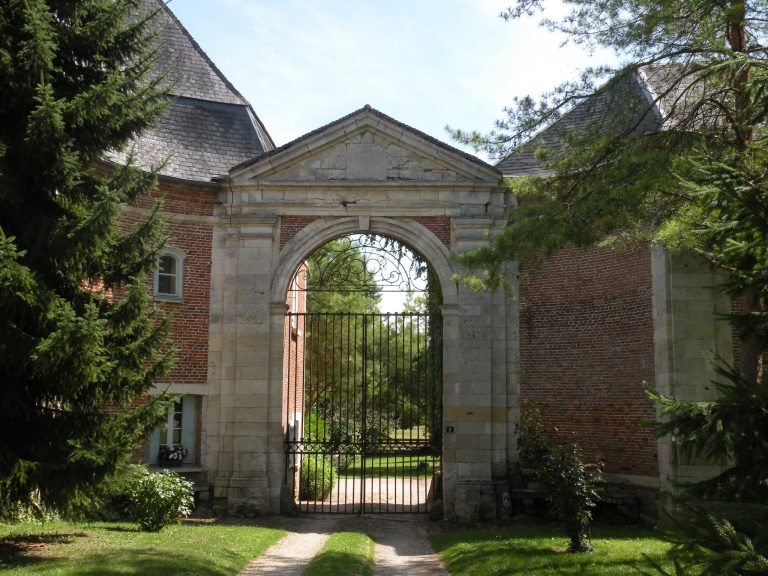
The château is built of brick and white limestone. Its plan forms an L, comprising a principal wing, a lower gallery wing, and the Tower of Time. The protected architectural ensemble includes the portal, façades, roofs, courtyard, moats, and water bodies. Within the building, the protected interiors include the grand staircase, the tower’s spiral staircase, the grand salon, and the ground-floor dining room with their decoration. The principal wing also contains a library, bedroom, boudoir, salon, and ceremonial staircase.
Tower of Time
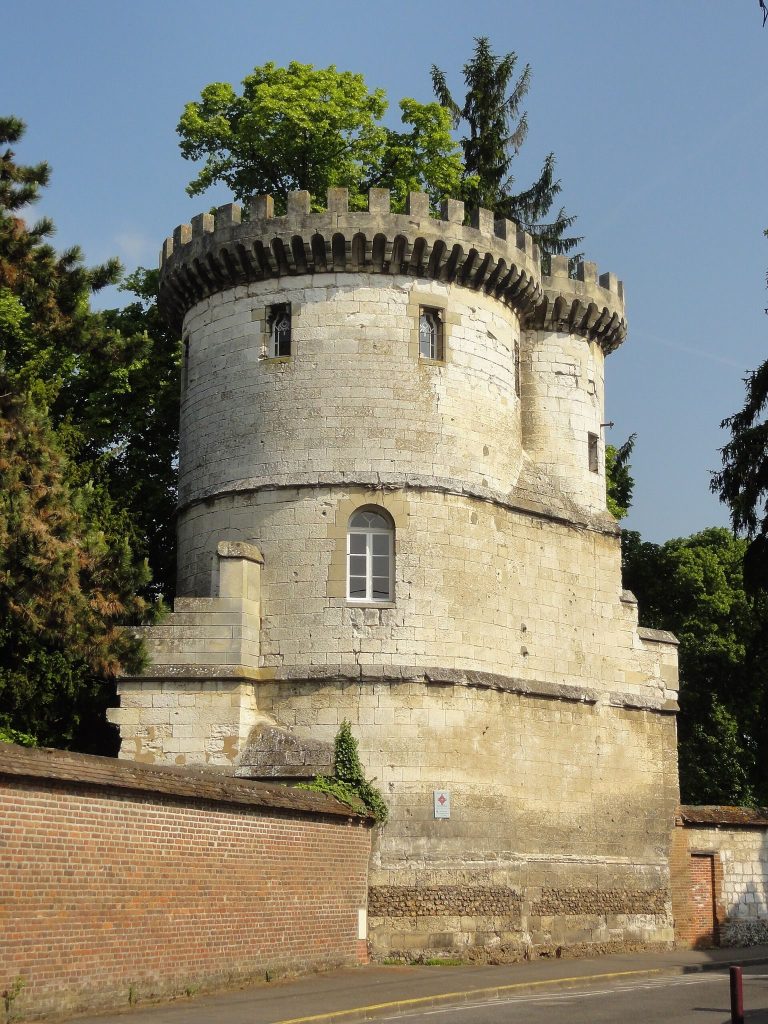
The Tower of Time contains a brick spiral staircase and a medieval clock classified as a historic monument. An astronomical weathervane, a roof-mounted vane incorporating astronomical imagery or motifs as well as indicating wind direction, stands at the top of the tower.
Park and water features
The twelve-hectare park was created in the sixteenth century and is attributed to Bernard Palissy. It contains an arboretum with 45 species of trees and shrubs, moats, a 330-metre-long grand canal, and a smaller canal. The park may be the only example of a “Protestant garden” proposed by Palissy, although that characterization remains uncertain.
Plane trees in the park are estimated to be between 150 and 400 years old, while bald cypresses were planted in 1786. The park forms a natural ornithological reserve for free-ranging birds, including herons, swans, geese, and kingfishers, and is used by many migratory birds.