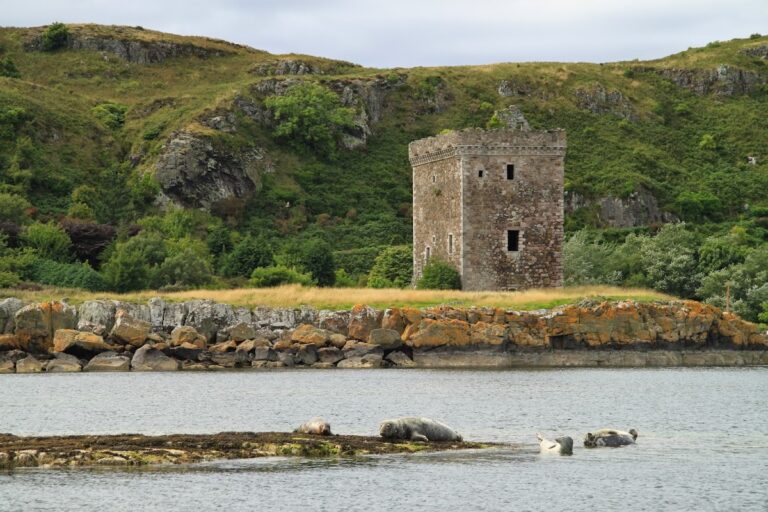
Ardrossan Castle: A Medieval Fortress in Scotland


Site at a Glance
- Rating
- 4.3
- Popularity
- Low
- Country
- United Kingdom
- Primary era
- Medieval
- External website
- Open
- Eras represented
- Medieval, Early Modern
- Civilizations
- Kingdom of Scotland
- Site type
- Military
- Remains
- Castle
On this page7 sections
History
Ardrossan Castle is a twelfth-century castle in Ardrossan, United Kingdom, on Scotland’s west coast. Its original construction dates to around 1140 and is attributed to Simon de Morville, a medieval Anglo-Norman nobleman who held major offices in Scotland, including that of Constable of Scotland. The castle developed through four construction phases and later became associated with several noble families and important events in Scottish history.
Origins and medieval development
The earliest castle belonged to Clan Barclay and had passed to the Ardrossan family by the thirteenth century. During the First War of Scottish Independence, a conflict over Scotland’s rule and independence from England, the castle was partly destroyed after its English garrison was slaughtered. The surviving vaults became known as “Wallace’s Larder,” linking the ruins to William Wallace, the Scottish military leader who became a central figure in resistance to English rule.
The castle was rebuilt by Clan Montgomery in the fifteenth century. During a second construction phase, the gatehouse was reconstructed from the first floor, probably to repair damage caused during the First War of Scottish Independence. In the fifteenth or early sixteenth century, the gatehouse was heightened into a keep, the principal fortified tower of a castle, and the castle may also have acquired a chapel. In a later phase, the entrance from the keep was blocked and a wide-mouthed gun port, an opening for firearms, was added.
Political use and decline
Ardrossan Castle briefly served an unusual governmental purpose on 18 June 1546, when the Privy Council of Scotland met there. The council was the monarch’s principal advisory and administrative body, and it normally met in Edinburgh, Stirling, or St Andrews. The meeting at Ardrossan therefore placed the castle within the wider political activity of sixteenth-century Scotland.
The castle later fell into disuse, while the Earls of Eglinton retained it. Records of repairs made in 1617 mention seventeen feet of rigging-stone worked by a stonemason. In 1648, troops serving Oliver Cromwell destroyed the castle. Cromwell was the English parliamentary military and political leader whose forces occupied and dismantled many Scottish strongholds during the conflicts of the mid-seventeenth century. Much of Ardrossan’s stonework was removed to Ayr for construction of the Ayr Citadel.
Ruins, traditions, and protection
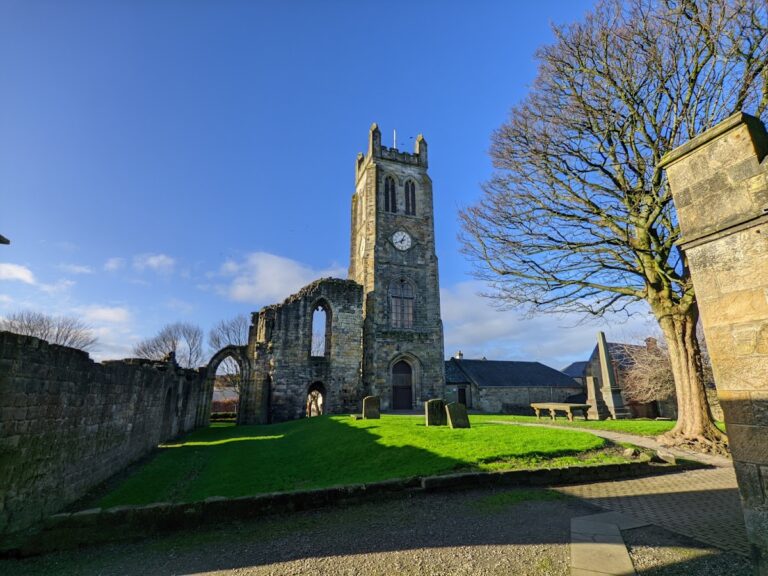
By 1847, the castle was already ruined and belonged to the Eglintoun family. Thomas and Edward Gilks described it in a travel book as a marker of regional identity and an object of antiquarian interest. They also placed it beside an old churchyard and described views of the sea from the castle. Their account stated that the site had originally been called “Castle Crags” before taking the name Ardrossan from the family that owned it.
Local tradition associates the ruins with the ghost of William Wallace, said to wander through them on stormy nights. Another tradition concerns Sir Fergus Barclay, known as “the De’il of Ardrossan.” He was said to have received a magical bridle from the Devil in exchange for his soul, then tricked the Devil into returning it. The enraged Devil allegedly attacked the castle and left hoofprints on a rock. Sir Fergus is traditionally said to be buried in a chapel associated with the castle farther inland and lower down the hill.
Ardrossan Castle is protected as a Scheduled Monument, a designation for an archaeological or historic site protected under Scottish heritage law because of its national importance. It was also protected as a Category B listed building, a status for buildings of regional or more than local importance, from 14 April 1971. The castle is no longer in use and remains hazardous, with loose rocks contributing to the danger.
Remains
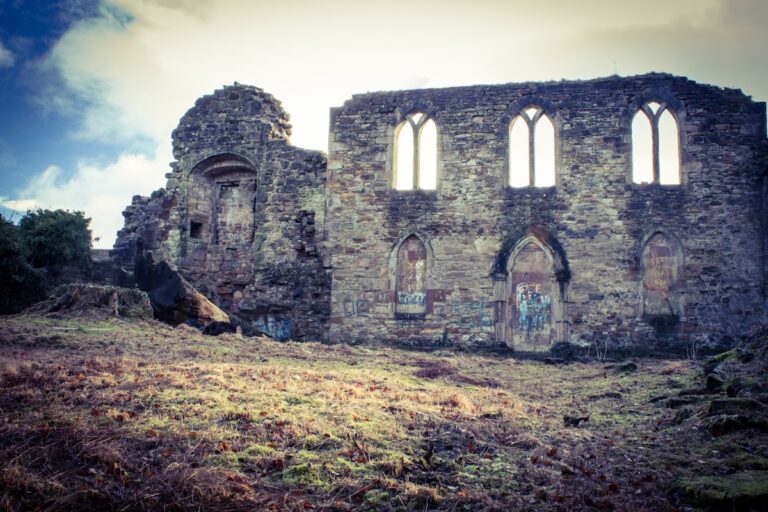
The ruins stand on a rocky ridge or hill above Ardrossan and were defended by a moat. The name Ardrossan is explained as deriving from terms meaning “height” and “rocky promontory.” The surviving complex includes a fifteenth-century keep, a vaulted range containing a kitchen and cellars, and a deep passageway with a well. Stone, wood, and metal are among the recorded construction materials.
Keep and gatehouse
Part of the keep survives up to the corbels of the parapet. Parapet corbels are projecting stone supports that carried the parapet or wall-walk above. The keep developed from the earlier gatehouse, which was reconstructed from the first floor during the second building phase and later heightened. Its entrance from the keep was subsequently blocked, while a wide-mouthed gun port was inserted during the later alteration phase. The remainder of the castle is ruined, and the surviving masonry forms part of a hazardous complex.
Vaults, passage, and chapel tradition
The vaulted range preserves the castle’s kitchen and cellars, while a deep passageway contains a well. The vaults are traditionally identified as “Wallace’s Larder,” the name associated with the destruction of the English garrison during the First War of Scottish Independence. A chapel may have been erected during the fifteenth- or early-sixteenth-century building phase. A separate chapel associated with the castle is traditionally described as standing a few hundred yards inland and farther down the hill.