Castellas de Montpeyroux: A Medieval Fortress in France


Site at a Glance
- Rating
- 4.4
- Popularity
- Low
- Country
- France
- Primary era
- Medieval
- External website
- Open
- Eras represented
- Medieval, Modern
- Civilizations
- French
- Site type
- Military
- Remains
- Castle
On this page7 sections
History
Castellas de Montpeyroux is a medieval fortress in Montpeyroux, France, founded in 1070 by a descendant of Saint Guilhem, the medieval Christian nobleman and monastic founder also known as William of Gellone. Conceived as a fortified aristocratic residence, it attracted inhabitants and developed into a village during the twelfth century.
Medieval fortress and village
The castle remained occupied through the medieval period, with much of its enclosure built during the first period of occupation between the twelfth and fifteenth centuries. In 1384, during the Hundred Years’ War, the English partially destroyed the castle.
Religious conflicts and abandonment
In the sixteenth century, Castellas de Montpeyroux became a Protestant stronghold, meaning a fortified place controlled or used by Protestants during the religious conflicts of that period. Marshal Joyeuse, a French military commander holding the senior rank of marshal, besieged and captured the fortress in 1567.
From the end of the sixteenth century into the early seventeenth century, the population gradually left the site for the lower hamlets of Barry and Adisse. Adisse later became the center of the present village of Montpeyroux.
Convent occupation and protection
After the fortress had been deserted, a convent reoccupied it in the mid-nineteenth century. Its chapel was built in 1863 and dedicated to Our Lady of La Salette. Castellas de Montpeyroux has been listed as a French historic monument since February 2025, placing it within France’s legal heritage-protection system for historically or architecturally important sites.
Remains
The site consists of a feudal castle enclosed by high, crenellated walls of notable architectural quality and flanked by several rectangular towers. The enclosure preserves fortifications from the first period of occupation, between the twelfth and fifteenth centuries, alongside sections associated with a second period of occupation in the nineteenth and twentieth centuries.
Fortifications
The surviving defensive enclosure defines the physical form of the medieval fortress. Its high walls are crenellated and reinforced by rectangular towers, while later sections reflect the continued occupation of the site after the medieval phase.
Convent and chapel
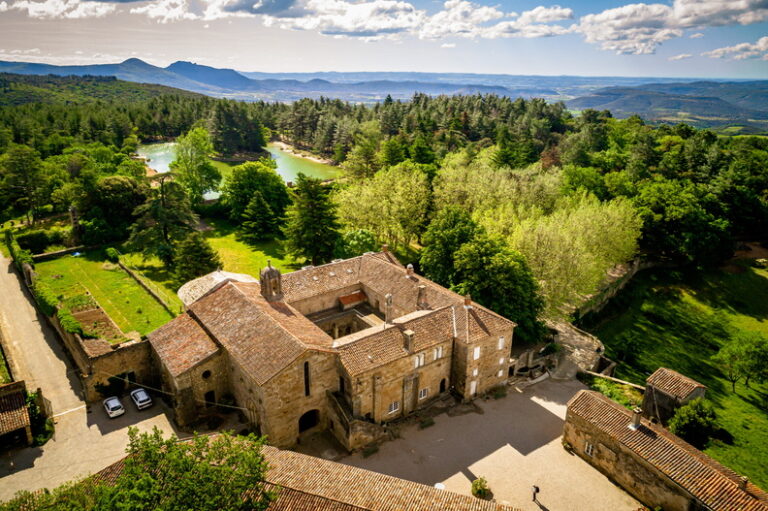
The visible ruins within the enclosure belong to the mid-nineteenth-century convent, including the chapel constructed in 1863. Building the convent erased traces of the earlier structures inside the fortified area, leaving the later religious complex as the principal visible remains within the walls.
Nearby sites