Egremont Castle: A Norman Fortress in Cumbria


Site at a Glance
- Rating
- 4.3
- Popularity
- Low
- Country
- United Kingdom
- Primary era
- Medieval
- Eras represented
- Medieval
- Civilizations
- English, Norman
- Site type
- Military
- Remains
- Castle
On this page4 sections
History
Norman Foundation
Egremont Castle is a ruined Norman castle in Egremont, United Kingdom, founded in the early twelfth century as a medieval motte-and-bailey stronghold. The original castle was built on the site of a Danish fort after William II, the Norman king of England from 1087 to 1100, conquered Cumberland in 1092.
William Meschin, a Norman lord associated with the establishment of Egremont, founded the present castle between 1120 and 1135. Further additions followed during the thirteenth century. The fortress protected the town that Meschin also created, whose long, wide street served as a marketplace. Traders received privileges and security in exchange for paying tolls.
Town, Priory, and Later Tradition
Some of the profits from Egremont’s trade were undoubtedly used by William Meschin to help establish St Bees Priory, a medieval religious house on the Cumbrian coast dedicated to Saint Bega. The castle later fell into disuse and became a ruin.
A local tradition tells of a horn kept at the castle that only the rightful heir could blow. William Wordsworth, an English Romantic poet associated with the landscapes and traditions of northern England, made this story the subject of his poem The Horn of Egremont Castle.
Remains
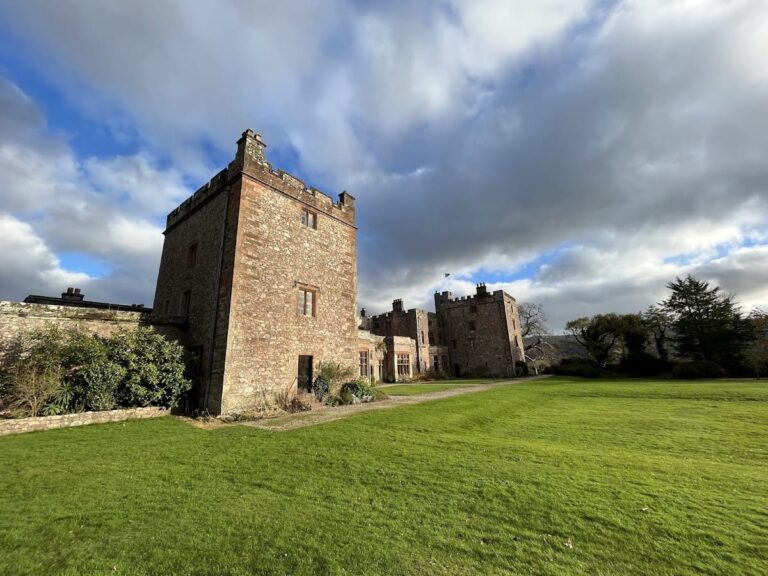
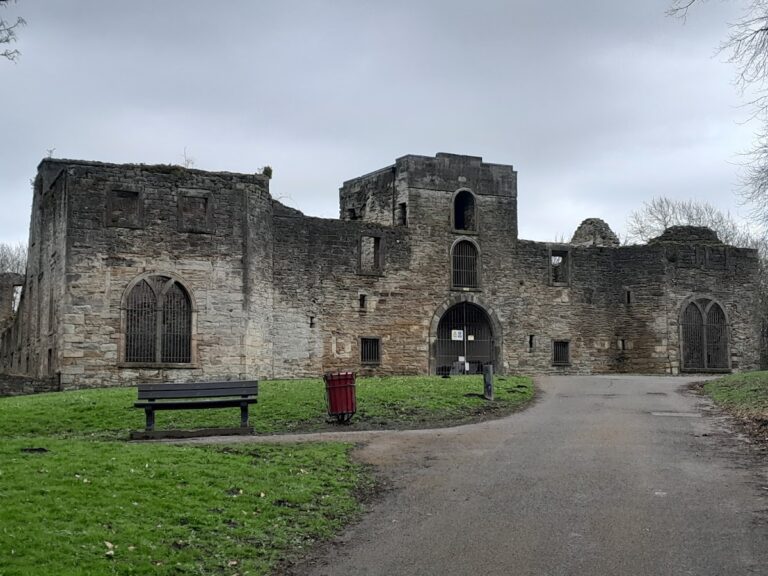
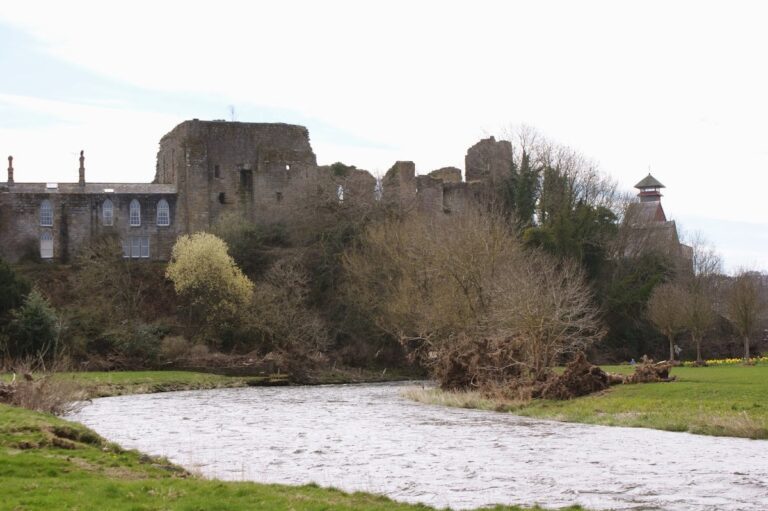
Egremont Castle occupies a mound above the River Ehen in the town of Egremont. Its surviving form is a motte-and-bailey design, combining a raised earthwork mound, or motte, with an enclosed outer yard, or bailey. The remains are ruined.
The castle stands at approximately 52 metres above sea level. The terrain is mainly grassland, with flatter ground to the west and hills to the east. The sea lies to the southwest, while the highest nearby ground reaches approximately 342 metres about 3.8 kilometres northeast of the castle. Whitehaven is approximately 8.4 kilometres north.
Nearby sites