Castle of Marcuello: An Aragonese Frontier Fortress in Spain




Site at a Glance
- Rating
- 4.5
- Popularity
- Low
- Country
- Spain
- Primary era
- Medieval
- Eras represented
- Medieval
- Civilizations
- Crown of Aragon
- Site type
- Military
- Remains
- Castle
On this page8 sections
History
Castle of Marcuello is a medieval Aragonese fortress in Spain, located at Sarsamarcuello within the municipality of Loarre in Huesca. Probably founded by Sancho Ramírez before 1074, it was one of the principal castles in the central Pre-Pyrenees and helped organize attacks in the basin of the Gállego River.
A frontier castle under Aragonese rule
Marcuello formed part of a geographical group with the castles of Murillo, Agüero, Ayerbe, and Loarre. At the beginning of the twelfth century, this group was governed by Berta, the widowed queen of Aragon. Marcuello appears to have been the most recently founded castle in the group.
Pedro Sánchez held Marcuello permanently until 1105, along with the more distant castles of Luesia, Cacabiello, and Boltaña. Barbatuerta held it between 1110 and 1114, followed by Sancio Enecones, who served as its tenente, a lord administering a castle or territory for the ruler, from 1114 to 1160. Pedro Ortiz held the castle in 1170. The names of its holders are then unknown until Antón de Luna possessed it at the beginning of the fifteenth century.
Decline and protection
A document from 1488 shows that Marcuello was still inhabited. Its residents were moving down to Sarsamarcuello and Linás de Marcuello, a relocation that also took place at Loarre. By 1610 the castle was uninhabited, and in 1808 it was described as ruined.
In 2006, Castle of Marcuello was declared a Spanish Asset of Cultural Interest, a legal designation protecting important cultural heritage. The declaration resolution was issued on 17 April 2006 and published on 22 May 2006.
Remains
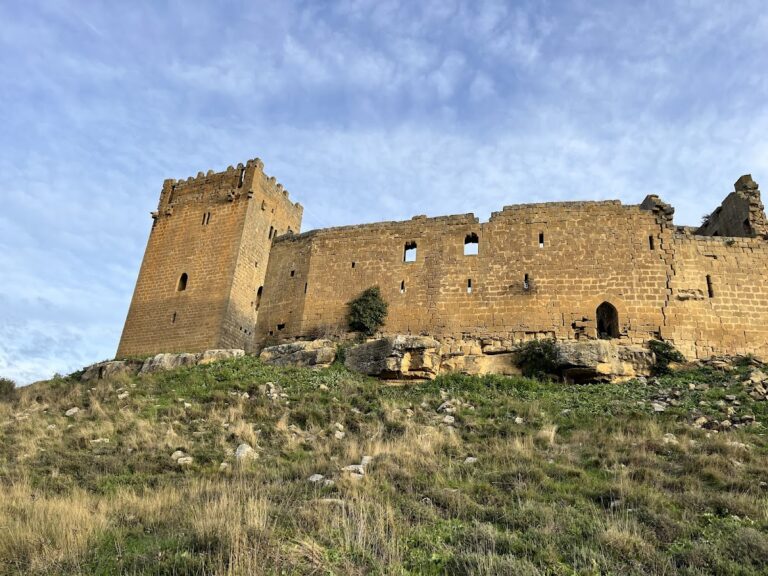
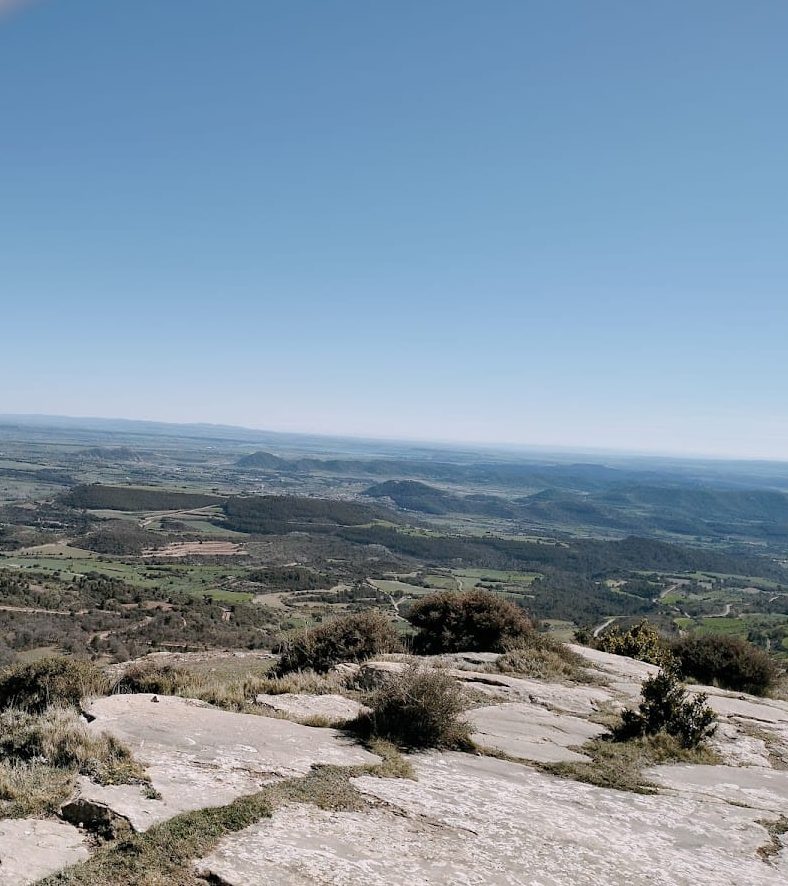
The castle occupied a highly elevated rocky spur with a broad, relatively level surface. From this position, it commanded an extensive field of view over the route of the Gállego River, where the river widens after leaving the mountains, as well as the Mallos de Riglos. The site stood considerably higher than the frontier areas of Ayerbe and Murillo. Its basic arrangement consisted of a tower set on the rock and an enclosed walled area.
Fortification and tower
Enclosing wall
Only one straight section of the enclosure wall survives. It is built of rough masonry, using less-finished stones, and contrasts with the carefully cut ashlar of the tower. The surviving stretch preserves part of the simple defensive boundary that surrounded the rocky stronghold.
Square donjon
The principal fortified tower was a square donjon measuring approximately 11 metres on each side. Its foundations indicate five storeys, giving it an unusually broad span for an eleventh-century tower. That width created difficulties in roofing the floors with timber beams long enough to cross the interior.
Unlike the narrower towers at Abizanda and Biel, whose floors were supported by beams laid across closely spaced transverse arches, Marcuello has no identifiable springings for such arches. Instead, the tower preserves continuous imposts, the horizontal masonry supports of an arch, together with sockets recessed into the walls for the ends of timber beams.
The tower is largely ruined. One wall and fragments of its side walls remain standing, while the three upper storeys contain splayed arrow slits. These openings widen toward the interior, allowing defenders to fire through narrow openings in the thick walls. The lowest surviving set has an interior semicircular arch, while the other two are covered by lintels.
Romanesque churches
The ruins on the spur also include two Romanesque churches. Romanesque architecture was a medieval tradition characterized by massive masonry, relatively small openings, and frequent semicircular arches. The churches survive alongside the tower and the remains of the enclosing wall, forming part of the complex’s medieval built remains.
Nearby sites