Château de Quillan: A Fortified Castle in France


Site at a Glance
- Rating
- 3.9
- Popularity
- Low
- Country
- France
- Primary era
- Medieval
- Eras represented
- Medieval
- Civilizations
- French
- Site type
- Military
- Remains
- Castle
On this page8 sections
History
Château de Quillan is a fortified castle in France, whose present form was probably built in a single campaign between the late thirteenth and early fourteenth centuries over earlier fortifications. The settlement of Quillan appears in a judgment issued on 3 June 782 by commissioners of Charlemagne in favor of Daniel, Archbishop of Narbonne, while the castle itself is first mentioned in 1125.
Archiepiscopal lordship and royal claims
During the Albigensian Crusade, a thirteenth-century campaign against Catharism and its supporters in southern France, Simon IV de Montfort seized Quillan. The town belonged to the possessions of the Archbishop of Narbonne, who held feudal authority over the Niort family, an active supporter of Catharism, a medieval Christian dualist movement condemned as heretical by the Catholic Church.
Arnaud Amaury, Archbishop of Narbonne, complained to Pope Honorius III about the confiscation in September 1216. The pope, the bishop of Rome and head of the Catholic Church, ordered Quillan’s restitution in March 1217. In 1224, Amaury VII de Montfort ceded his rights in Occitania to King Louis VIII. The king then claimed jurisdiction over Quillan and sought to bring it into the royal domain, the territory directly controlled by the French crown, but the Archbishop of Narbonne contested the claim.
The dispute continued through the thirteenth and fourteenth centuries. In 1255, the inhabitants of Quillan recognized the castle as belonging to Archbishop Guillaume de la Broue. King Philip III the Bold confirmed an agreement between his officers and Archbishop Pierre de Montbrun in 1280. King Philip VI of Valois still held the castle in 1332, after which it passed fully into the possession of the Archbishops of Narbonne.
Damage, decline, and protection
Protestants attacked the castle in 1573, burning part of its buildings. An inspection in 1628 found the poorly maintained complex in very bad condition. The inspection described a timber stairway, a paved courtyard, a walled gate tower used as a prison, lower rooms, and large halls with rotten floors.
Dismantling began in 1735 and continued into 1736. The process accelerated after the castle was sold during the French Revolution. Château de Quillan was entered on the French register of historic monuments in 1954.
Remains
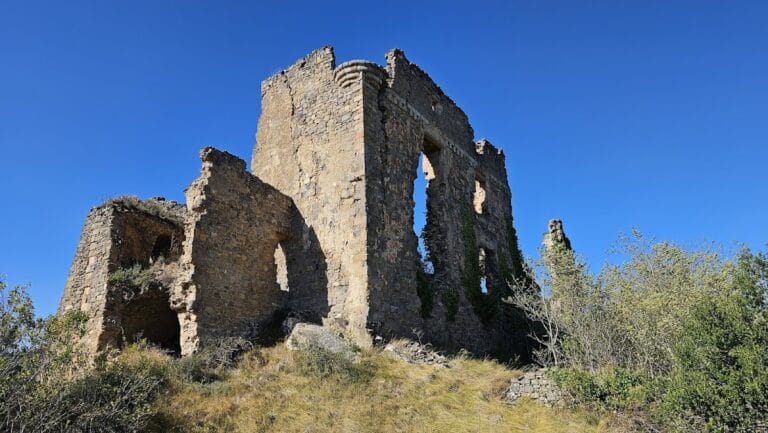
The surviving design is organized around a square enclosure reinforced by small defensive turrets at its corners and by a gate tower on one side. Buildings once occupied the interior, while the surviving arrangement preserves the castle’s basic fortified plan. The complex was constructed over earlier defensive works, and later burning and dismantling affected its physical fabric.
Fortified enclosure
Square enclosure
The square enclosure forms the main structural framework of Château de Quillan. Small defensive turrets strengthen its corners, giving the perimeter a compact defensive arrangement. The enclosure incorporates earlier fortifications within the later medieval construction campaign.
Gate tower
A gate tower protects an entrance through one side of the enclosure. The tower was walled and included prison use by 1628. One of its storeys has disappeared, reducing the surviving height of the structure. The inspection also recorded a timber stairway providing access, along with lower rooms connected to the castle’s internal accommodation.
Interior buildings
The castle interior included a paved courtyard and large halls. By 1628, the floors of these halls had deteriorated, reflecting the poor condition noted throughout the complex. The internal buildings were later affected by the 1573 fire and by the dismantling that began in the eighteenth century.