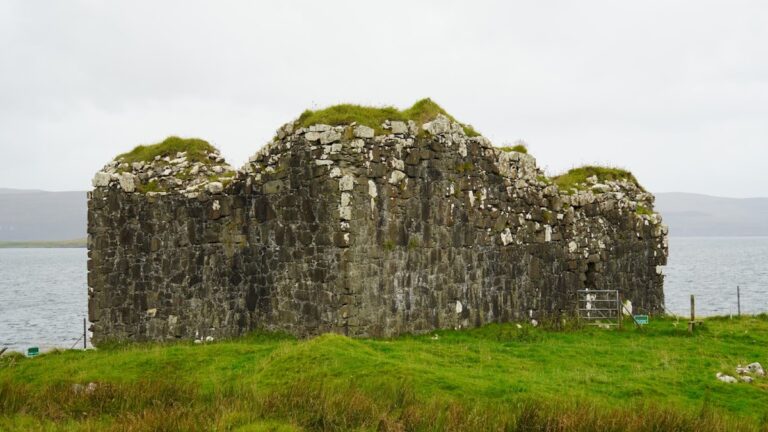
Caisteal Maol: Clan Mackinnon’s Fortress at Kyleakin


Site at a Glance
- Rating
- 4.4
- Popularity
- Low
- Country
- United Kingdom
- Primary era
- Medieval
- External website
- Open
- Eras represented
- Medieval, Early Modern
- Civilizations
- Kingdom of Scotland
- Site type
- Military
- Remains
- Castle
On this page8 sections
History
Caisteal Maol is a ruined fortress in Kyleakin, United Kingdom, built for Clan Mackinnon in the late fifteenth or early sixteenth century. It stood above the Kyle Akin strait, the narrow passage between the Isle of Skye and the mainland, and controlled a route that ships had to use unless they attempted the stormy waters around Skye through the Minch.
Traditional Origins and Norse Associations
The castle’s earliest history belongs partly to tradition. Findanus, traditionally regarded as the fourth Mackinnon chief and a great-grandson of Alpín mac Echdach, was said to have brought Dunakin into the clan around 900 by marrying a Norse princess known by the nickname “Saucy Mary.” According to the tradition, the couple stretched a heavy chain across the strait and charged tolls to passing ships. Saucy Mary is traditionally buried on Beinn na Caillich on Skye, with her face turned toward Norway.
The site also has a probable Norse connection. King Haakon IV of Norway is thought to have gathered his longship fleet at or near the castle before the Battle of Largs in 1263. Haakon’s defeat ended Norse domination of the Scottish islands. Medieval and early modern references call the castle Dunakin or Dun-Haakon, names associated with the Old Norse meaning “Haakon’s castle.”
Clan Mackinnon Stronghold
The present castle was constructed in the late fifteenth or early sixteenth century, a date supported by historical documents and carbon dating. In 1513, it hosted a meeting of clan chiefs who agreed to support Donald MacDonald as Lord of the Isles, the title held by the ruler of the Hebridean islands and parts of the western Scottish mainland.
Neill MacKinnon, a nephew of the clan’s twenty-sixth chief, was the castle’s last occupant. He died around 1601. The ruin later suffered repeated damage. Storms caused parts of the structure to collapse in 1949 and 1989, and a lightning strike on 14 February 2018 destroyed another part of the remains. The surviving fabric was subsequently secured and stabilised. Caisteal Maol is a Category A listed building and has protected-monument status in the United Kingdom, recorded from 10 November 1953.
Remains
Headland Keep
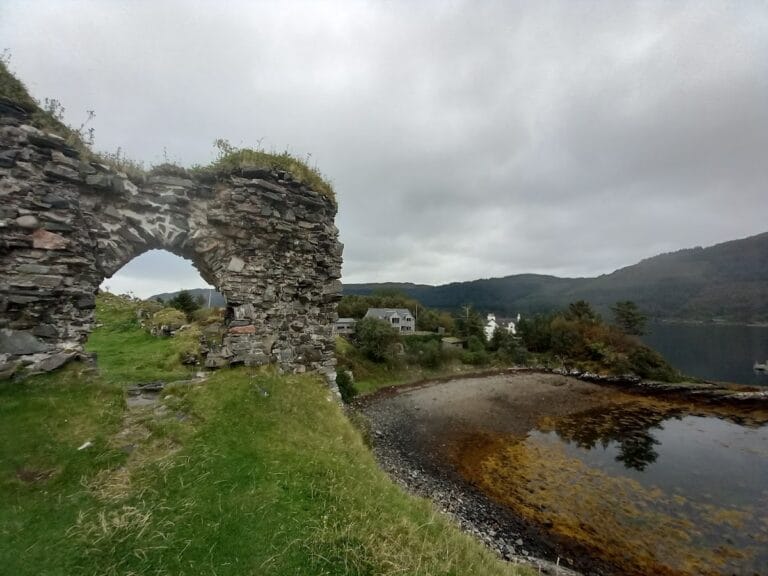
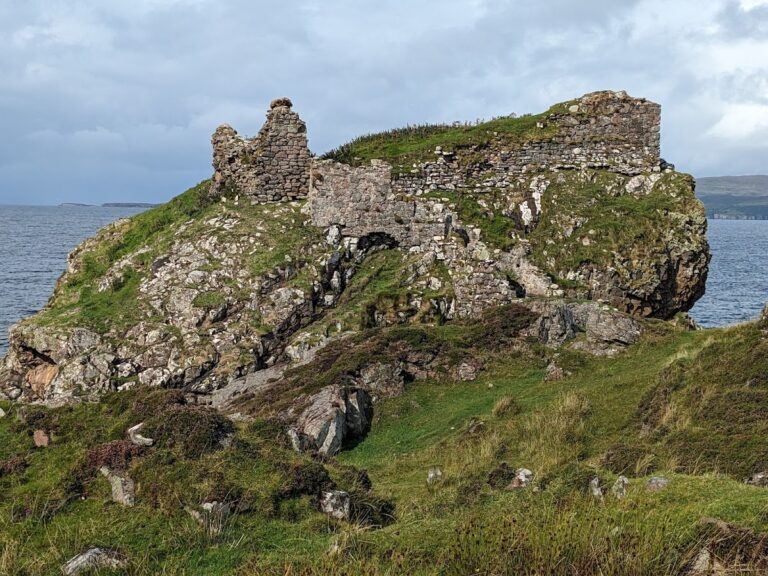
The ruin occupies a headland above Kyleakin, near the village harbour, facing Kyle of Lochalsh across the Kyle Akin strait. The castle was a simple rectangular keep, the principal fortified residential building, combining defensive walls with living and administrative spaces. It rose approximately three storeys, and the surviving walls reach up to 3.4 metres in thickness.
Caisteal Maol is now almost completely ruined. Storms and the 2018 lightning strike removed parts of the structure, while the remaining walls have been secured against further deterioration and stabilised.
Internal Arrangement
Basement
The basement remains filled with rubble and other debris. Its original arrangement has not been explored, but it is believed to have contained a kitchen and possibly storage rooms.
Main Level and Upper Floors
The present entrance leads to the main level, which formerly held the public hall or dining space. Stairs connected this area with private apartments on the upper floors, organizing the keep around a division between communal rooms and residential space.