Castello Arabo Normanno: A Medieval Fortress at Castellammare del Golfo


Site at a Glance
- Rating
- 4.2
- Popularity
- Low
- Country
- Italy
- Primary era
- Medieval
- Eras represented
- Medieval, Early Modern
- Civilizations
- Kingdom of Sicily, Norman, Spanish
- Site type
- Military
- Remains
- Castle
On this page8 sections
History
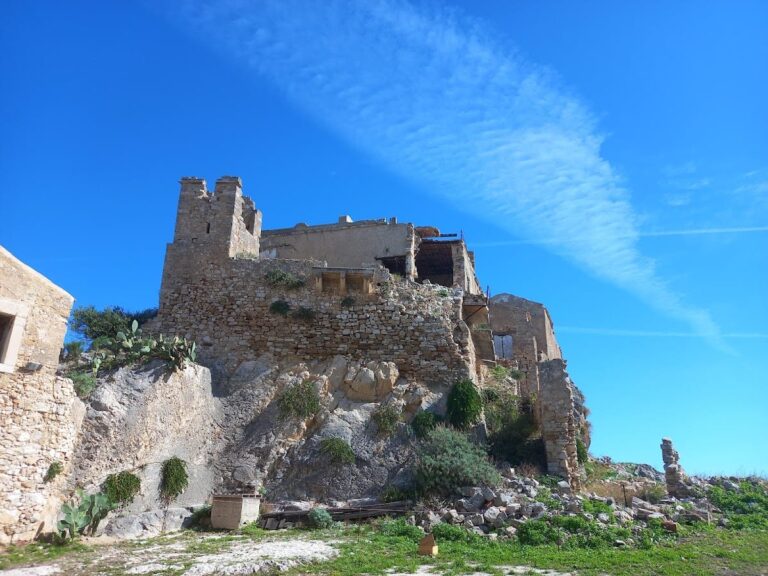
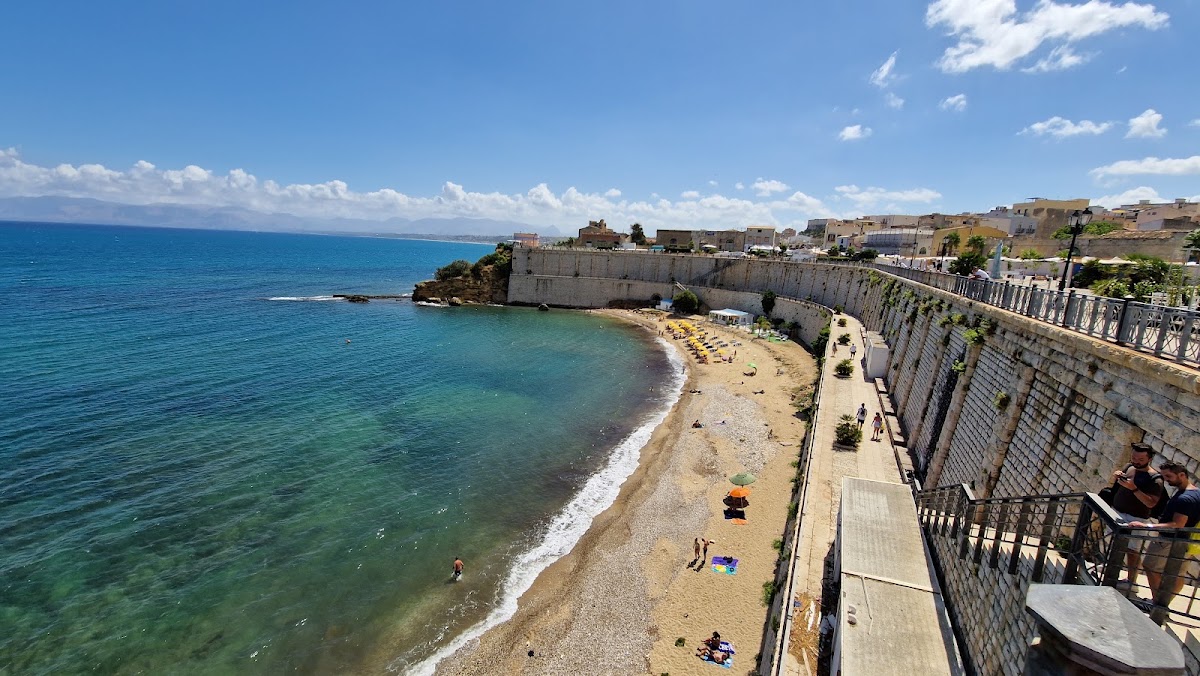
Castello Arabo Normanno is a medieval fortress in Italy, standing near the marina of Castellammare del Golfo, the former emporium, or major trading port, of Segesta. Generally attributed to the Arabs around the tenth century, it was built over earlier fortifications, although the date of the earliest foundation remains uncertain. Its history reflects the successive powers that controlled Sicily and its coastal strongholds.
Arab, Norman, and Swabian phases
The Arabs established the fortress around the tenth century, and the Normans later enlarged it. The Normans were northern European rulers who conquered and consolidated power across much of southern Italy and Sicily. Under the Swabians, the Hohenstaufen dynasty from Swabia that later ruled Sicily, the castle became a stronger fortified site, enclosed by walls and equipped with raised towers.
Aragonese and Angevin conflicts
The fortress was drawn into the repeated struggle between the Aragonese and Angevins. The Angevins, a French ruling dynasty established in southern Italy, captured it in 1314. The Aragonese, an Iberian dynasty contesting control of Sicily, recovered the castle two years later and destroyed part of its fortifications, including one tower. The structure was subsequently rebuilt.
Later ownership and changing use
After its reconstruction, the castle had two crenellated towers, the Tower of San Giorgio and the Bell Tower. A third tower, the Bastion, was added in 1537. Pietro II of Aragon assigned the castle to Raimondo di Peralta, after which it passed to his heirs Guglielmo and Nicolò. It later belonged to Pietro Spadafora Ruffo, who transferred it to Sigismondo di Luna as his daughter’s dowry. Pietro de Luna was lord of the castle in 1560, and after further changes of ownership it returned to the Luna family at the end of the sixteenth century. In 1649, Francesca Balsamo Aragona, Princess of Roccafiorita, purchased it.
During the nineteenth century, the castle was used as a prison. Its last private owner, the lawyer Giuseppe Cassarà, undertook excavations, uncovered underground spaces, and carried out restoration work. The property then passed to the state maritime estate and was granted to the municipality in concession in 1981. Restoration by the Superintendency followed between 1992 and 1997, and the castle returned to the municipality in 2011.
Modern recovery
Further recovery and adaptation work by the Sicilian Region in 2020 prepared the castle for a municipal museum complex. The site is owned by the Municipality of Castellammare del Golfo and is an Italian national heritage site.
Remains
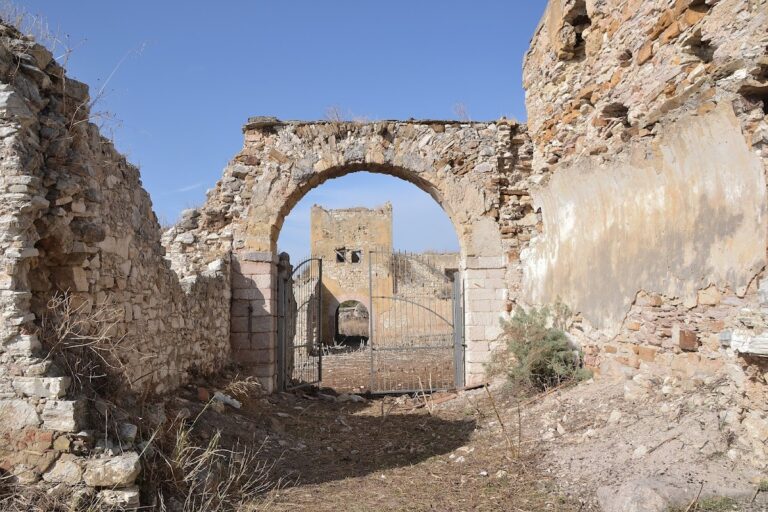
Castello Arabo Normanno occupies a rocky spur linked to the mainland by a drawbridge, a bridge that can be raised to restrict entry to a fortified enclosure. The medieval fortress has an Arab-Norman character and stands over the remains of ancient fortifications. Its defensive layout developed through successive additions, including towers, enclosing walls, gates, and changes to the approach from the mainland.
Towers, walls, and entrance
The rebuilt fortress included the crenellated Tower of San Giorgio and Bell Tower, while the Bastion was added in 1537. A second circuit of walls was completed in 1587 and incorporated three entrance gates. The original drawbridge was later replaced by the masonry bridge that remains visible today. Until the 1980s, seawater surrounded the castle. In front of the tower, a natural basin enclosed by rocks was known as the “Queen’s Pool.” Local legend connected the pool with the castle’s queen.
Museum complex
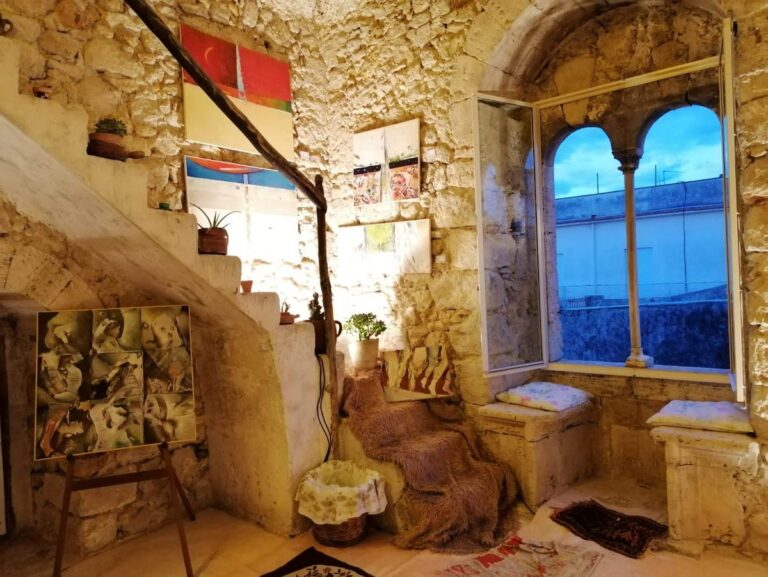
The restored and adapted interiors now form a museum route called “The Memory of the Mediterranean.” Its four sections are the Museum of Water and Mills, the Museum of Productive Activities, the Archaeological Museum, and the Museum of Maritime Activities. Together, these spaces occupy the historic fortress while presenting the themes associated with water, production, archaeology, and maritime activity.