Weissenau Castle: An Imperial Castle in Switzerland


Site at a Glance
- Rating
- 4.5
- Popularity
- Low
- Country
- Switzerland
- Primary era
- Medieval
- External website
- Open
- Eras represented
- Medieval
- Civilizations
- Holy Roman Empire
- Site type
- Military
- Remains
- Castle
On this page7 sections
History
Weissenau Castle is a 13th-century imperial castle in Switzerland, located at Unterseen and built during the medieval period of the Holy Roman Empire. Together with an associated harbor, it helped secure and control the movement of goods across the Alpine passes. The castle was first mentioned in 1298 as castrum Wissenowe, although its original builder and earliest ownership remain uncertain.
Origins and imperial connections
One possibility is that the lords of Rotenfluh and Unspunnen built the castle and granted it as a fief to the lords of Weissenau. Another is that the Weissenau family constructed it as the center of its estates. The site was also held by the barons of Wädenswil during the 13th century. In 1318, Leopold I of Austria, a Habsburg duke who ruled Austria in the late 13th and early 14th centuries, pledged the castle to the lords of Weissenburg.
The foundation of Unterseen in 1279 was connected with the castle’s economic decline. Around 1334, local nobles, including the lord of Weissenau, opposed the growing power of Bern. After their defeat, the lords of Weissenburg sold Weissenau Castle and the market settlement of Widen to Interlaken Monastery in order to settle their debts.
Widen and the loss of the market
Widen developed as a market town around the castle. A bridge connected the settlement with Weissenau in 1362, but three years later Interlaken Monastery transferred Widen’s weekly market and annual fair to Aarmühle, now Interlaken. The removal of these markets severely damaged Widen, which then declined.
Bernese administration and decline
Bern adopted the Protestant Reformation in 1528, a religious movement that challenged Roman Catholic authority and led to the formation of Protestant churches, and imposed the new faith in the Bernese Oberland. Interlaken Monastery and its villages resisted, but without success. The monastery was secularized in 1530, meaning its religious institution was dissolved and its lands were taken into secular administration. Bern annexed the monastery’s lands and placed Weissenau Castle and the reduced village of Widen under the Bernese bailiwick of Interlaken, an administrative district governed on behalf of a territorial authority.
During the 16th century, the castle was used as a prison. It later deteriorated and eventually collapsed. Repair plans were drawn up in 1655 and again in 1700, but neither was carried out. The ruins received formal monument protection in 1981 and were conserved in 1988 and 1989. They are protected as a Swiss heritage site of national significance.
Remains
Island setting and surviving structures
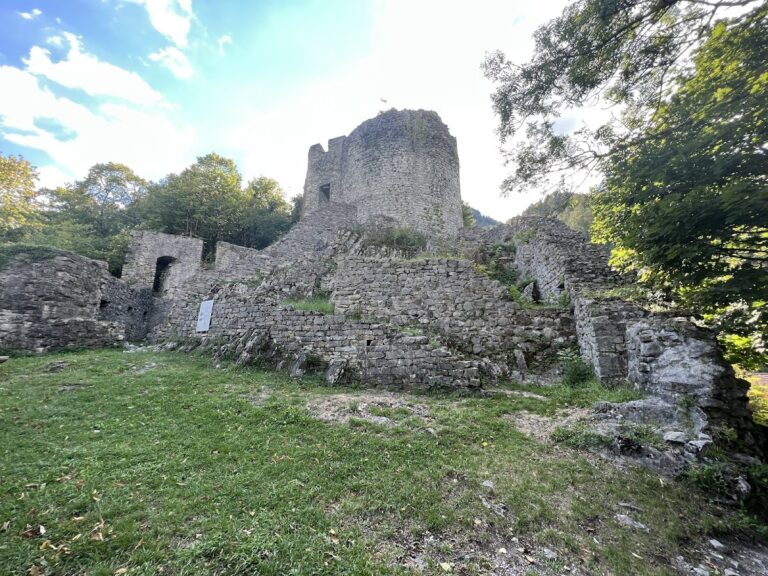
Weissenau Castle was built on a low-lying island at the mouth of the Aare River, where the river enters Lake Thun. Sediment later filled the waterway and joined the former island to the shore. The ruins now lie within the Neuhaus-Weissenau nature reserve. Surviving elements include the castle residence, a tower, parts of the other castle buildings, and sections of the curtain wall, the enclosing defensive wall that linked the fortified structures.
Viewing platform
The surviving tower ruin is used as a lookout tower. A staircase of 71 steps reaches a viewing platform 14.5 metres above the ground. From this platform, the Aare, Lake Thun, and the Niesen are visible.