Castle of Nalda: Medieval Fortress of the Iregua Valley


Site at a Glance
- Rating
- 4.2
- Popularity
- Low
- Country
- Spain
- Primary era
- Medieval
- External website
- Open
- Eras represented
- Medieval
- Civilizations
- Crown of Castile
- Site type
- Military
- Remains
- Castle
On this page6 sections
History
The Castle of Nalda is a medieval fortress in Nalda, La Rioja, Spain, whose earliest recorded mention dates to 1299. It formed part of the defensive system of the Iregua Valley and later became the center of power of the Lordship of Cameros.
Origins and Medieval Development
The fortress may have originated before its first written mention, when the strategic importance of the castles of Viguera and Clavijo was declining in the context of Muslim rule. During the fourteenth century, the castle became associated with the Ramírez de Arellano family and served as the political center of Cameros, a seigneurial territory governed by a noble lord rather than directly administered as a royal domain. Its lands extended from the northern part of the modern Province of Soria to the Ebro Valley.
Juan Núñez II de Lara was imprisoned at Nalda in 1299 after attacking lands belonging to the Bishopric of Calahorra and being defeated. In the following century, Juan Ramírez de Arellano enlarged the keep and established a new perimeter of walls, reinforcing the fortress’s role within the lordship.
Tradition and Later Use
A longstanding tradition states that the dagger used by Enrique II of Castile to kill his half-brother Pedro I after the Battle of Montiel in 1369 was kept at the castle for decades. The story connects Nalda with the dynastic conflict that ended with Pedro’s death and Enrique’s accession.
The castle began to decline from the middle of the sixteenth century. In 1652, Juan Domingo Ramírez de Arellano, Count of Aguilar, took up residence there, after which the fortress was used for administrative purposes. Its institutional role ended after the lordships were abolished at the beginning of the nineteenth century. The site then became a quarry, while the removal of building materials and the accumulation of rubble gradually buried the former fortress.
Damage and Archaeological Recovery
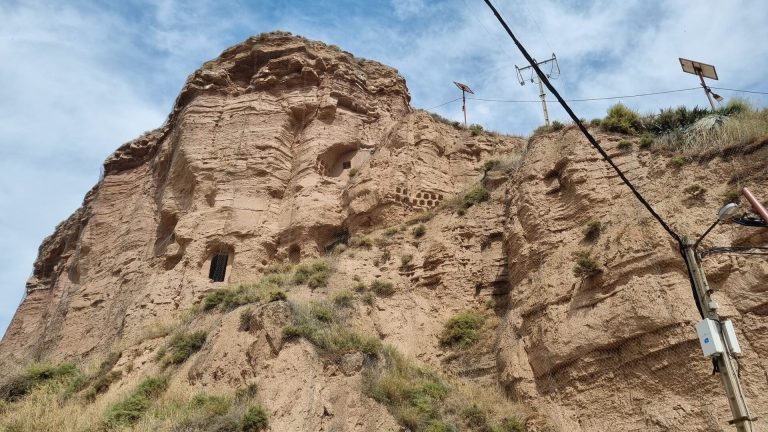
The castle suffered extensive damage during the Peninsular War. The four culverins, relatively long-barreled cannons, that remained there were taken to Logroño to help defend the city against the French. Later, the hill was converted into a threshing floor, and small family wine cellars were excavated into it.
In 2012, the Town Hall of Nalda and Islallana proposed adapting the hill as a viewpoint. The place-name and the few visible structural remains prompted archaeological intervention, which revealed further parts of the fortress and began a continuing program of excavation, study, and rehabilitation. The Castle of Nalda has been protected as a Property of Cultural Interest since its designation as a monument on 5 May 1949.
Remains
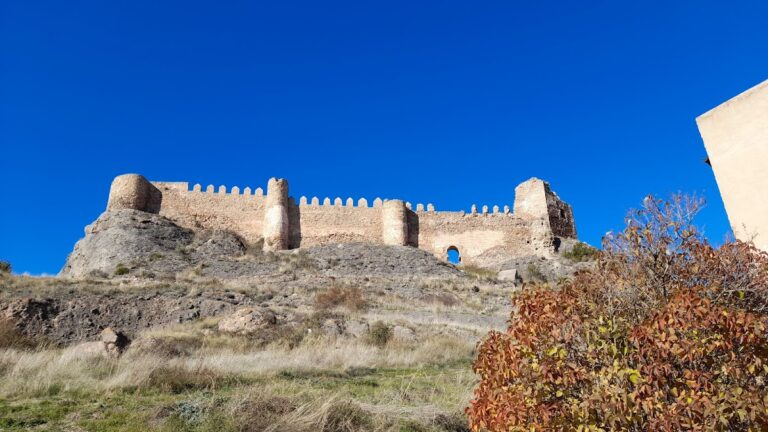
The Castle of Nalda occupies a hilltop and survives as consolidated ruins. Its medieval layout included a keep and a surrounding defensive wall. Structures dating from the twelfth century form part of the surviving archaeological evidence, while the keep was enlarged and the perimeter of walls was established during the fourteenth century.
Hilltop Fortress
Quarrying removed parts of the former fortress and left the remaining structures progressively covered by rubble. Archaeological work begun after 2012 uncovered additional structural remains beneath this material, allowing the hilltop’s former organization to be examined and supporting the rehabilitation of the ruins. The later wine cellars cut into the hill belong to a post-fortress phase, when the site had already been converted to other uses.