Castell de Pratdip: A Medieval Castle in Catalonia


Site at a Glance
- Rating
- 4.3
- Popularity
- Low
- Country
- Spain
- Primary era
- Medieval
- External website
- Open
- Eras represented
- Medieval
- Civilizations
- Crown of Aragon
- Site type
- Military
- Remains
- Castle
On this page7 sections
History
Castell de Pratdip is the fragmentary remains of a medieval castle in Spain, built as part of the fortified settlement of Pratdip. The settlement was organized around its parish church and enclosed by gates, while the castle probably played an important role in its defense and organization.
Medieval settlement
Pratdip emerged during the medieval re-establishment of Christian rule in territories previously governed by Muslim powers. The settlement is documented from the mid-twelfth century, when its parish church appeared in a formal document issued by Pope Anastasius IV in 1154. The castle and village themselves remain sparsely documented, although the castle formed part of this fortified community.
The Barony of Entença
Pratdip belonged to the Barony of Entença, a feudal territorial lordship in medieval Catalonia. The Castellvell family initially held the barony, which passed to the Entença family in 1244 and retained their name. In 1324, Jaume II, a medieval king of the Crown of Aragon, acquired the barony and incorporated it into the recently created County of Prades, a later noble county to which the barony was attached.
Later noble ownership
During the fifteenth century, the County of Prades and the Barony of Entença became possessions of the ducal House of Cardona. Through succession, they passed in 1663 to the Dukes of Medinaceli, who were the last lords of Castell de Pratdip and the village. After seigneurial jurisdictions were abolished, Pratdip remained the property of the Duke of Cardona and the Duke of Medinaceli.
Castell de Pratdip is protected as a historic monument in Catalonia and is recorded in Spain as a Cultural Asset of National Interest under reference RI-51-0006687.
Remains
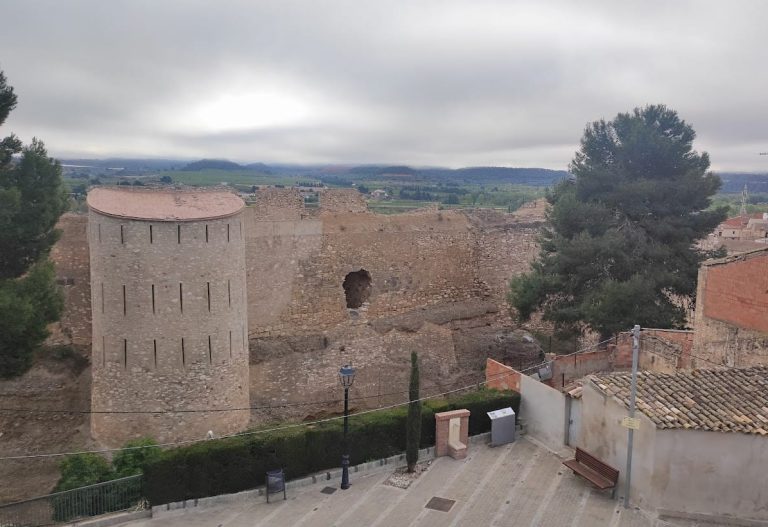
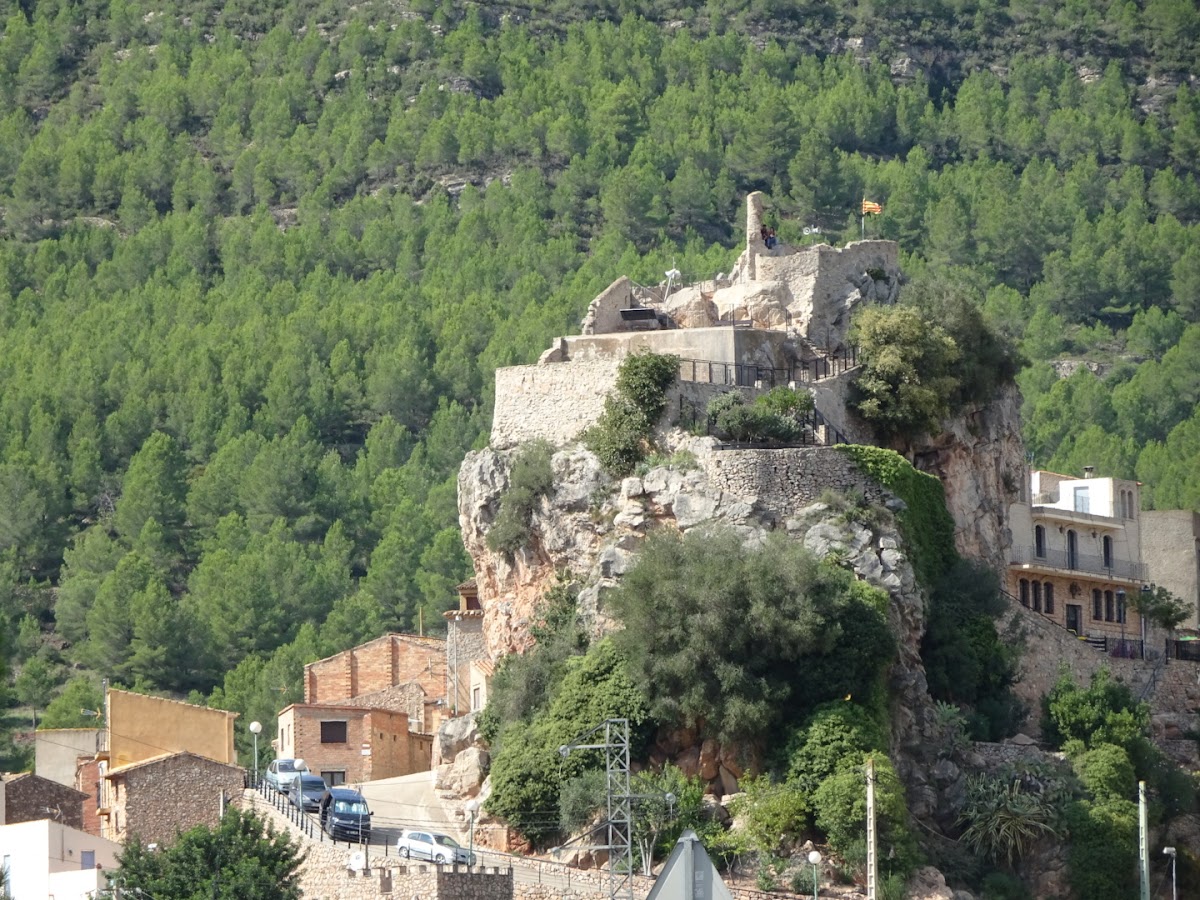
The remains occupy the summit of a rocky hill at the southern end of Pratdip, approximately 248 metres above sea level. The castle formed part of the fortified settlement, with its position on the rock incorporating the cliff edge and rocky enclosure into the site’s defensive setting. Fragmentary masonry survives around the perimeter, together with later walls on the summit that delimit the remaining area.
Gateway and approach
A ramp from the upper part of the village reaches a large Gothic vault that served as the castle gateway. This vaulted entrance connected the settlement below with the fortified summit and remains one of the clearest surviving architectural features of the site.
Rocky summit walls
The castle’s surviving walls are roofless and incomplete. Several stretches follow the edge of the cliff or rocky enclosure, while a few later-built walls define the space on the hilltop. The present silhouette is therefore formed largely by roofless masonry crowning the rock.