Andraz Castle: A Medieval Border Fortress in Italy


Site at a Glance
- Rating
- 4.4
- Popularity
- Low
- Country
- Italy
- Primary era
- Medieval
- External website
- Open
- Eras represented
- Medieval, Early Modern
- Civilizations
- Holy Roman Empire
- Site type
- Military
- Remains
- Castle
On this page11 sections
History
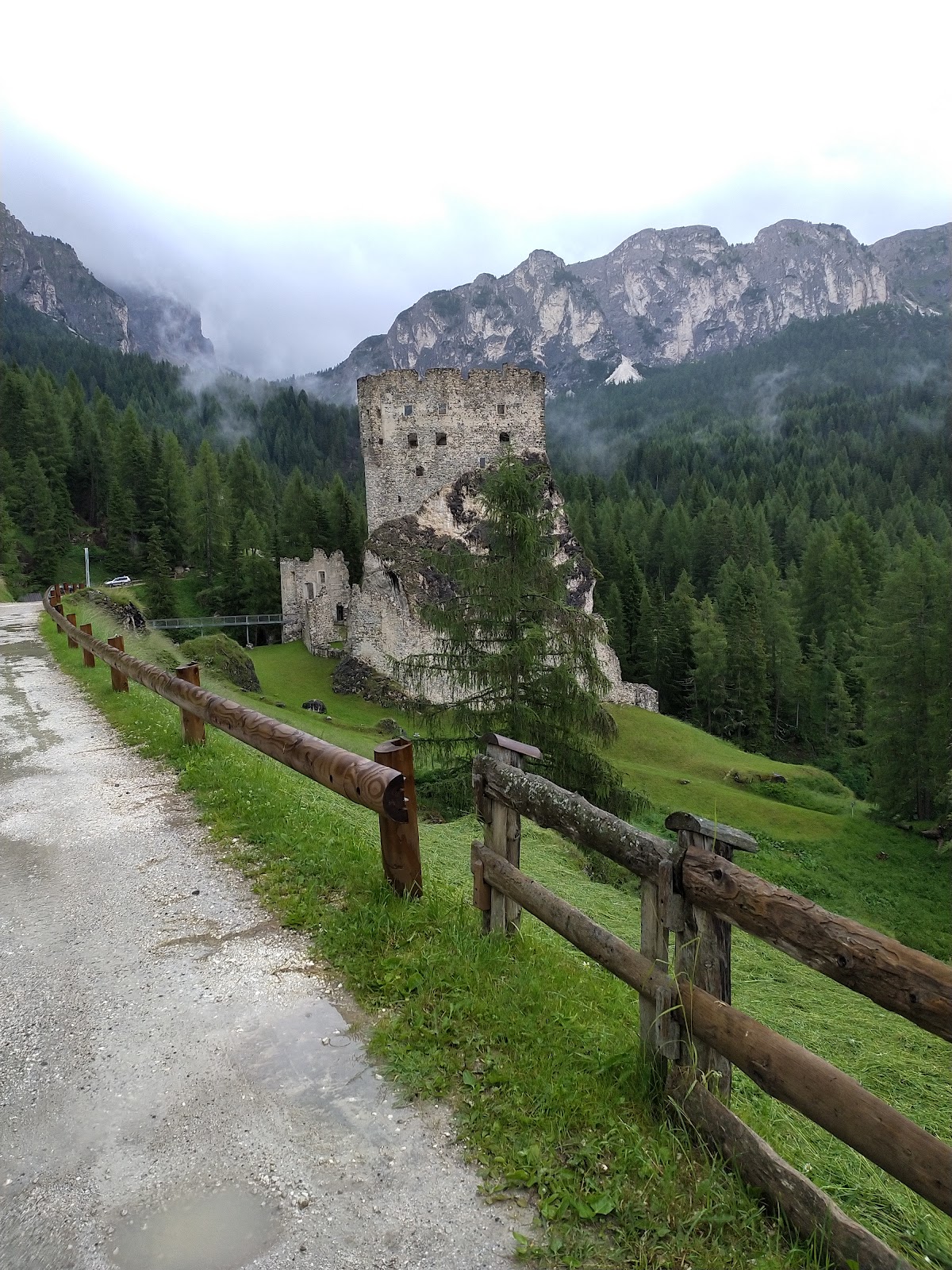
Andraz Castle is a medieval fortified site in Italy, near Livinallongo del Col di Lana in the Dolomites south of Falzarego Pass. Built on a rocky spur at the boundary between the Patriarchate of Aquileia, a medieval ecclesiastical principality with religious and secular authority, and the Diocese of Brixen, it controlled routes toward Belluno and Agordo, Brixen and Val Badia, and Ampezzo. Alongside fortifications at Rocca Pietore, Selva di Cadore, and Avoscan, it formed part of a defensive system linking the Agordino and Val Pusteria regions.
Origins and feudal control
The castle’s foundation date remains uncertain. A document from around the year 1000 refers to the site, while more precise evidence dates from 1221. Construction has also been placed around 1027, and the castle may have existed at least a century before the document from around 1000. Its earliest purpose was connected with securing the Iron Road, the transport route that carried ore from nearby Dolomite mines to furnaces and through the Alpine region.
By the early thirteenth century, Andraz was held by the Schöneck family as feudal dependants of the bishops of Brixen. In the fourteenth century, ownership passed to the Avoscano family and later to the Stuck family. Around 1350, Bishop of Brixen forces commanded by Enrico Beringer besieged the castle during a dispute with Guadagnino Avoscano, whose territorial expansion had reached toward Mareo and the jurisdiction of Castel Badia. Guadagnino abandoned the castle after the siege, which ended without bloodshed, and it passed to the Stuck family.
Further disputes involving the abbess of Castel Badia led the bishop to remove the Stuck family’s feudal authority. The fief was assigned instead to a paid captain, an appointed military and administrative officer who acted for his lord and lacked independent decision-making power. Forty-five captains served at Andraz between 1416 and 1803. Brixen took the castle into direct administration in 1426, and it was rebuilt in 1432 under a castle captain.
Ecclesiastical refuge and strategic importance
Andraz became more important militarily during the sixteenth century, when the bishops of Brixen were concerned about the Republic of Venice expanding toward the interior. Its position also gave it access to nearby timber and mineral resources, especially iron. The castle remained tied to regional iron production and trade for centuries. Ore from mines in the Fursil area near Col Santa Lucia and around Monte Pore travelled along the Iron Road to furnaces including those at San Martino in Badia, before circulating through Tyrol.
In the mid-fifteenth century, Nicolaus of Cusa, also known as Cardinal Cusanus, used Andraz as a secure refuge and stayed there for extended periods between 1454 and 1460. The German philosopher, theologian, church reformer, and cardinal came to the castle during disputes involving the church of Brixen and the Sonnenburg convent. A later tradition concerns Cristoforo Brach, known as Gran Bracun, who served as a castle captain. According to the story, hunters blocked a rope bridge to ambush him, but Brach urged his horse across a ravine near the Travenanzes Valley. The horse landed on its forelegs, and both survived, leaving the episode between history and legend.
Decline and modern history
Iron mining in the Buchenstein lordship ended in 1755. The exhaustion of mineral resources, changing political conditions, and conflicts involving Brixen, Castel Badia, and Venice reduced the castle’s importance. After the French Revolution and the secularization of ecclesiastical territories, meaning their transfer into secular political control, the office of castle captain was abolished. Johann Lindner of Brixen, the last captain, remained at Andraz until 1803.
Buchenstein passed to Austria in 1803, to the Kingdom of Italy in 1810, and back to Austria through its incorporation into Tyrol in 1813. The territory later became part of the Province of Belluno. Andrea Faber purchased the castle in 1808. In 1851, local people removed its roof for charcoal production, accelerating its deterioration. During the First World War, the ruin provided lodging for Italian soldiers, while a small cemetery in the meadows below it received Italian military dead.
The chapel altar was transferred to the church at Andraz. Conservation of the castle remains began under regional heritage authorities in the early 1980s and was followed by a major restoration of the surviving fabric. Andraz is now a historical ruin and is recognized as the highest castle in Italy.
Remains
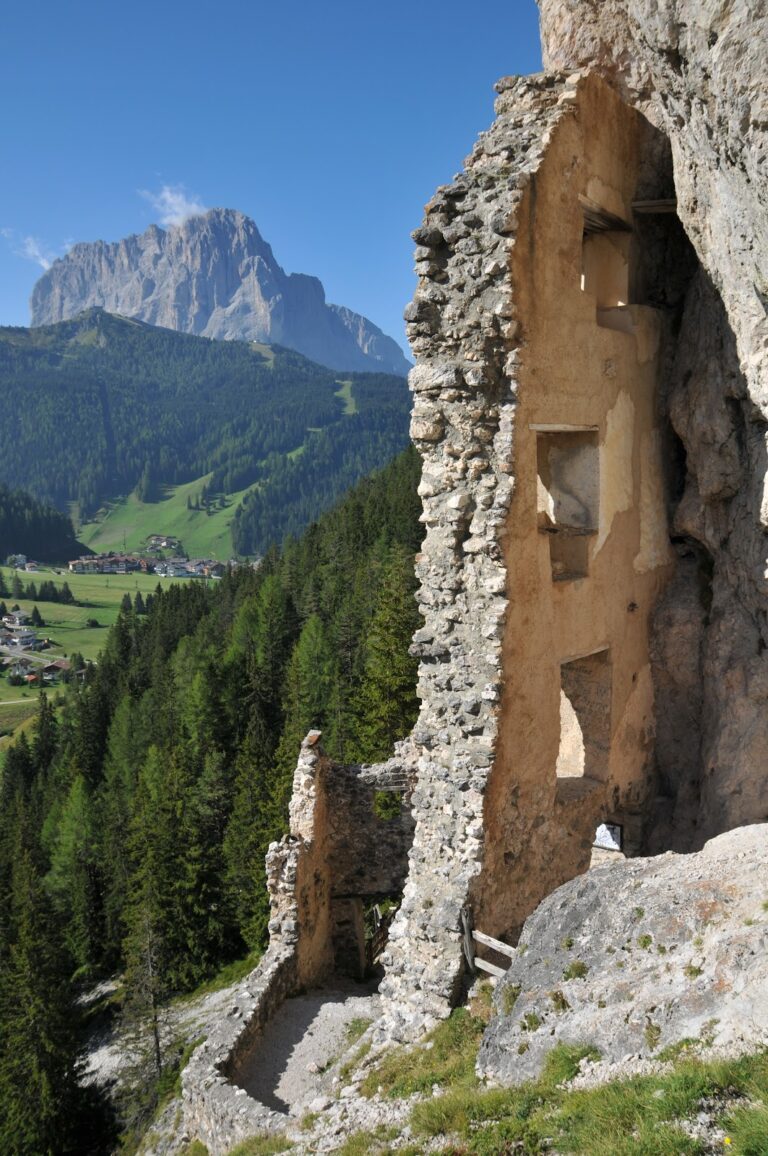
Andraz Castle occupies a steep rocky spur above 1,700 metres, commonly placed at approximately 1,730 metres. The rock mass may have fallen from Sas de Stria in remote geological times. The restricted summit shaped the castle’s unusual form: its rooms and defensive elements were arranged on several superimposed levels rather than across a broad, level enclosure. A stone ramp connected the different floors, and part of this ramp has been restored. Because of the steep rock, supplies were lifted to the castle by winch.
Defensive enclosure and access
Perimeter wall
A perimeter wall enclosed the rocky spur and helped protect the castle’s occupants. It also created space for stables within the defended area. Corbels remain visible in the masonry where a projecting gallery once rested. This gallery provided a patrol position along the walls and formed part of the castle’s defensive arrangement.
Stone ramp and internal levels
The stone ramp is an important surviving response to the summit’s limited space. By linking the superimposed floors, it organized movement through the vertically arranged building. Its partial restoration makes the relationship between the different levels more legible while preserving the castle’s distinctive adaptation to the rock.
Chapel and later building phases
Chapel of Saint Raphael
A chapel dedicated to Saint Raphael stood near the main entrance. Its wooden altar was regarded as valuable and was later moved to the church at Andraz, where it is preserved. The chapel’s position by the entrance associated religious space with the castle’s principal approach.
Fire damage and restoration
The castle is preserved in a ruined condition, with its surviving fabric reflecting repeated changes and repairs. The most substantial documented intervention followed a fire between 1484 and 1488, when residential and administrative functions were strengthened as military uses became less important. Further work followed another fire in 1516, and additional intervention took place in 1599. Modern restoration focused on recovering and conserving the ruined structure and its setting.