Castello di Meleto: A Medieval Fortress and Villa in Chianti


Site at a Glance
- Rating
- 4.5
- Popularity
- Medium
- Country
- Italy
- Primary era
- Medieval
- External website
- Open
- Eras represented
- Medieval, Early Modern
- Civilizations
- Grand Duchy of Tuscany, Republic of Florence
- Site type
- Military
- Remains
- Castle
On this page11 sections
History
Castello di Meleto is a medieval castle in Italy near Gaiole in Chianti, with construction attributed to a branch of the Ricasoli family in 1256. Set in the historic borderland between Florence and Siena, it became a major Florentine stronghold and later one of the principal fortifications of the Gaiole district within the Chianti League, a medieval territorial and military organization linked to Florence’s administration and defense of Chianti.
Early Lords and Ricasoli Ownership
The earliest records of Meleto date to the eleventh century, when the nearby Badia di Coltibuono, a historic abbey in the Chianti region, held the site. It later passed to a local feudal family represented by Guardellotto. After conflicts with Emperor Frederick I Barbarossa, a twelfth-century Holy Roman Emperor whose authority extended across northern and central Italian territories, Guardellotto lost his holdings. The castle then came to the Firidolfi family, whose branch at Meleto became known as the Firidolfi da Meleto.
In the mid-thirteenth century, a branch of the Ricasoli, a prominent Tuscan noble family with longstanding ties to Chianti, is credited with constructing the castle. The Ricasoli subsequently owned and gradually improved Meleto for approximately eight centuries, maintaining its place within the political and military landscape of the region.
Frontier Stronghold and Villa
Meleto’s position near the Florentine and Sienese boundary made it a contested prize, although it never suffered major destruction. During the second Aragonese invasion of Chianti in 1478, Aragonese troops allied with Siena occupied the castle. Florentine forces recaptured it in 1480, after which major works strengthened its most exposed southern side.
Imperial troops besieged Meleto in 1529, but the attack failed and the castle did not fall. When the military threat had receded, the property was transformed into a villa during the eighteenth century. Ricasoli ownership continued until the late twentieth century. The estate is now associated with a wine and agricultural enterprise producing Chianti Classico, the regulated wine area in the historic central part of Chianti, and it also operates as a wine and tourism business. Castello di Meleto holds Italian national heritage status.
Remains
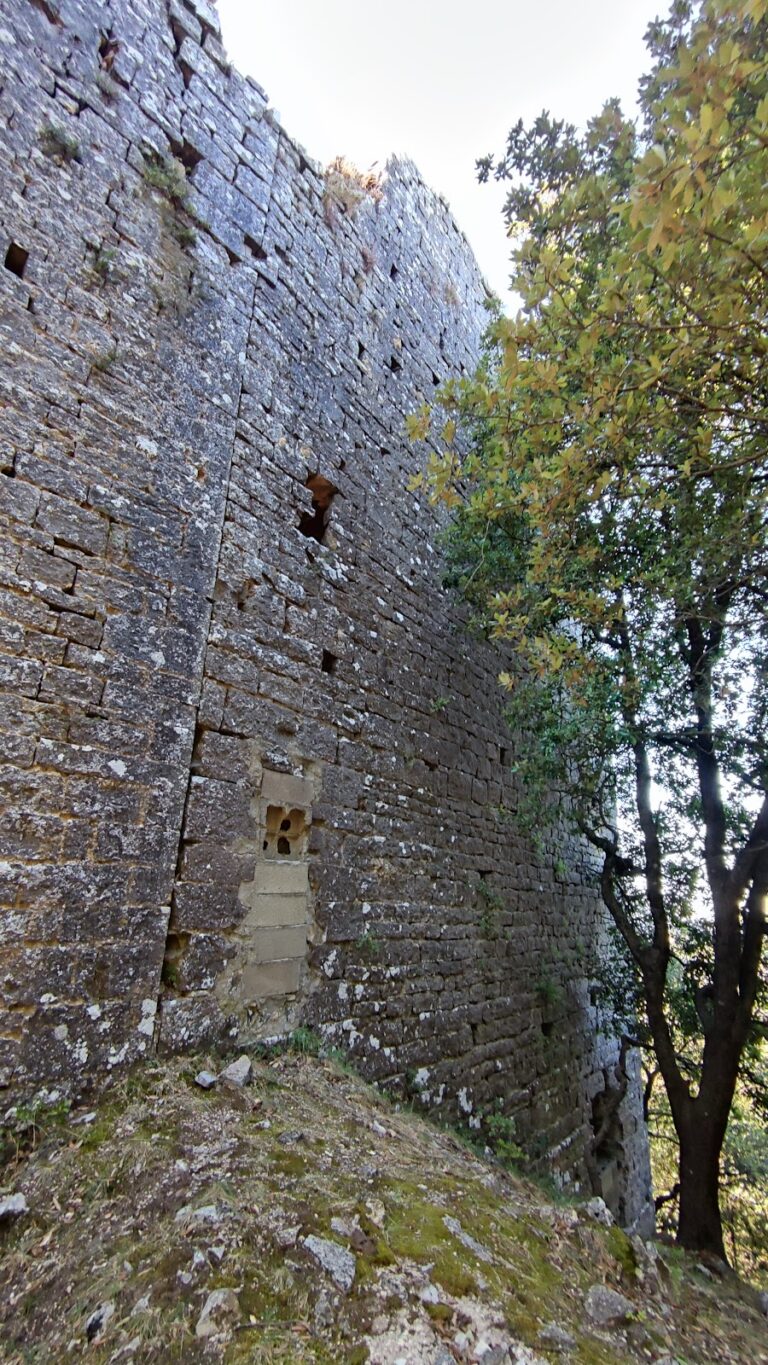
Castello di Meleto stands on a hill near Gaiole in Chianti and retains a distinctly military character. Its quadrilateral, or square, plan is organized around an older central keep, the principal fortified tower and strongest defensive and residential element. Stone forms the façade, while later defensive additions occupy the positions most exposed during a siege.
Fortifications
Central Keep
The oldest part of the castle is the central keep tower, which occupies the middle of the quadrilateral plan. As the principal fortified element, it anchors the surviving defensive layout and preserves the castle’s connection with its medieval military function.
Southern Bastioned Towers
After the Florentine recapture of 1480, major works added two powerful cylindrical bastioned towers at the southern margins. Bastioned towers are fortified projections designed to strengthen walls or corners against attack, especially from artillery and siege forces. Their placement addressed the positions most exposed during a siege.
Northern Galleries
The northern corners retain brick galleries or balconies supported by projecting corbels. Corbels are projecting blocks that carry an overhanging structure such as a balcony or gallery. These features remain part of the castle’s fortified exterior.
Villa Interiors and Theater
Furnished and Frescoed Rooms
The interiors contain numerous furnished and frescoed rooms decorated according to eighteenth-century taste. Their Baroque character reflects the transformation of the former military stronghold into a villa after the castle’s defensive importance had declined.
Ricasoli Theater
A small theater occupies a room reached from the inner courtyard. It retains its stage and seven original eighteenth-century stage sets. The Ricasoli used the theater for concerts and operettas, adding a performative and domestic function to the castle’s later life as a residence.