Château de Roquefixade: A Medieval Fortress in France


Site at a Glance
- Rating
- 4.5
- Popularity
- Low
- Country
- France
- Primary era
- Medieval
- External website
- Open
- Eras represented
- Medieval, Early Modern
- Civilizations
- French
- Site type
- Military
- Remains
- Castle
On this page10 sections
History
Château de Roquefixade is a ruined medieval fortress in France, first documented in 1034. It began as a seigneurial residence, the home of a feudal lord, and later became a refuge for the Albigensians during the thirteenth-century Albigensian Crusade, a military campaign against religious dissenters and their supporters in southern France.
Early lords and the Albigensian Crusade
The earliest known lords of Roquefixade were the lords of Pailhès. In 1205, the castle hosted the marriage of Raimon de Péreilhe and Corba de Lanta. Raimon also held the castles of Péreilhe and Montségur, linking Roquefixade to the network of lordships involved in the politics of medieval Ariège.
Roquefixade is often described as a Cathar castle, but the ruins visible today belong to later building phases. During the Albigensian Crusade, however, the site served as a refuge and place of resistance for the Albigensians. In 1212, Simon de Montfort, the French nobleman and commander who led the crusade, captured the castle after burning the village. At that time, Roquefixade belonged to the counts of Toulouse.
Royal frontier fortress
In 1272, following the surrender of Roger-Bernard III, count of Foix, King Philip III seized Roquefixade. The French crown maintained and rearranged its fortifications, then established a royal garrison there from 1278. It comprised a castellan, the official responsible for administering and defending a castle, a watchman, a gatekeeper, twelve sergeants, and guard dogs.
The fortress helped monitor the frontier with the Kingdom of Aragon, a major medieval Iberian power whose territories bordered those of the French crown in the Pyrenean region. By the end of the thirteenth century, Roquefixade formed part of a royal line of fortifications guarding the territory of the count of Foix.
Return to the counts of Foix and destruction
In 1463, Louis XI returned the castle to Gaston IV, count of Foix. Further alterations followed during the fifteenth and sixteenth centuries. The fortress was destroyed by order of Louis XIII in 1632, during the suppression of the Languedoc revolt. That revolt ended with the defeat and imprisonment of Henri II de Montmorency at Castelnaudary. Roquefixade was then considered purposeless and too costly to maintain.
In 1675, Vital Guilhon de Lestang, baron of Celles, purchased the castle. His family retained it until the French Revolution, when it was sold as national property. The ruins have been protected as a French historic monument since 1995.
Remains
Rocky setting and enclosures
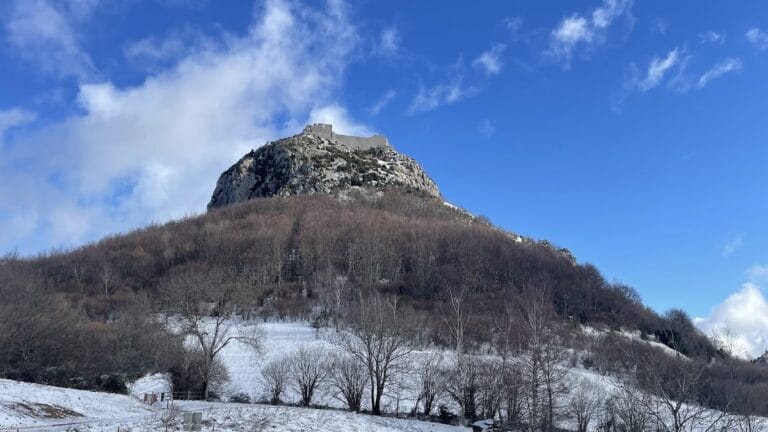
Château de Roquefixade occupies a limestone spur about 400 metres northwest of Roquefixade, at an altitude of approximately 850 metres. The fortress is integrated into the rock and was built across a natural cleft. The name derives from the Occitan roca fissada, meaning “split rock,” in reference to this fissure and the vault crossing it on the northern side.
Natural cleft and northern vault
The natural cleft forms a defining part of the fortress. On its northern side, a vault or arch spans the opening, while the surrounding walls support and enclose the stronghold. The structure is now ruined, but its position across the rock explains the unusual form of the surviving remains.
Enclosures and entrances
The fortress had two enclosures. The second led toward the centre through a narrow passage and a postern, a small secondary entrance through a fortification. Access to the courtyard was controlled by a châtelet, a fortified entrance structure.
Keep and upper fortifications
Keep enclosure
The keep, the principal fortified tower and stronghold of a medieval castle, stood at the highest point. Walls enclosed it, and its enclosure crossed the natural fissure by means of an overhanging arch. The keep was remodelled in the fourteenth century.
The ruined fortress forms part of a wider rocky landscape that includes the Roc de la Lauzade and Roc Marot. Behind the castle are the peaks of Soularac and Saint-Barthélemy and the Tabe massif.