Burg Tittmoning: A Salzburg Border Fortress in Germany


Site at a Glance
- Rating
- 4.6
- Popularity
- Low
- Country
- Germany
- Primary era
- Medieval
- External website
- Open
- Eras represented
- Medieval, Early Modern
- Civilizations
- Holy Roman Empire
- Site type
- Military
- Remains
- Castle
On this page11 sections
History
Burg Tittmoning is a hilltop castle in Tittmoning, Germany, probably built by the local Lords of Titmoningen during the twelfth or thirteenth century. The date and attribution remain uncertain. The castle became a Salzburg border fortification against Bavaria and later developed through repeated military, administrative, residential, and religious changes.
Salzburg border fortress
The castle first enters the historical record when Archbishop Eberhard II of Salzburg acquired it for the defence of the border with Bavaria. Salzburg’s archbishops were not only senior churchmen but also territorial rulers, and they initially assigned the castle’s custody for short periods. Recorded castellans and officials included Friedrich von Törring in 1273, Ulrich von Wispeck in 1282, Heinrich von Nopping in 1299, Wulfing von Goldegg in 1306, Otto von Goldegg in 1307, Kuno von Teising in 1312, and Konrad von Oberndorf in 1320. By then, the office was already known as that of a district administrator, combining local administrative, judicial, and often military duties.
The castle became involved in the rivalry between Bavaria and Salzburg. Konrad von Oberndorf fought on the Habsburg-Salzburg side at the Battle of Mühldorf and remained a prisoner of the Count of Hals until 1323. Wulfing von Goldegg held fiefs from both the Bavarian duke and the Salzburg archbishop. In 1324, he supported Emperor Louis the Bavarian and opened Tittmoning’s town and castle to him. Bavarian troops then destroyed the castle and plundered the town. In 1327, both were sold back to the Archbishopric of Salzburg.
The fortifications were reinforced in 1338. Tittmoning also served repeatedly as the Salzburg delegation’s meeting place for negotiations with Bavarian representatives at Wechselberg. Later district administrators included Hans von Traun in 1369, Hadmar von Laber from 1383 to 1387, and Jörg von Frauenberg in 1490.
Late Gothic expansion and administrative change
During the second half of the fifteenth century, the castle was enlarged into a late Gothic fortress. The retired Archbishop Bernhard von Rohr lived there from 1484. Tittmoning was pledged to Bavaria for four years in 1525, and the district administrator Adam von Thurn received payment for major rebuilding in 1540. A granary may have been built in 1553 under Administrator Ernst, Duke of Bavaria.
Sigmund von Lamberg received the fortress in 1561 on the condition that he hold it personally. He resigned in 1590 and transferred the administration to a deputy. In 1591, Jakob Hannibal von Raitenau became district administrator, but because he held other offices, he was required to visit Tittmoning only twice each year. A deputy handled routine administration and also served as local and town judge. From this period, the district administrator no longer lived in the castle, while the district court and archive moved to the town courthouse.
Hunting lodge, destruction, and later uses
In 1611, during the Salt War, an early-seventeenth-century conflict between Bavaria and the Salzburg archbishopric, Bavarian troops damaged the castle. Its commander, Schneeweiß of Arlezstain, had to surrender it to Duke Maximilian I. Tittmoning was sold back to the Archbishopric of Salzburg in 1614.
Between 1614 and 1621, Archbishop Markus Sittikus commissioned the court architect Santino Solari to transform the castle into a hunting lodge. During the Thirty Years’ War, the major European conflict of 1618 to 1648, part of Salzburg’s territorial levy was stationed there. The court chamber maintained the lodge until 1686, after which the local estates took on half of its costs. The chapel of St. Michael received a Baroque remodeling between 1690 and 1694.
The last castle commander, Baron von Schaffmann, departed in 1790, and the castle then remained unoccupied. It burned in 1805 during the French occupation, and the keep, the principal fortified tower, was among the structures destroyed. After 1816, the Bavarian state owned the castle. Tittmoning purchased it in 1852 as the buildings began to deteriorate. A museum operated by the Historical Association moved into the castle in 1911. In 1940, the site became a prisoner camp for officers; after the Second World War, it served as a transit camp for refugees and expellees. The museum reopened in 1953, when restoration work also began.
Burg Tittmoning is now a protected architectural monument of Tittmoning and an archaeological monument that includes underground medieval and early-modern remains, traces of predecessor structures, and graves from the earlier or High Middle Ages. Its exhibition rooms house the Rupertiwinkel Museum, formerly known as the Heimathaus of the Rupertiwinkel.
Remains
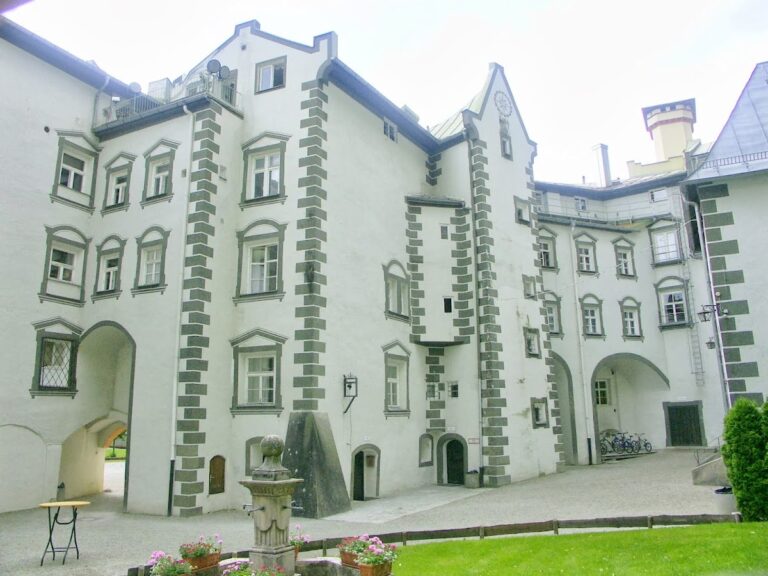
The castle stands about 388 metres above sea level on a projecting hill or rocky cone south of Tittmoning’s old town. Its position combines a hilltop and spur-top setting with a direct relationship to the town. The surviving appearance is shaped mainly by the fifteenth- and sixteenth-century alterations, while two cross-vaulted ground-floor rooms in the Cavalier House and the well in front of the Kitchen House belong to the castle’s foundation period.
Walls and residential buildings
Granary and ring wall
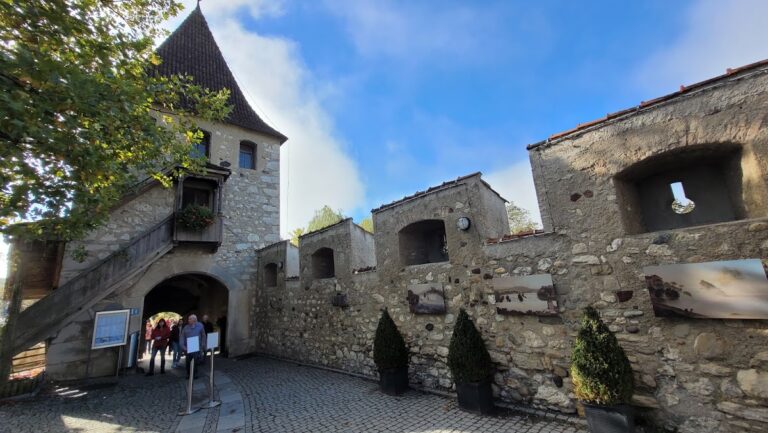
The most prominent building is the three-storey granary built against the inner side of the southern ring wall. A ring wall is the enclosing defensive wall of a castle. The granary has a massive hipped roof and forms part of the surviving group of buildings arranged within the fortified enclosure. The documented castle components also include a separate section of wall.
Residential buildings
Several residential buildings survive as the structures identified as Burg 2, Burg 3, Burg 4, Burg 5, Burg 6, Burg 7, and Burg 9. The ring wall is associated with Burg 3, Burg 4, and Burg 6, while the separate wall section is associated with Burg 9. These buildings, together with the Cavalier House and Kitchen House, preserve elements from the castle’s medieval foundation and later rebuilding phases.
Chapel and museum collections
Chapel of St. Michael
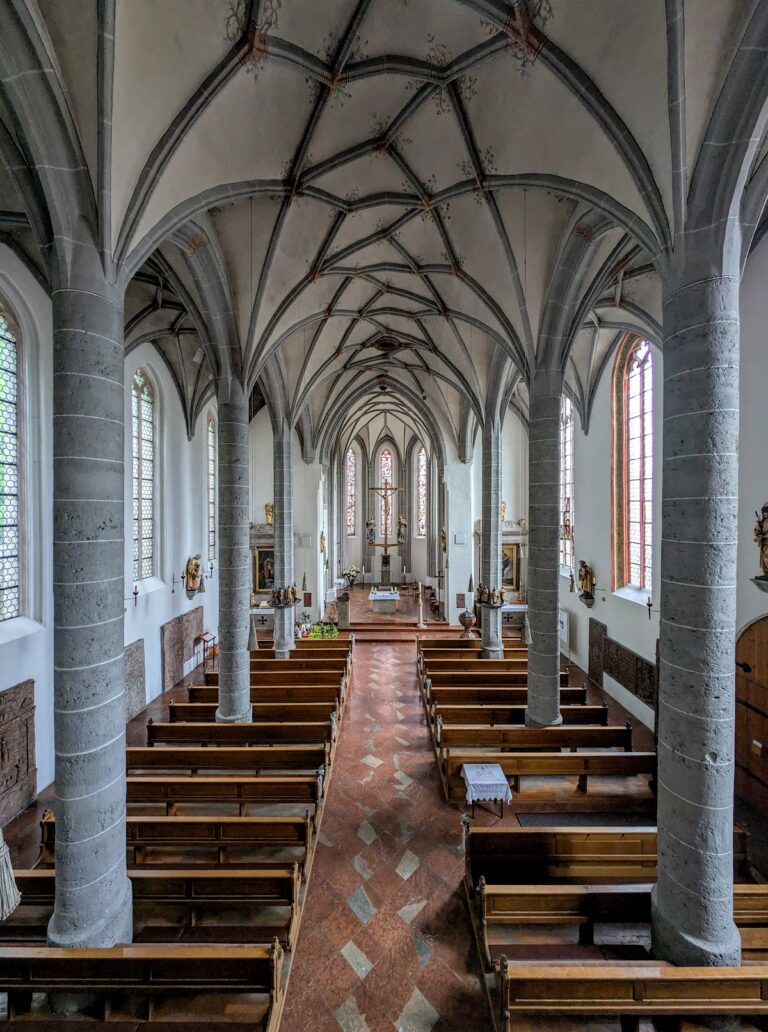
The present castle chapel of St. Michael was remodeled in the Baroque style between 1690 and 1694. It forms part of the documented architectural group within the castle and preserves the religious function associated with the later hunting-lodge period.
Rupertiwinkel Museum
The Rupertiwinkel Museum displays the castle’s collection of shooting targets dating from 1600 to 1930, described as Bavaria’s largest group of such targets. The castle also contains works by the Tittmoning artist Johann Baptist Cetto. These collections form part of the site’s present museum use.
Nearby sites