Auxonne Castle: A Fifteenth-Century Frontier Fortress in France


Site at a Glance
- Rating
- 4.1
- Popularity
- Low
- Country
- France
- Primary era
- Medieval
- Eras represented
- Medieval, Early Modern
- Civilizations
- Duchy of Burgundy, French
- Site type
- Military
- Remains
- Castle
On this page12 sections
History
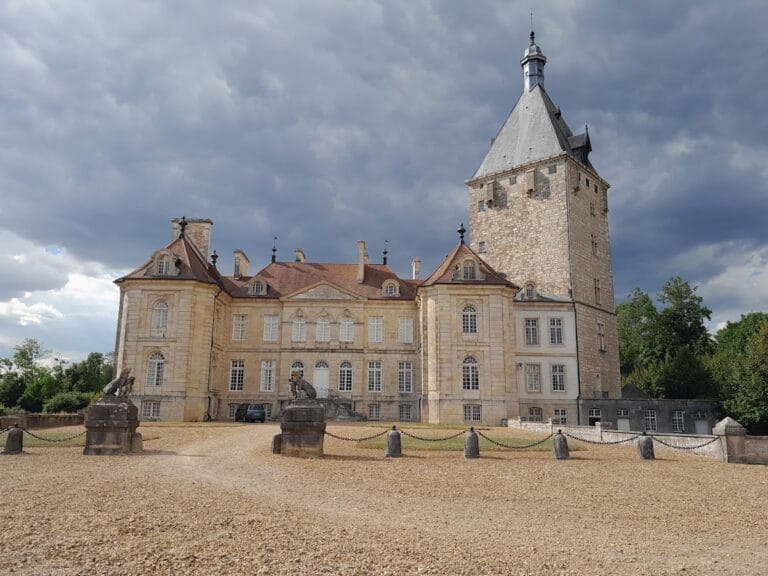
Auxonne Castle is a former fifteenth-century fortified castle in Auxonne, France, built during the late medieval strengthening of the town’s defenses. It stood in the historical County of Auxonne, within the Duchy of Burgundy, and controlled a crossing of the Saône between Dole and Dijon.
The County of Auxonne
From the thirteenth century, Auxonne served as the capital of the County of Auxonne within the Duchy of Burgundy. During the second half of that century, six powerful isolated towers were erected around the town. These defensive structures were later incorporated into the fifteenth-century fortifications.
In 1412, an earlier castle known as the Mound of the Old Mint was destroyed to make way for a convent of the Poor Clares. The convent occupied the site of the present hospital, marking a change in the use of this earlier fortified location.
Construction under Louis XI
After Charles the Bold, duke of Burgundy, died in 1477, Louis XI of France pursued the reconquest of Burgundian territories. This succession crisis enabled the French king to move against the duchy and its strategic towns. He ordered new castles at Dijon, Beaune, and Auxonne to monitor the Burgundians of the duchy and the frontier with the Holy Roman Empire.
Construction at Auxonne began in 1479 under Louis XI, with the military architect and engineer Vauzy de Saint-Martin directing the work. Most of the building was complete by 1493. The Treaty of Senlis, concluded that year, made Auxonne a frontier town between the Kingdom of France and the Holy Roman Empire.
Later military development
The fortifications were strengthened under Louis XII and Francis I, successive kings of France. Barracks and a Governor’s residence were added during the sixteenth century. In the seventeenth century, Louis XIV commissioned the military engineer Vauban to develop Auxonne as a fortified stronghold within the defensive system known as the “iron belt,” a network of fortified places intended to protect France.
The site also acquired a modern historical role. From 1970 to 2012, the Notre-Dame Tower housed a Bonaparte Museum devoted to Napoleon Bonaparte, the French military leader and emperor who ruled as Napoleon I. The castle’s towers, curtain walls, and gatehouse were listed as historic monuments by an order dated 5 July 1926. The complex is also included in the Mérimée architectural-heritage database under reference PA00112082.
Remains
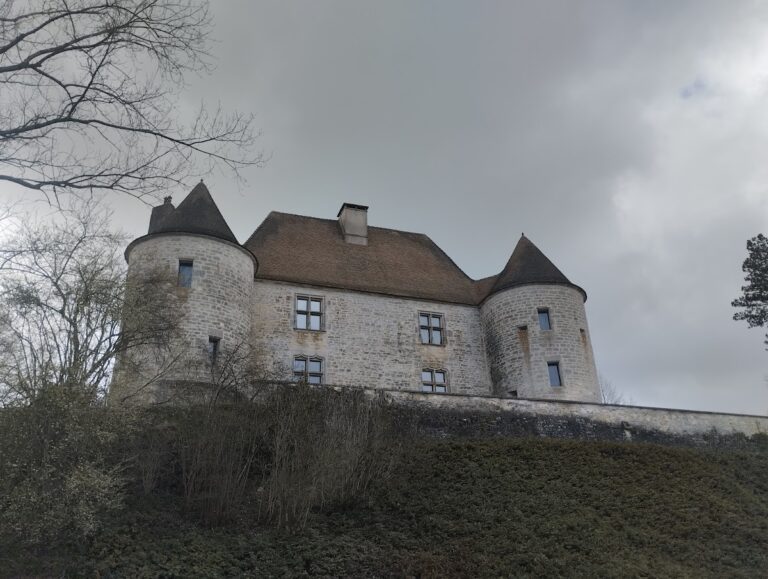
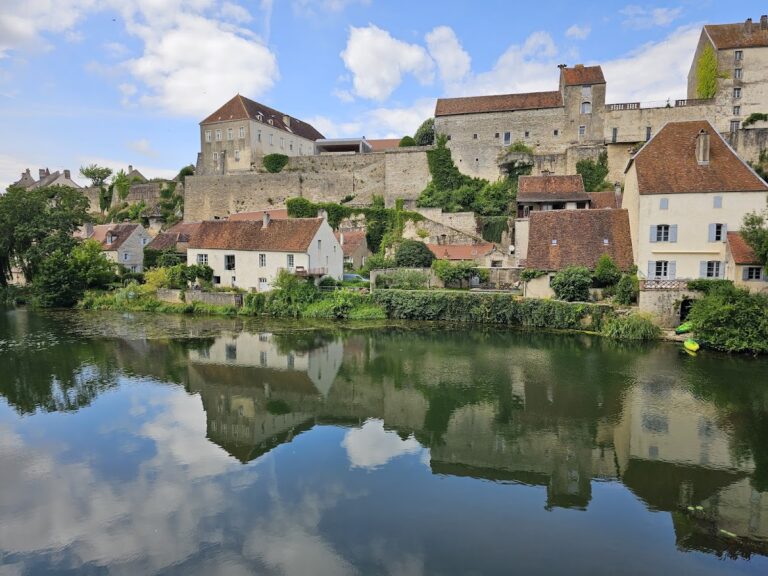
Auxonne Castle occupies the southwest corner of the town’s existing walls beside the Saône. Its pentagonal plan has a perimeter of approximately 400 metres. Five corner towers are linked by thick curtain walls, forming the principal castle enclosure. The protected complex includes these towers, the connecting walls, and the gatehouse.
Corner towers and walls
Notre-Dame Tower
The Notre-Dame Tower is the principal tower of the castle. It is 20 metres in diameter, with walls measuring 6 metres thick at the base. The tower rises 22 metres and contains three levels. Its later use as the Bonaparte Museum connected the surviving medieval structure with the modern interpretation of Napoleon Bonaparte.
Mill, Pied-de-Biche, and Beauregard towers
The High Mill Tower and Low Mill Tower form two of the five corner towers. The Pied-de-Biche Tower and Beauregard Tower complete the group. Beauregard Tower is identified both from the Saône side and from the interior side of the castle. Together, the five towers are joined by the substantial curtain walls that define the pentagonal plan.
Town fortifications and gates
The castle was incorporated into Auxonne’s broader fortified enclosure. This town defense included twenty-three towers, two small turrets, and four gates placed at the cardinal points. The arrangement connected the castle’s defensive structures with the wider walls surrounding the historic town.
Porte Royale
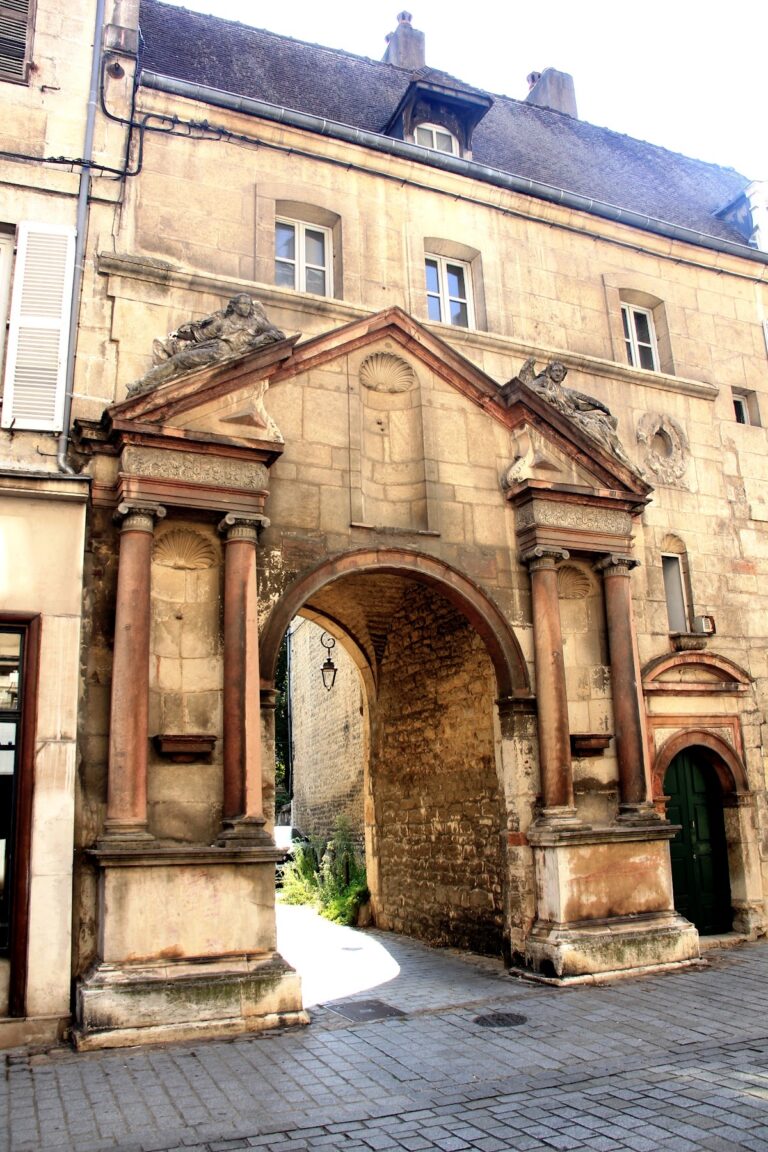
The Porte Royale stands on the northern side of the enclosure, facing the road from Gray. It was built in the seventeenth century under Louis XIV, during the period when Auxonne was developed as a fortified stronghold.
Porte de Comté
The Porte de Comté occupies the eastern side and faced the road from Dole, the capital of the County of Burgundy. Its position formed part of the town’s controlled approaches and linked the enclosure with the route toward the neighboring county.
Tour du Signe and Tour de Belvoir
The Tour du Signe stood on the western, Saône-facing side of the town’s fortifications. It bears a salamander, the emblem of Francis I. The Tour de Belvoir was another tower belonging to the former town fortifications, adding to the surviving defensive structures associated with the castle and enclosure.
Nearby sites