Castle of Aguas Mansas: Medieval Fortress in Spain


Site at a Glance
- Rating
- 4.4
- Popularity
- Low
- Country
- Spain
- Primary era
- Medieval
- External website
- Open
- Eras represented
- Medieval
- Civilizations
- Crown of Castile, Spanish
- Site type
- Military
- Remains
- Castle
On this page10 sections
History
The Castle of Aguas Mansas is a medieval fortress in Agoncillo, Spain, generally dated in its construction to the thirteenth and fourteenth centuries. Its history reflects the changing control and adaptation of a fortified site in La Rioja, from an earlier Muslim stronghold to a noble residence and later municipal building.
Early fortress and medieval lordship
The Albeldense Chronicle, a medieval Latin historical work associated with the monastery of Albelda, records that Sancho Garcés, king of Pamplona, conquered a Muslim castle in the area at the beginning of the tenth century. Documents from the eleventh and twelfth centuries name a fortress called Aguas Mansas or Aguas Muertas and emphasize the strength of its defenses.
The castle and its surrounding lands were contested possessions. In 1191, Alfonso VIII, king of Castile, reached an agreement with Pedro and Gómez García concerning the lordship of the fortress and its territory.
Rebuilding and noble residence
In 1337, Rodrigo Alfonso de Medrano, a crossbowman serving Alfonso XI of Castile, bought the village and castle and began remodeling them in the fourteenth-century manner. His testament of 1345 states that he had spent substantial sums on building the castle and the village.
During the fourteenth-century Castilian conflicts between Peter the Cruel and Henry of Trastámara, rival claimants to the Castilian throne, the castle briefly passed to Charles II of Navarre. In 1392, Rodrigo Alfonso de Algoncillo left it to his nephew Diego López de Medrano and to Diego’s heirs, the Counts of Siruela. The counts inhabited the castle until the nineteenth century.
Later alterations and protection
The parade ground was rehabilitated in the sixteenth century. Utilitarian rooms were added during the eighteenth and nineteenth centuries, but an integral restoration in 1990 removed these additions and returned the complex to its former appearance. The castle is now used by Agoncillo’s town hall, library, and other municipal departments, including offices in its restored dependencies. It has been protected as an Asset of Cultural Interest in Spain since 9 March 1983.
Remains
Fortified layout
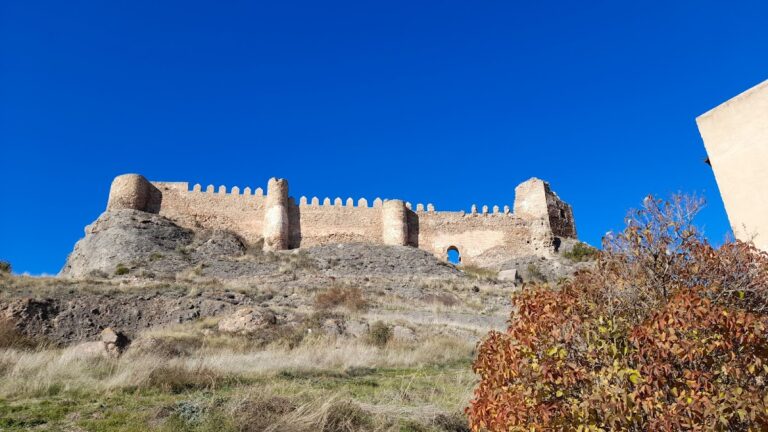
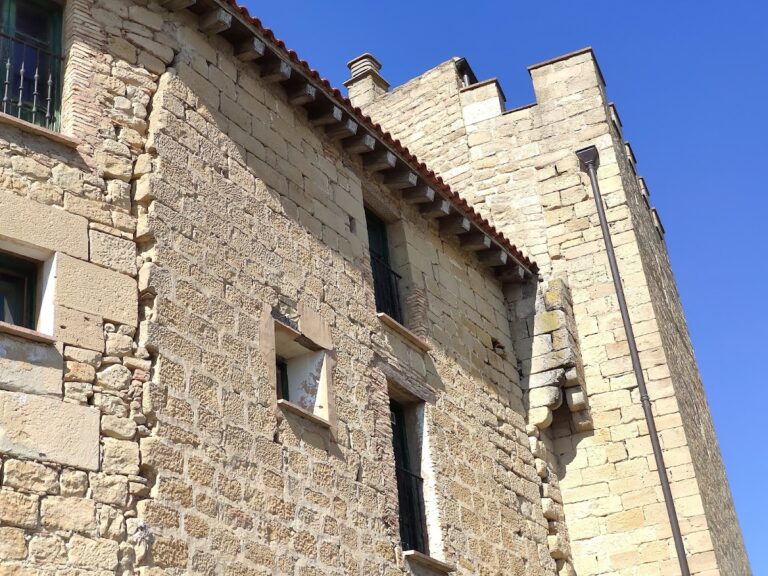
The castle has an almost rectangular plan enclosed by walls and four prism-shaped corner towers. The walls and towers are crowned with machicolations, projecting defensive structures with openings for dropping or discharging missiles onto attackers below. Several of these features survive. Dressed stone masonry was used in the construction, which developed through two principal stages: an initial phase in the middle of the fourteenth century over an earlier building, followed by a second phase at the end of the fifteenth century.
Inside, the parade ground has a cloister-like arrangement on two levels. Its main-floor gallery is supported by semicircular arches, creating a clearly defined internal space within the fortified enclosure.
Corner towers
Keep
The tallest tower stands to the left when entering the castle and is identified as the keep. It has four floors covered by pointed barrel vaults and is entered through a pointed-arch doorway.
Tower of the Doves
The smallest tower is known as the Tower of the Doves. Its floors are formed by evenly spaced timber members resting on corbels, or projecting masonry supports. Some of the corbels that carried its machicolation remain well preserved.
Medrano heraldry
Above the portal on the eastern facade is a shield belonging to the House of Medrano and bearing the Cross of Calatrava. The cross is the emblem of a military religious order established in medieval Castile. The shield expresses the castle’s association with the Medrano lordship and with its most recent historical ownership.
Following the 1990 restoration, the castle is described as being in an excellent state of conservation, while its restored dependencies continue to accommodate municipal offices.