Bentomiz Castle: A Muslim-Era Fortress in Málaga, Spain

Site at a Glance
- Rating
- 4.3
- Popularity
- Low
- Country
- Spain
- Primary era
- Medieval
- External website
- Open
- Eras represented
- Classical, Medieval, Early Modern
- Civilizations
- Nasrid, Roman, Umayyad
- Site type
- Military
- Remains
- Fort
On this page9 sections
History
Bentomiz Castle is a Muslim-era fortress at Arenas in Málaga, Spain, first documented in the eleventh century and built within the Andalusi Islamic tradition. Its surviving architecture reflects several occupation phases, although the precise date and attribution of the ruins remain uncertain. The fortress controlled a broad area of La Axarquía and became an important military and administrative centre under successive Muslim governments.
Early Islamic fortress
Bentomiz, also known as Benthomiz, was associated with the revolt led by Umar ibn Hafsun, a major opponent of the Umayyad government of al-Andalus during the late ninth and early tenth centuries. The surrounding region had a substantial Mozarab population, meaning Christians living under Muslim rule who had adopted elements of Andalusi language and culture.
The fortress appears in the eleventh-century memoirs of Abd Allah, the last Zirid amir, or ruler, of the taifa of Granada. In 1082, Abd Allah regarded Bentomiz as sufficiently important to threaten his communications while he was advancing toward Málaga. He abandoned that advance, negotiated the fortress’s surrender, and then demolished part of its fortifications. This episode demonstrates the military value attributed to Bentomiz during the political struggles of the period.
Regional stronghold and district centre
Ibn al-Khatib later described Bentomiz as one of the principal fortresses of the administrative district of Rayya. Together with Comares and Zalia, it formed a defensive triangle and ranked among the three major Muslim strongholds of central La Axarquía. The wider region was influenced by the Almohads and Merinids, successive Berber Muslim dynasties that ruled parts of North Africa and exerted power in areas of the Iberian Peninsula between the twelfth and fourteenth centuries.
During the Nasrid period, from the thirteenth to the fifteenth century, Bentomiz served as the administrative centre of a district. The Nasrids were the Muslim dynasty that ruled the Emirate of Granada until the Christian conquest of Granada in 1492. Under their administration, the mountainous district prospered through silk production and raisins, giving the fortress authority over a productive hinterland as well as a strategic position.
Conquest and later abandonment
Bentomiz acquired renewed importance during the civil wars of the final Muslim period in Iberia. When the Catholic Monarchs besieged Vélez-Málaga in 1487, control of Bentomiz was considered necessary to secure the campaign. The fortress passed to the Catholic Monarchs that year through a negotiated surrender rather than a battle.
After the conquest, Bentomiz was attached to the district of Vélez-Málaga and continued to perform a defensive and controlling role over a large Morisco population. Moriscos were Muslims who remained in Christian-ruled Spain after the conquest and were subsequently converted to Christianity, voluntarily or by force. Under a pact with Ferdinand II of Aragon, one of the Catholic Monarchs, Christian inhabitants of the fortress reportedly recovered their religion and customs.
A diocesan census from 1492 associated with Bentomiz listed 39 heads of family, 156 inhabitants, and 58 Muslim families. The same record attributed approximately 7,500 defenders to the fortress. Many inhabitants later fled with their property and settled in Algarrobo, Torrentes, and Alcalayn. Bentomiz retained military importance during the Morisco rebellion of 1570, a major uprising in the former Kingdom of Granada. After the revolt, the fortress entered a period of abandonment that resulted in its ruinous condition.
Spain declared Bentomiz a monument of cultural interest on 22 June 1993. The surviving fabric has also been regarded as suitable for archaeological investigation and restoration, preserving the site as evidence of the successive political and military phases of La Axarquía.
Remains
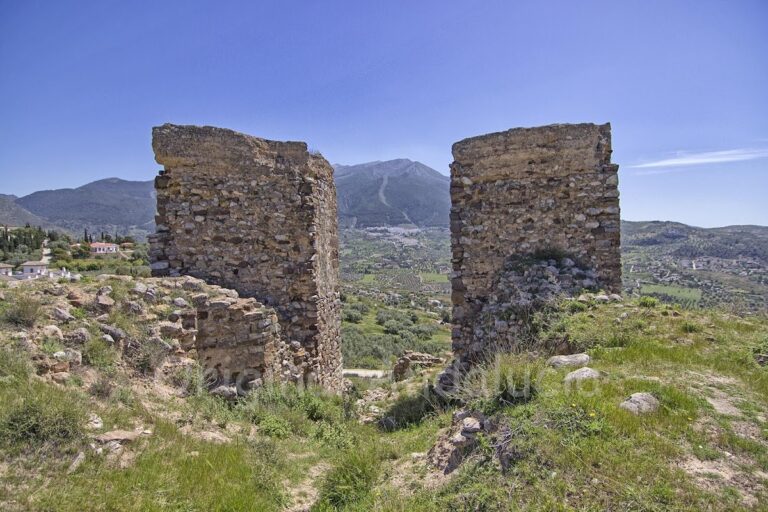
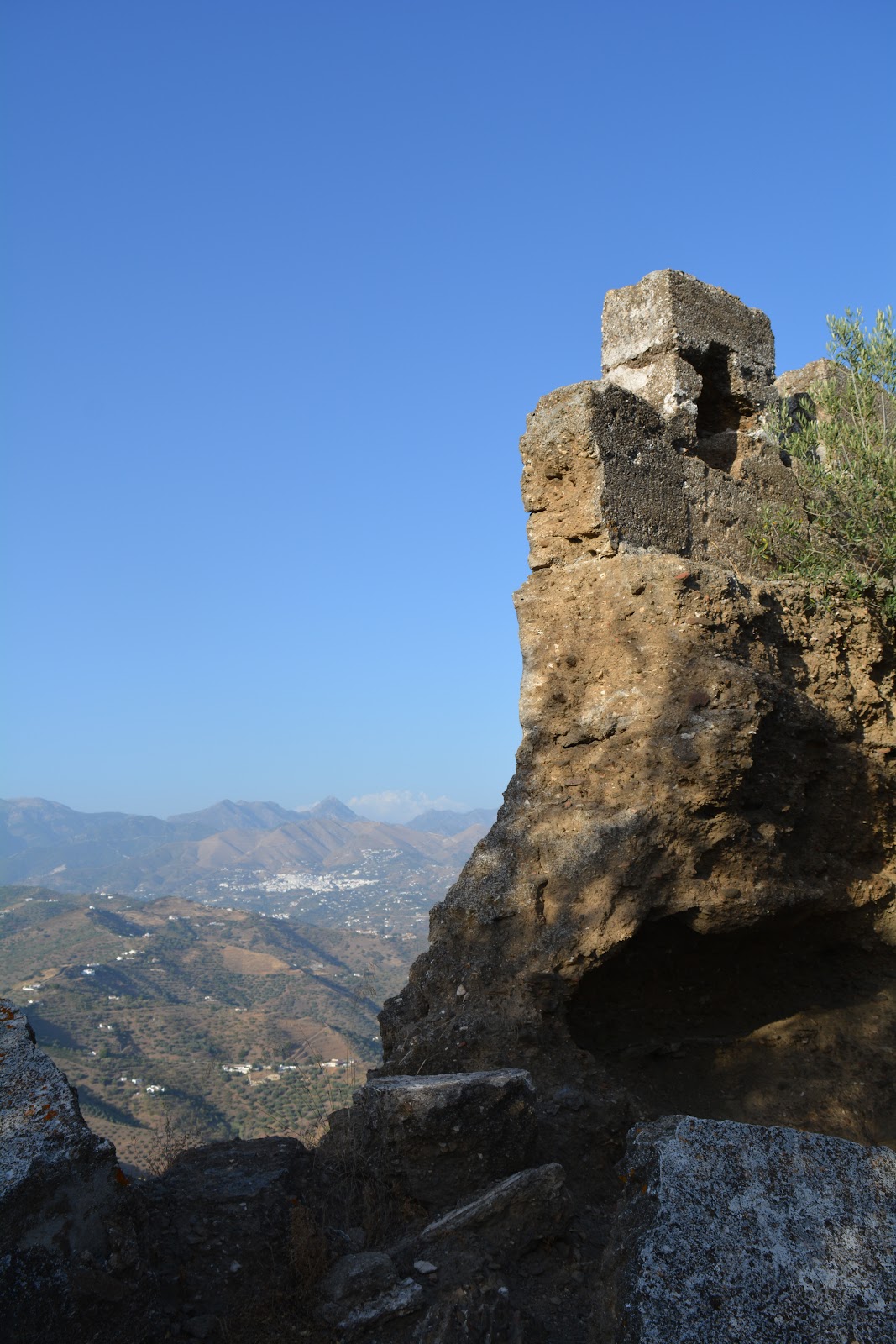
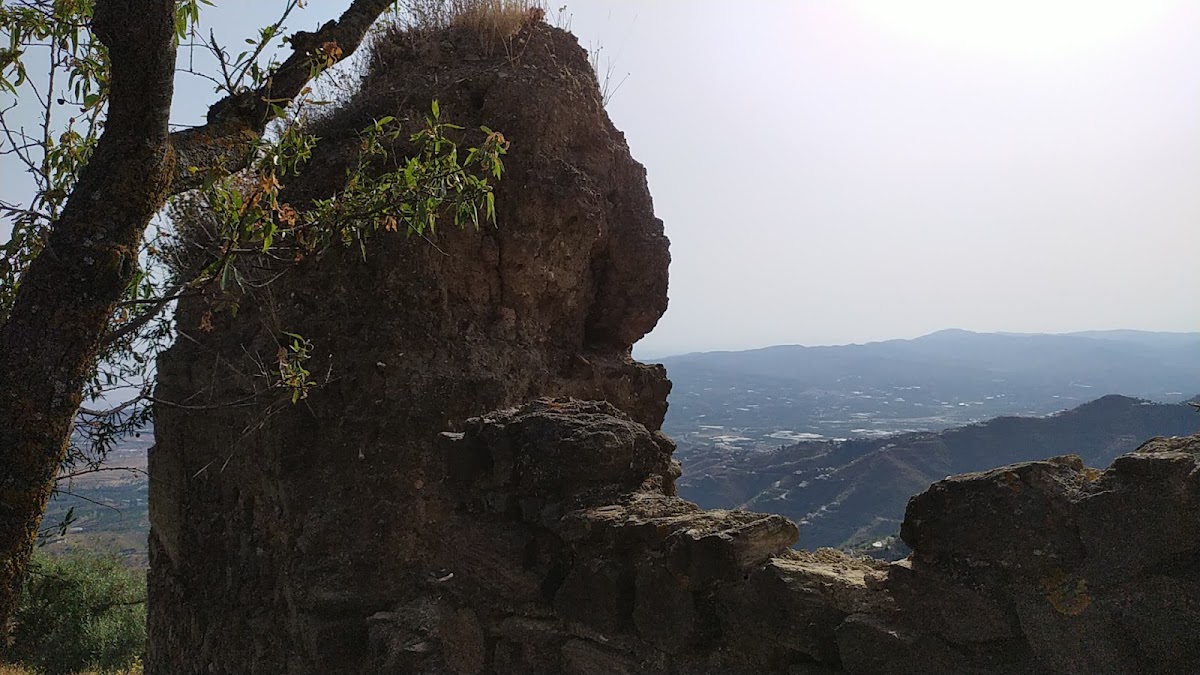
Bentomiz Castle occupies a hilltop approximately 711 metres above sea level in the municipality of Arenas. From this position, it controlled a wide area of La Axarquía toward the sea and overlooked the eastern Costa del Sol and the interior. The fortress is among the largest in Málaga Province. Its irregular plan follows the shape of the terrain and is organized into two extensive enclosures, with walls, towers, cisterns, underground spaces, and interior structures surviving in a substantially ruined complex.
Fortified enclosures
Higher enclosure
The first enclosure occupies the higher part of the hilltop. Thick walls are supported by square towers, while one tower has a hexagonal form. Inside that tower are two single-chamber cisterns covered by barrel vaults, structures designed to store water beneath a curved ceiling. The combination of elevated position, enclosing walls, towers, and water storage reflects the defensive organization of this upper section.
Outer plateau enclosure
The larger second enclosure follows the edge of the plateau behind a thick wall reinforced with towers. Some towers retain crenellation, the notched parapet formed by alternating raised sections and openings. Two large cisterns are also located within this enclosure; they originally had ribbed vaults, whose curved surfaces were strengthened by projecting ribs.
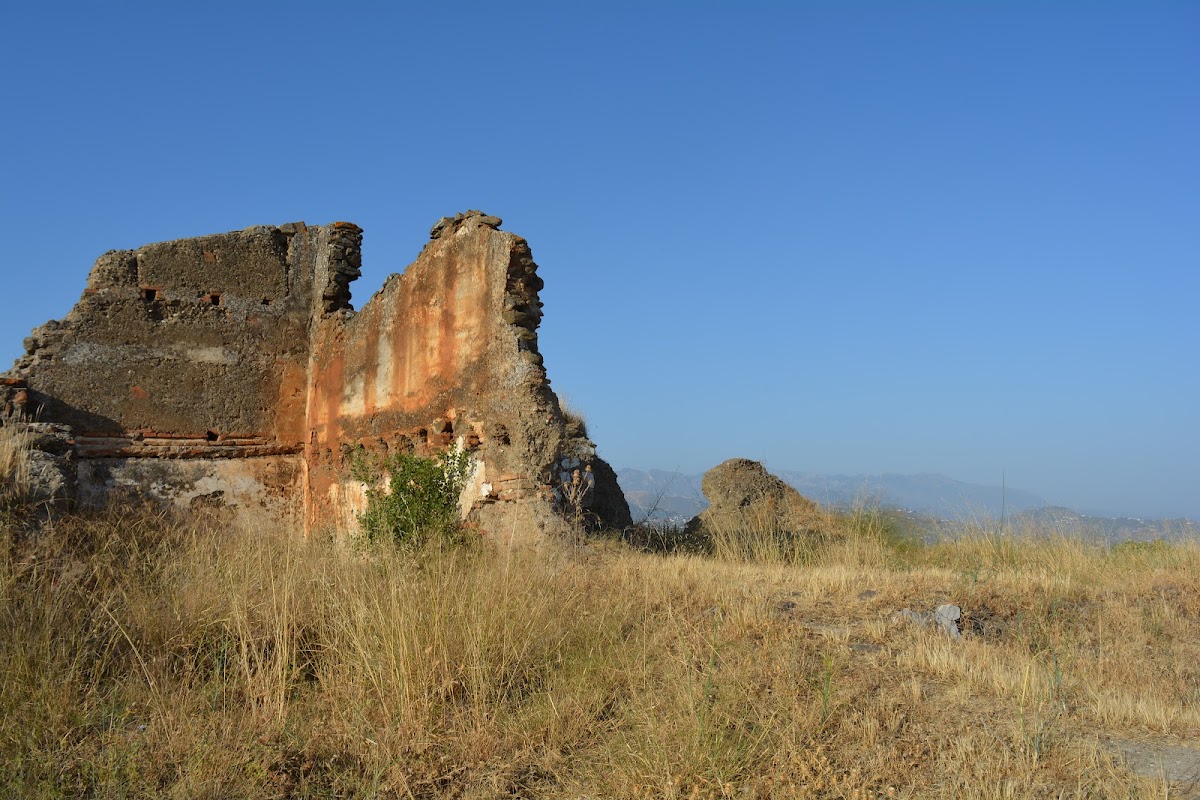
The surviving complex includes sections of wall, standing towers, underground spaces, interior rooms, and portions of the eastern and western entrance structures. The masonry varies across the site, and some construction uses rammed earth, a technique in which compacted earth is formed inside temporary shuttering. These differing materials and methods reflect multiple phases of occupation. The castle’s cistern has been compared architecturally with a cistern beneath the Palace of Charles V at the Alhambra in Granada, while its double-enclosure plan and irregular hilltop arrangement have been compared with the fortresses of Montemayor, Archidona, and Zalia.
Residential and later structures
A group of houses was constructed against the northern wall of the second enclosure. These dwellings remained in use until relatively recently, adding a residential phase to the fortress’s military and administrative history. A small building containing a television repeater was installed at the highest point of the residential enclosure. Together with the surviving walls, towers, cisterns, and underground spaces, these later elements form part of the varied physical remains of Bentomiz.
The range of masonry, rammed-earth work, towers, water installations, and domestic buildings gives the site a layered architectural character. Elements attributed to periods from the caliphal era through the time of the Morisco rebellion remain combined within the hilltop complex, while possible Phoenician, Greek, and Roman occupation phases, including identified Roman baths, point to an even earlier history for the location.