Burg Jesberg: A Medieval Hilltop Castle in Germany


Site at a Glance
- Rating
- 4.4
- Popularity
- Low
- Country
- Germany
- Primary era
- Medieval
- External website
- Open
- Eras represented
- Medieval
- Civilizations
- Holy Roman Empire
- Site type
- Military
- Remains
- Castle
On this page8 sections
History
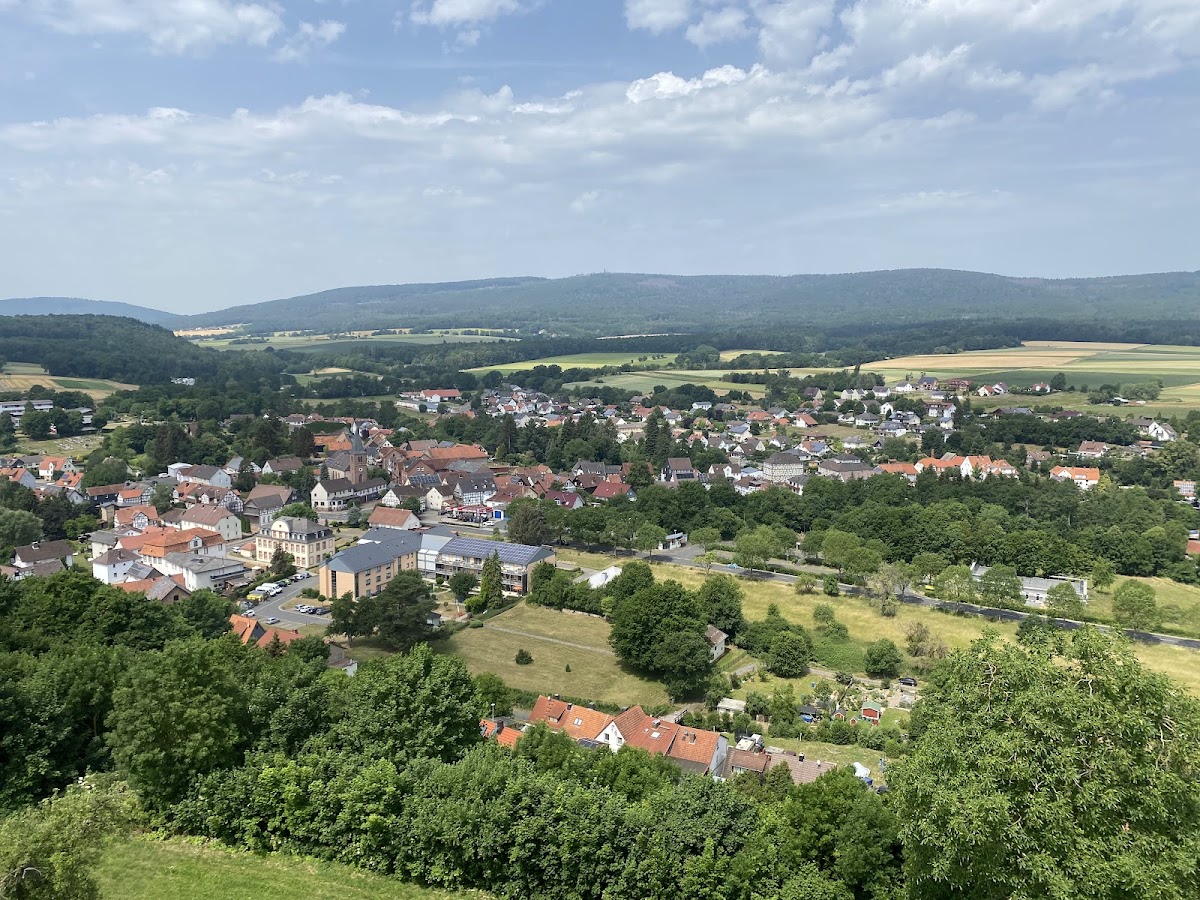
Burg Jesberg is the ruin of a medieval castle in Jesberg, Germany. Built as a Romanesque hilltop stronghold toward the end of the twelfth century or at the beginning of the thirteenth, it stood on the Schlossberg above the old Fritzlarer Straße, an important trade route between the Wetterau and the Fritzlar and Gudensberg area.
Foundation and Mainz Rule
The fortification occupied the Schlossberg at an elevation of 280 metres. On 2 April 1241, Ludwig and Wortwin of Linsingen sold the castle and the court of Lenswideshusen to Siegfried III, Archbishop of Mainz. The brothers then received the property back as a Mainz fief, meaning land granted in return for service and allegiance.
The Archbishops of Mainz were powerful ecclesiastical and territorial rulers whose authority also included the administration and defense of their lands. Because Jesberg controlled the Fritzlarer Straße, the castle became one of Mainz’s principal bases in Lower Hesse, together with Fritzlar, Naumburg, and the Heiligenberg near Felsberg.
During the next two centuries, the castle was pledged repeatedly. Members of the ministerial families of Falkenberg, Linsingen, Gilsa, and Grifte served as pledge-holders or castle men, medieval officials responsible for defending or administering a castle. Around 1350, Jesberg suffered heavy damage, probably during conflicts between Mainz and the Landgraves of Hesse, although the precise cause is unknown.
Rebuilding and Fifteenth-Century Wars
In 1400, the Linsingen family became vassals of the Hessian landgrave. Mainz responded by besieging and capturing Jesberg. Between 1425 and 1426, the fortifications were almost entirely renewed under Happel Katzmann, a Fritzlar ministerial. The work greatly enlarged the castle and added a newly excavated defensive ditch around the stronghold. The Romanesque keep was retained rather than rebuilt.
Jesberg was drawn into the decisive war of 1427 between Ludwig I of Hesse and Konrad, Archbishop of Mainz. After Mainz troops commanded by Count Gottfried of Leiningen were defeated on 23 July on the Großenengliser Platte near Fritzlar, they fled to Jesberg. They suffered another defeat near Fulda on 10 August.
During the Hessian War of the Brothers in 1469, Mainz supported Heinrich the Rich of Hesse-Marburg against Ludwig II of Hesse-Kassel. Mainz castle men from the Linsingen family defended Jesberg, but a lengthy siege and bombardment ended with the castle’s storming and near-total destruction by 500 Bohemian mercenaries and 300 mounted troops recruited by Ludwig. The defenders were reportedly all killed.
Rebuilding, Decline, and Preservation
The castle was rebuilt in 1524. In 1586, Jesberg and its court became permanently part of Hesse. With this change, the fortress lost its strategic importance and fell into decay. Stones from the castle walls and wall towers were reused in houses in Jesberg. When the Hessian branch of the Linsingen family died out in 1721, the castle and its fief reverted to the Landgraviate of Hesse, the principality ruled by a landgrave.
A merchant named Appell acquired the remains around 1820 and prevented the complex from being completely destroyed. The municipality of Jesberg purchased the ruin and the Schlossberg grounds in 1964. Restoration between 1980 and 1987 included the keep, surviving portions of the palas, cellars, and ring walls. The remaining fabric is protected as a cultural monument.
Remains
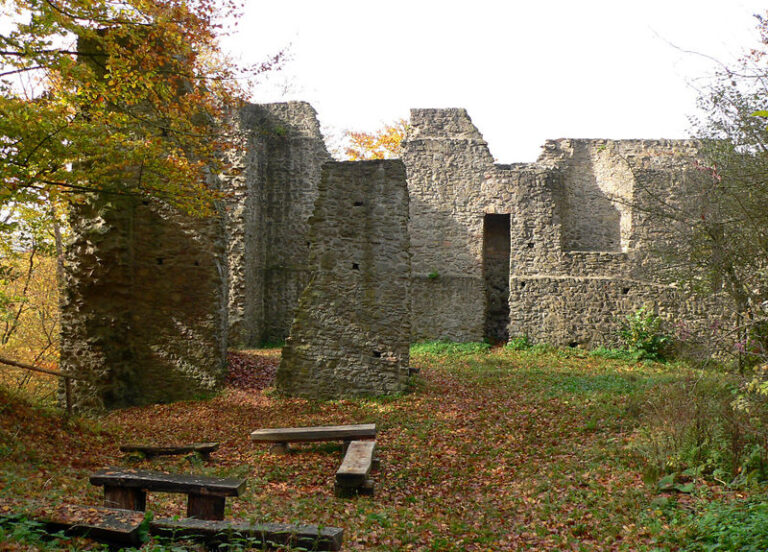
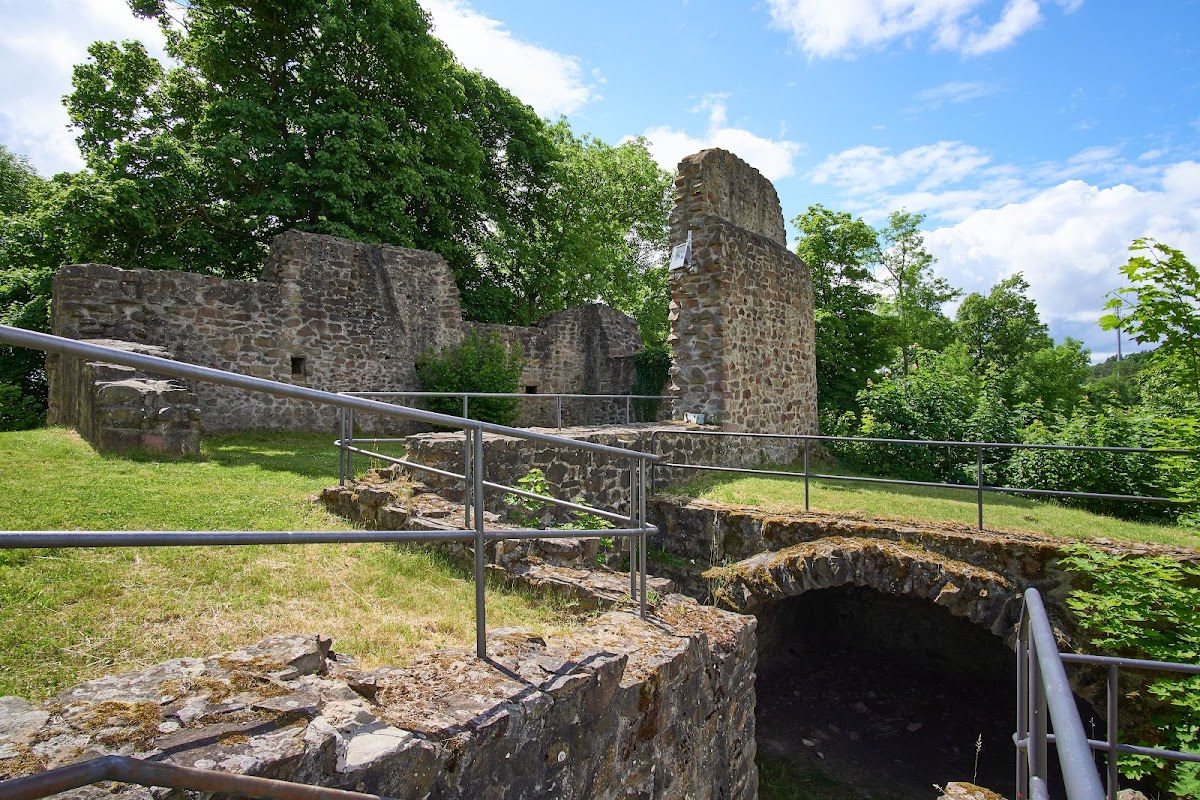
Burg Jesberg survives as a hilltop fortification on the Schlossberg above Jesberg. The visible complex consists of the keep, parts of the palas, cellars, sections of the enclosing ring wall, and remains of the enlarged fifteenth-century defenses. A defensive ditch, excavated around the fortifications during the rebuilding of 1425–1426, formed an additional obstacle around the castle.
Fortified and Residential Structures
Romanesque Keep
The keep is the principal fortified tower of the castle and the most important surviving element from its Romanesque phase. Romanesque architecture is characterized by massive masonry, thick walls, and rounded arches. The tower was specifically spared during the extensive renewal of 1425–1426 and was restored between 1980 and 1987.
Palas, Cellars, and Ring Walls
Parts of the palas, the castle’s main residential and representative building, survive together with cellars and sections of the ring wall, the defensive wall enclosing the complex. These remains were included in the late twentieth-century restoration. Stones taken from former wall sections and wall towers were later incorporated into houses in Jesberg, linking some material from the ruined fortification to the surrounding settlement.