Wasserburg Rückingen: A Medieval Water Castle in Germany

Site at a Glance
- Rating
- 4.4
- Popularity
- Very Low
- Country
- Germany
- Primary era
- Medieval
- External website
- Open
- Eras represented
- Medieval
- Civilizations
- Holy Roman Empire
- Site type
- Military
- Remains
- Castle
On this page9 sections
History
Wasserburg Rückingen is the surviving remnant of a medieval lowland water castle in Germany, in Rückingen, now part of Erlensee in Hesse. A castle is said to have stood here as early as the tenth century, and the site was first recorded in 1248 as castri Ruggingin. It was a ministerial castle, held as a fief of Mainz by noble families who provided administrative and military service to a higher lord.
Medieval fief and destruction in 1405
The castle initially belonged to the Lords of Brauneck under Mainz. From 1463, the Counts of Isenburg held it and granted it as a sub-fief to the related Lords of Rückingen and Lords of Rüdigheim. Among the co-heirs, members of a joint community of heirs administering an estate, was Johann von Rüdigheim.
Johann became involved in attacks on merchant vessels travelling on the Main and Kinzig rivers. On 17 February 1405, during the reign of King Ruprecht, the castle was destroyed along with other regional castles, including Hüttelngesäß and Mömbris. It was initially forbidden to rebuild the stronghold.
As part of an oath of reconciliation, a formal pledge to end retaliation after a settlement, Johann von Rüdigheim renounced further conflict. He was permitted to construct only an unfortified farmstead east of the castle. This building became known as the Herrenhof. It was demolished in 1909, although associated buildings included the Lords’ Barn and the building called the Little Castle.
The Knights’ War and later rebuilding
During the Knights’ War of 1522, a conflict in the Holy Roman Empire between Franz von Sickingen and opposing territorial princes, a coalition from Hesse, the Palatinate, and Trier attacked Rückingen. Landgrave Philipp of Hesse destroyed the castle because Philipp von Rüdigheim had supported Franz von Sickingen, a prominent German knight and military leader.
The castle was rebuilt in 1569. A stone bearing a coat of arms above the gate commemorates this rebuilding through its date and the arms of Eitel von Rückingen and Adelheit Roth von Burg-Schwalbach. During the Thirty Years’ War, Croatian troops burned Rückingen, and the castle was probably affected.
The Lords of Rüdigheim died out in 1666. The castle then passed through several owners before returning to Isenburg in 1756 as a reverted fief. It became privately owned during the nineteenth century and was used for agricultural purposes from about 1860. The surrounding ditches were filled during this period.
Excavation and museum use
After the municipality of Erlensee acquired the property, a local history museum opened in the castle rooms in 1983. The Erlensee Historical Association administers the museum. Investigations by the Hanau Historical Association in 1988, followed by further work in 2001, indicated that the castle had been larger during an earlier construction phase than the visible remains suggest. Wasserburg Rückingen is designated as a cultural heritage monument in Hesse.
Remains
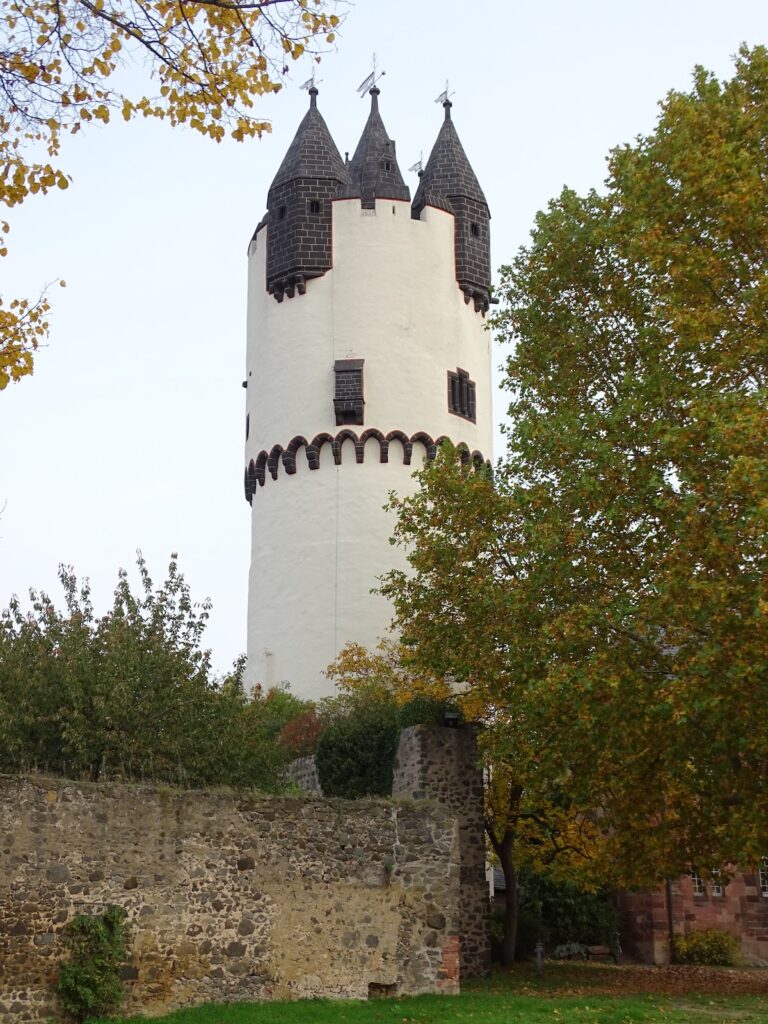
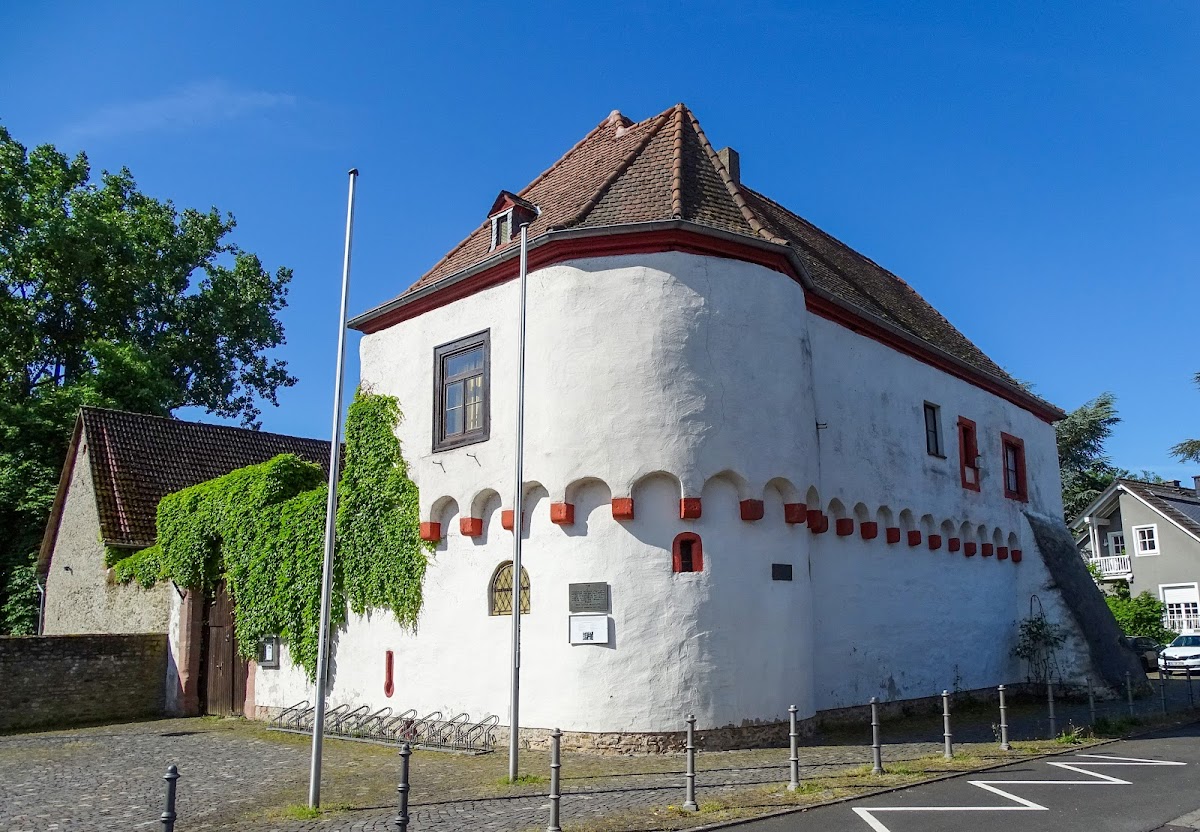
The castle has an approximately rectangular plan. Its surviving northern section preserves the probable main building, a corner round tower, and substantial stretches of the enclosing wall. Most of the visible fabric dates from the first half of the fifteenth century, while earlier construction phases are also present. The southern part was later built over by a barn.
Castle layout and water defenses
Moats originally surrounded the castle and were directly connected to the Kinzig. The filled-in ditches occupied ground east of the present parking area, north of the present road, and west of the square in front of the castle. A keyhole-shaped loophole remains visible at a level far below the present ground surface, preserving physical evidence of the former moat and the earlier height of the surrounding ground.
Northern buildings and museum collections
Main building and corner tower
The northern section contains the probable main building beside a corner round tower. These structures stand within the surviving stretches of the enclosing wall and form the principal visible part of the medieval castle. Archaeological investigations indicate that the earlier complex extended beyond this surviving area.
Local history museum
The castle rooms house a local history museum with a large collection of exhibits from Rückingen and Langendiebach. A separate section covers the nearby Roman fort at Rückingen and presents archaeological finds from the Roman period, especially ceramics.