Barwałd Castle: A Medieval Frontier Fortress in Poland


Site at a Glance
- Rating
- 3.9
- Popularity
- Very Low
- Country
- Poland
- Primary era
- Medieval
- Eras represented
- Medieval
- Civilizations
- Holy Roman Empire
- Site type
- Military
- Remains
- Castle
On this page7 sections
History
Barwałd Castle is a medieval knightly fortress in Poland, on Mount Żar near Barwałd Górny in present-day Wadowice County. Built in the mid-fourteenth century, it guarded the eastern frontier of the Duchy of Oświęcim, a medieval Silesian polity whose rulers became vassals of the Bohemian crown. The construction is attributed, though not with certainty, to Jan I Scholastyk, Duke of Oświęcim.
A Frontier Stronghold
In 1327, Jan I Scholastyk swore fealty to John of Luxembourg, King of Bohemia. The eastern frontier of the duchy consequently became a border between hostile states. On the Polish side, in Kraków Land, Lanckorona Castle served a corresponding defensive purpose. Barwałd therefore formed part of a wider network of strongholds shaped by the rivalry between the Bohemian and Polish crowns.
The castle initially served as the residence of the Skrzyński family, who bore the Łabędź coat of arms and were vassals of the dukes of Oświęcim. The family also held the castles at Żywiec and was described as consisting of robber knights. A barwałd starost, an administrative official who could also oversee a military stronghold, named Mikołaj Rudzki held the office from 1427 to 1429. Barwałd Castle itself first appears in written records in 1440.
Conflict with the Polish Crown
In 1452, Polish forces commanded by Piotr Szafraniec campaigned against Włodek of Skrzynno, then the holder of Barwałd Castle, but the expedition failed. During the fifteenth century, Barwałd and Żywiec passed to the Komorowski family, who bore the Korczak coat of arms.
In the later 1470s, Piotr Komorowski supported Matthias Corvinus, King of Hungary from 1458 to 1490, who was allied with the Teutonic Order, a German-founded military-religious order that controlled a territorial state in the eastern Baltic. King Casimir IV Jagiellon regarded the Komorowski castles at Barwałd, Żywiec, and Szaflary as threats to the Kingdom of Poland and ordered a military campaign against them.
In 1477, Jakub of Dębno, the starost of Kraków and voivode of Sandomierz, led the operation. The siege lasted seven weeks and involved mercenary troops and artillery. Barwałd surrendered, after which Casimir IV ordered the castle to be demolished and levelled. The fifteenth-century Polish chronicler Jan Długosz described it as protected by a high wall and a very good defensive position.
Ruins and Later Reuse
Tradition holds that in 1616 and 1617, Mikołaj Zebrzydowski used stone from the castle ruins to build the Chapel of Saint Mary Magdalene on Mount Żar. The chapel is now part of the Hermitage of the Five Polish Brothers with the Chapel of Saint Magdalene. This later building tradition links the surviving remains of the fortress with the religious complex that occupies the mountain.
Remains
Fortress Layout
The castle occupied a flat summit of Mount Żar, which reaches 527 metres above sea level in the Wieliczka Foothills, a subrange of the Beskids. Its plan formed an elongated oval measuring approximately 50 by 20 metres. A single earth rampart enclosed the fortification, while a dry moat reached depths of up to 10 metres. An additional defensive ditch lay along the northern side.
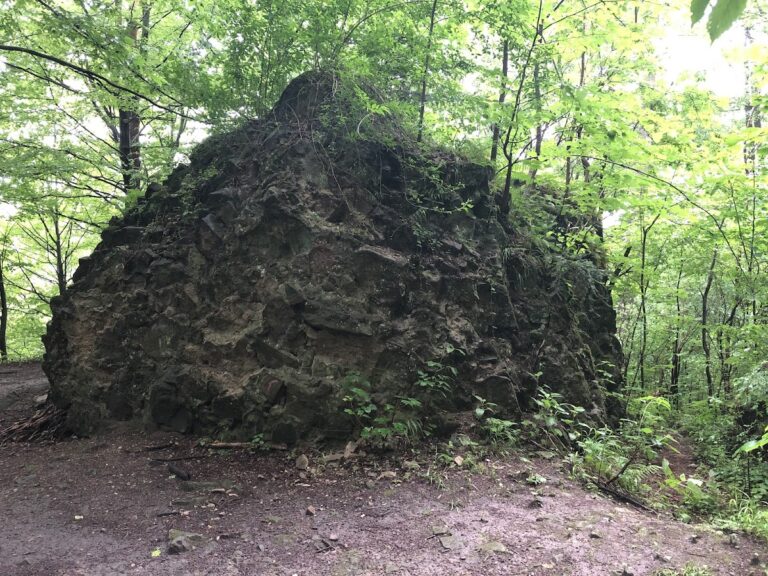
The earth rampart still rises to approximately 6 metres. Sections of the moat and the foundations of the enclosing walls also survive, particularly along the inner edge of the central courtyard. These earthworks and masonry foundations preserve the outline of the demolished fortress and indicate how its elevated position was combined with artificial defensive barriers.
Stone Reused at the Chapel
Stone from the castle ruins is traditionally said to have been incorporated into the Chapel of Saint Mary Magdalene on Mount Żar during its construction in 1616 and 1617. The chapel forms part of the Hermitage of the Five Polish Brothers with the Chapel of Saint Magdalene, providing a later physical connection between the former fortress and the mountain’s religious buildings.