Wildeneck Castle Ruins: A Medieval Lordship in Austria
Site at a Glance
- Rating
- 3.3
- Popularity
- Very Low
- Country
- Austria
- Primary era
- Medieval
- Eras represented
- Medieval
- Civilizations
- Duchy of Bavaria, Holy Roman Empire
- Site type
- Military
- Remains
- Castle
On this page10 sections
History
Wildeneck castle ruins are the remains of a medieval hilltop castle in Austria, near Zell am Moos, built around 1140 by Rapoto I of Ortenburg. The site was also known as Wildenegg, Wildenekke, Wildenek, and castrum Wildenekk. Its history is closely connected with the Ortenburg dynasty, the Bavarian dukes, Mondsee Abbey, and the changing jurisdictions of the surrounding region.
Ortenburg and Bavarian Rule
In 1286, Count Rapoto IV of Ortenburg sold the castle to Dukes Stephen and Otto of Lower Bavaria. Their authority extended over Mondsee Abbey, the Mondsee region, and one-third of the Mondsee properties administered by the Salzburg Urbaramt. In 1321, the Bavarian dukes agreed that Heinrich III of Ortenburg could regain possession of the Wildeneck lordship.
Around 1370, the Mondsee region was separated from the Bavarian Weilhart district court. A separate Wildeneck district court was established and placed under the Burghausen rent office, which administered the financial affairs of the wider territory. The castle was managed by custodians who also served as district judges, giving Wildeneck both a residential and an administrative role.
Between Bavaria and Salzburg
Salzburg’s purchase of the Mattsee lordship, including Straßwalchen, in 1390 turned the Mondsee region into an enclave separated from Lower Bavaria. The Bavarian dukes pledged the Wildeneck lordship several times, and after 1462 Mondsee Abbey acquired it as a pledged lordship. In 1494, the lordship was granted to Wolfgang Kolberger, Count of Neukolberg and chancellor in Landshut.
King Maximilian I, a Habsburg ruler who later became Holy Roman Emperor, bought the Mondsee region in 1506 and resold it to the Archbishop of Salzburg in the same year, while retaining a right of repurchase. In 1565, the estates of Upper Austria bought the region back. These transfers left Wildeneck within a complicated landscape of overlapping territorial, judicial, and financial claims.
Abandonment and Later Jurisdiction
The district court was eventually moved to Mondsee. Wildeneck castle was abandoned in 1572 or, at the latest, in 1611, and it was no longer inhabited by 1611. After abandonment, the buildings were left to decay.
At the beginning of the seventeenth century, dual authority, increasing taxation, and widespread rural poverty contributed to a tax boycott and peasant uprisings between 1611 and 1662. Authorities suppressed the unrest through imprisonment in the water tower, binding peasants to a stake, and starvation. In 1662, some peasants were executed, expelled from the country, or sentenced to lifelong forced labor.
In 1678, Mondsee Abbey purchased the Vogtei and district-court lordship. A Vogtei was a secular protective and administrative jurisdiction over an ecclesiastical institution or its property. The purchase gave the abbey high jurisdiction, including capital jurisdiction, which allowed severe corporal and death sentences, as well as the right to collect taxes.
Until the Salzburg Urbaramt was bought back from Regensburg in 1759, inhabitants of the Mondsee region owed obligations to two authorities: the territorial custodian of the Wildeneck Vogtei and district court, and either the manorial court of Mondsee or Salzburg officials. Disputes over judicial and taxation rights continued for many years. The Peace of Teschen on 13 May 1779 ended the War of the Bavarian Succession with Prussia and brought the Innviertel definitively to Austria, ending the jurisdictional and taxation disputes.
Legend of the Golden Carriage
A local tradition about the “Golden Carriage of the Countess of Wildeneck” reflects the perceived contrast between the wealth of the lordship and the oppression experienced by its subjects. The legend preserves a popular memory of the unequal social conditions associated with Wildeneck’s former authority.
Remains
Hilltop Setting and Defences
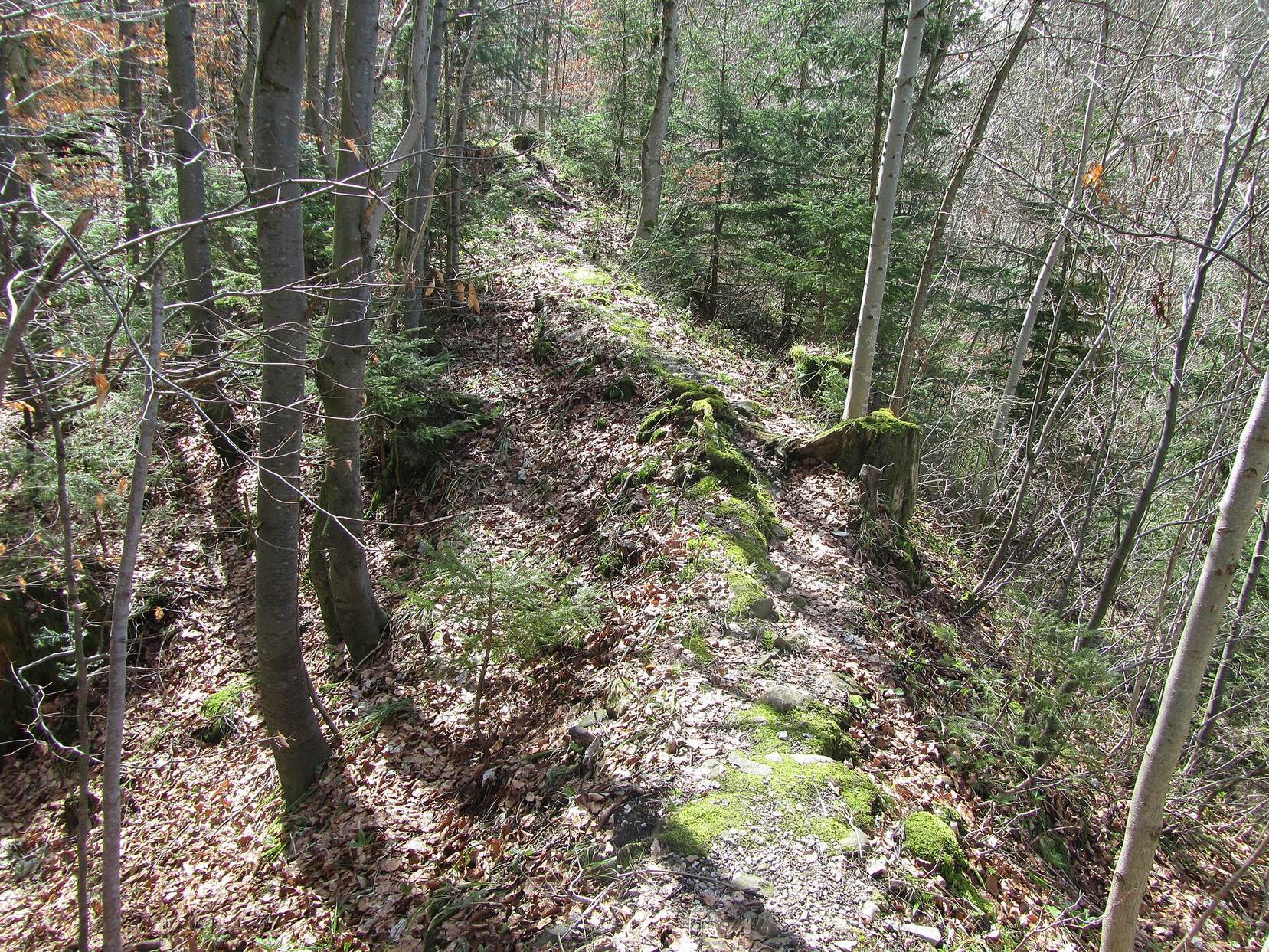
The castle occupied a steep promontory on the western shore of Lake Irrsee, on the eastern slope of the Kolomansberg in Oberhofen, Upper Austria. The site lies at approximately 720 metres above sea level and takes the form of a hilltop stronghold in a spur position. A deep neck ditch protected the approach side, separating the castle site from the adjoining ground. A drawbridge across the ditch is considered probable, although its existence is inferred rather than directly documented.
Walls and Tower
Enclosing Wall and Tower
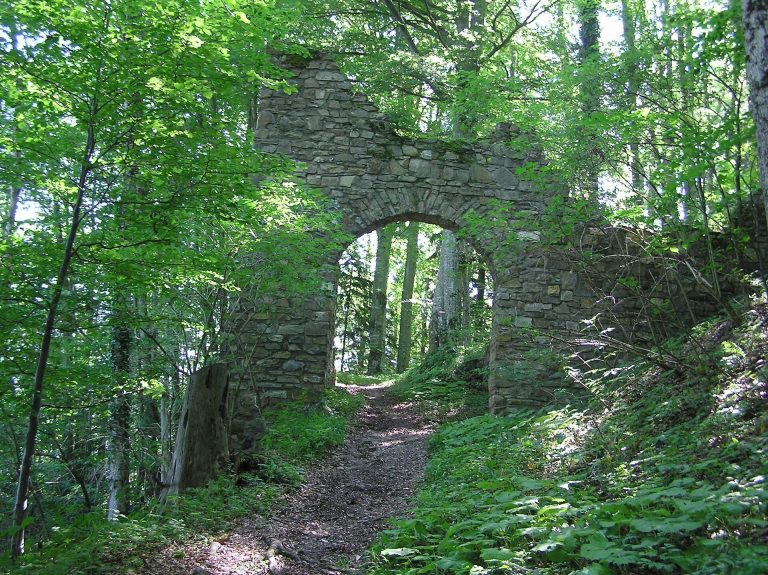
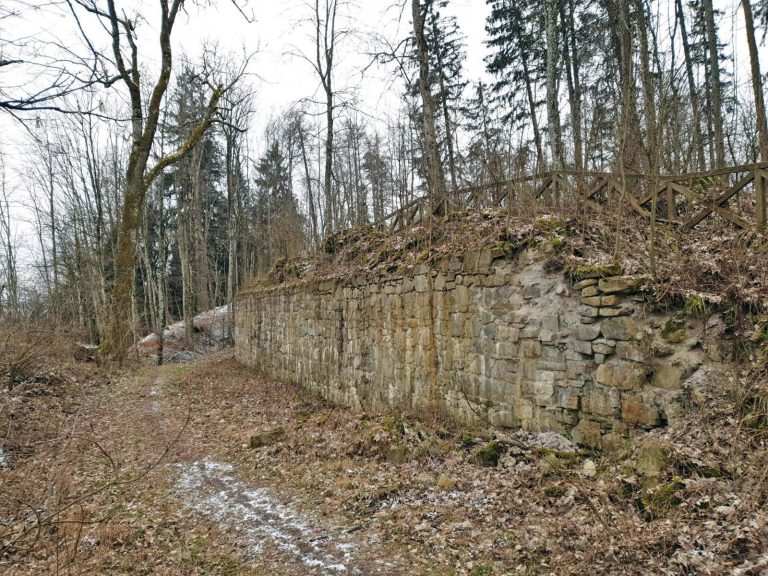
The surviving remains include an overgrown section of enclosing wall and several wall sections belonging to a tower incorporated into that enclosure. The tower remains help indicate the defensive construction of the castle, while the neck ditch preserves part of its approach-side protection.
Collapsed Vaults
Numerous depressions across the castle site indicate collapsed vaults. Together with the wall fragments, the tower remains, and the neck ditch, these features represent the fragmentary physical evidence of the former hilltop complex.