Montferrer Castle: A Medieval Fortification in France


Site at a Glance
- Rating
- 4
- Popularity
- Very Low
- Country
- France
- Primary era
- Medieval
- Eras represented
- Medieval
- Civilizations
- Kingdom of Majorca
- Site type
- Military
- Remains
- Castle
On this page6 sections
History
Montferrer Castle, also called Mollet Castle, is a medieval fortification in France, above the commune of Montferrer in Vallespir, a historic Catalan region in the eastern Pyrenees. Its first written mention dates to 1070, when the knight Guillem Bernat swore allegiance to Bernat III of Besalú on behalf of his castles in Vallespir, including Montferrer. The site took its name from the settlement around it, formerly called Mollet, which appears as Molledo in 927 and villa Moleto in 967.
The lords of Montferrer
After Guillem Bernat, the earliest apparently known lord was Guillem-Arnau de Montferrer, bishop of Urgell from 1092 to 1095. Pere is mentioned in 1215, while Arnau de Montferrer, a canon of Elna, appears in records between 1233 and 1242. Around 1270, Bernat de Montferrer held the lordship, and in 1273 he founded a benefice at the church of Thuir. A benefice was a church endowment that supplied income or support to a cleric or religious foundation.
On 1 June 1313, Sanç I of Mallorca confirmed the rights of justice over Montferrer to the lordship of Castellnou, represented by Dalmau de Castellnou, lord of Santa Maria de Mollet and Montferrer Castle. These rights were jurisdictional powers exercised by a lord over a territory and its inhabitants. Dalmau’s son Berenguer died in 1373 and was forced to sell the title to Blan, a knight from Perpignan. The lordship then passed to Blan’s son Pere, Pere’s daughter Elionor, and her husband Joan de Pontós. In the next generation, Joan III de Banyuls took the name Banyuls de Montferrer.
Sales, repurchase, and the marquisate
The Banyuls family retained Montferrer until 30 December 1585, when Tomàs I de Montferrer sold the domain to Joan Vilansosa, a surgeon from Barcelona. The villagers bought it back from Vilansosa’s son for 3,000 ducats on 13 December 1610. Governance then returned to Francesc III de Montferrer, Tomàs’s son, but his tenure was short. Pressured by creditors, he sold the lordship on 12 January 1623 to Lluïsa Guanter, widow of a notary from Prats de Molló.
In 1642, Louis XIII of France appointed Tomàs II de Montferrer royal procurator for the counties of Roussillon and Cerdanya. A royal procurator represented royal authority and administered or defended the Crown’s interests. Tomàs II used his position to repurchase the lordship from the Guanter family in June 1649. In April 1675, the king created the Marquisate of Montferrer, a territorial lordship held by a marquis, and granted it to Carles de Banyuls. Carles had been forced into exile after taking part in the 1674 Conspiracy of Vilafranca de Conflent, so the title went to Francesc III de Banyuls. The marquisate was later enlarged with properties confiscated from the Llar conspirators.
The former settlement eventually lost its population, and the castle became associated with the abandoned site. The parish church retained the name Mollet until the eighteenth century. Part of the castle’s stone was later reused in houses in the village.
Remains
Hilltop fortifications
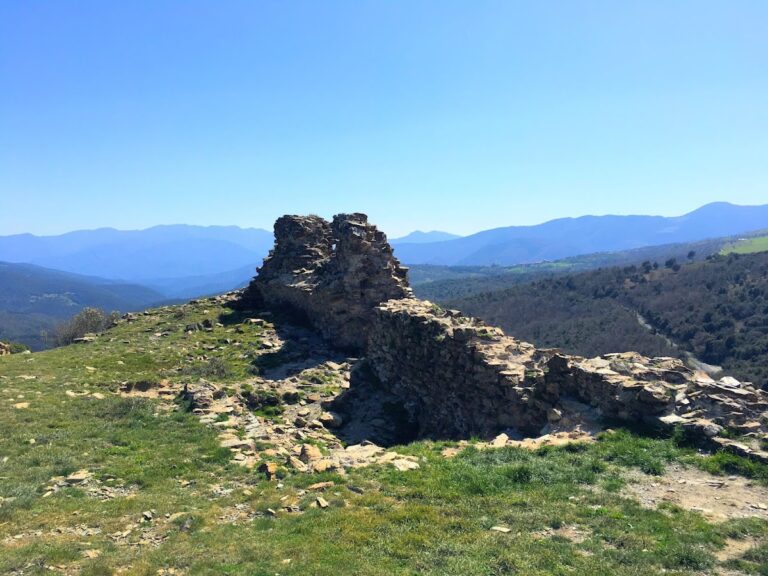
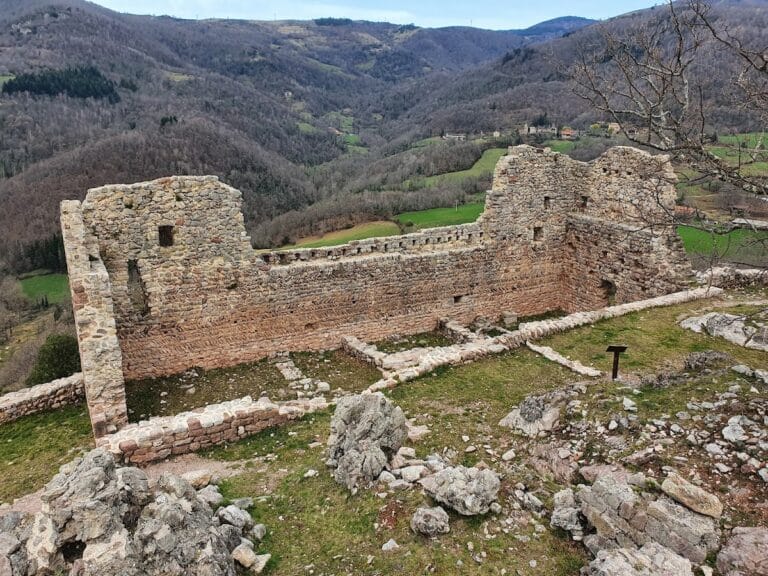
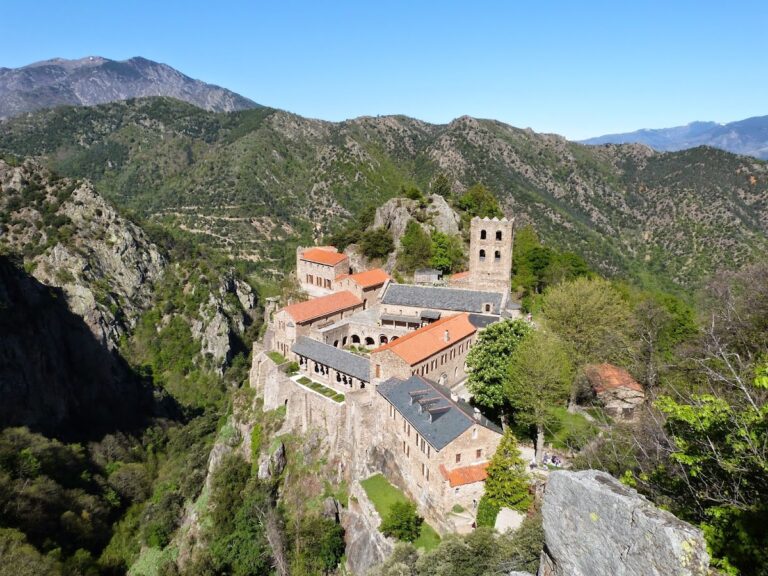
The ruins stand at about 1,100 metres above sea level on the crest of a hill on Puig de Vilafort, east of its summit and roughly 800 metres north of Montferrer. They lie near Mas Figueres to the north and Les Abadies to the northwest. The fortification is closely joined to a rocky outcrop, making the masonry and natural rock difficult to distinguish from a distance.
Two interlocking fortifications survive on the hilltop. To the southwest, the remains extend towards a ruined round tower linked by two walls. The entrance consists of a vaulted doorway set between two rock walls, combining the natural defensive position with the surviving built structure.
Chapel of Santa Maria de Mollet
The ruins also include identifiable remains of the chapel of Santa Maria de Mollet. Santa Maria is a Christian title for the Virgin Mary. The chapel had two parallel naves and served as the church of the settlement until a new church was established. Its surviving remains preserve the connection between the castle complex and the former village of Mollet.
Nearby sites