Rouelbeau Castle: A Medieval Fortress in Switzerland
Site at a Glance
- Rating
- 4.6
- Popularity
- Very Low
- Country
- Switzerland
- Primary era
- Medieval
- External website
- Open
- Eras represented
- Medieval
- Civilizations
- Unclassified
- Site type
- Military
- Remains
- Fort
On this page10 sections
History
Rouelbeau Castle is a medieval fortress in Switzerland, near Meinier in the canton of Geneva. The Faucigny lords established it at the beginning of the fourteenth century during a prolonged struggle with the counts of Geneva, the lords of Gex, and the house of Savoy for control of the Geneva region. Its position helped secure Faucigny’s access to Hermance, a newly founded settlement on the southeastern shore of Lake Geneva, and formed part of a defensive chain with fortifications at Hermance, Nernier, and Les Allinges.
Early traditions and the Faucigny fortress
Earlier activity is suggested by scattered Roman-period finds from the marshes around the upper Seymaz, although these do not establish a direct connection with the medieval castle. A 1785 drawing by Hans Conrad Escher von der Linth identified the ruins as a fifth-century castle of Gundobad, the Burgundian king, but no evidence supports that attribution. A later nineteenth-century attempt to identify Rouelbeau with Quadruvium, supposedly a royal residence of Gundobad’s son Sigismund, was also abandoned when Quadruvium came to be located at Carouge.
The first medieval fortress was a quadrangular wooden installation completed on 7 July 1318 under the knight Humbert de Choulex, a vassal of Hugues de La Tour et de Coligny, known as Hugues Dauphin. In 1319 the site became a Faucigny administrative castellany, a territorial district governed from a fortified center, and Hugues Dauphin acquired it from Humbert. The fortress served as a garrison rather than a feudal residence. It apparently held two or three infantrymen in peacetime and about ten foot soldiers and six cavalrymen during war.
Amadeus V, Count of Savoy, attacked Rouelbeau in 1321. After his death in 1323, his sons Edward and Aymon continued the attacks. The fortress was still described as wooden in 1334. In 1339, an artificial mound was formed in the marshland and the installation was protected by a double moat. That same year Faucigny transferred Rouelbeau to Hugues de Geneva, Baron of Gex, before it returned to Humbert de Choulex in 1341.
Stone rebuilding and Savoyard rule
The stone fortress represented by the surviving ruins was built after the wooden installation, probably between 1339 and 1355. Major strengthening works may have begun under the knight Nicod de Ferney, who inherited the estate from the childless Humbert de Choulex in 1345. In 1355 Faucigny was incorporated into the County of Savoy, and Rouelbeau passed under Savoyard authority as the regional conflict was settled. Its strategic value soon declined. The fortress was progressively abandoned or adapted for other purposes, including use as a prison and later as a hunting lodge. The estate remained with the Ferney family until 1420, when marriage transferred it to the barons of Genève-Lullin.
Geneva’s adoption of the Reformation and declaration of independence in 1536 led to fighting with Savoy, during which Rouelbeau was damaged. Geneva temporarily retained the fortress as security during negotiations over the debts of the Genève-Lullin family, while Bern returned it to the barons in 1564. Under the Treaty of Lausanne of the same year, Meinier was jointly administered by Geneva and the dukes of Savoy for more than two centuries.
Decline, protection, and archaeological renewal
After the last representative of the Genève-Lullin family died in 1664, the estate passed to Claude-Alexandre de Fauchier, Baron de l’Etoile. His son François-Emmanuel sold it nineteen years later to Jacques de Loys, lord of Bonnevaux and owner of the nearby hamlet of Merlinge, but the buildings continued to decay. François Carron inherited the ruins in 1793 and was expropriated after the French invasion of 1798; the state later leased the property.
During the nineteenth century, local people used the ruins mainly as a quarry, and fragments were incorporated into buildings nearby and in neighboring villages. Paintings from the period also show the site as a destination for day trips from Geneva. The surrounding marshes were systematically drained from 1915, while the Seymaz was channelled to create cultivable land and counter rural depopulation.
Rouelbeau entered Geneva’s first register of historic monuments in 1921, under the canton’s first monument-protection law. It was described then as the last surviving medieval castle remains in the canton and became the first building placed under that protection. Over much of the twentieth century, however, vegetation continued to grow over the exposed masonry. Restoration and renaturation of the Seymaz marshes from 2000 to 2002 renewed archaeological interest. From 2001, the Cantonal Archaeological Service excavated, preserved, and interpreted the site, with campaigns continuing through 2014 and broader enhancement measures through 2016. The work clarified the sequence from the earlier wooden fortress to the later stone construction and revealed traces of the wooden installation.
Rouelbeau is classified in the Swiss inventory of cultural property of national significance. The site was reopened in September 2016 after restoration and interpretation work, making the surviving remains accessible through an educational route.
Legends of Rouelbeau
A longstanding legend identifies the White Lady of Rouelbeau with the unnamed repudiated wife of Humbert de Choulex, supposedly rejected because she had not borne a son. She is described as a beautiful ghost wearing a diadem who haunts the ruins and is associated with disappearances and unexplained deaths, especially on Christmas Eve. Some versions say that the castle and its former inhabitants briefly return in their past splendor.
A version recorded in 1870 and published in 1902 tells of Jean Bahut, who supposedly encountered the White Lady while hunting near the ruins on Christmas Eve during the French occupation of Geneva. In this story, she rewarded his devotion to his widowed mother with gold and silver, then punished a greedy relative by trapping him fatally in the castle vaults. Another local tradition concerns a black cat with glowing eyes that roamed the marsh on foggy evenings and attacked its victims. The story may be linked to the 1567 execution of Claude and Jenon Dexert, brothers who lived at the marsh’s edge, were accused of witchcraft, and confessed under torture. One tradition interprets the cat as their avenging spirit.
Remains
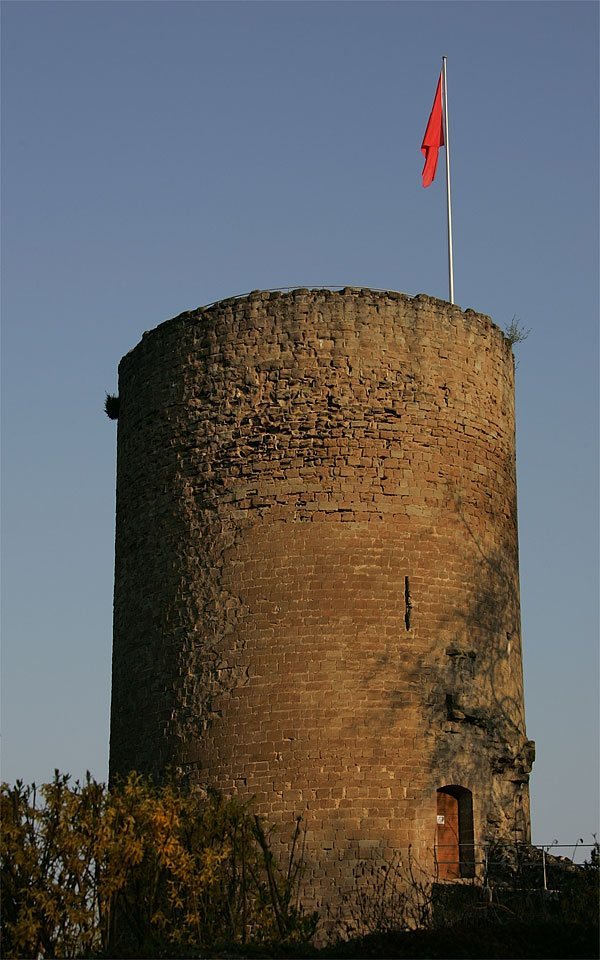
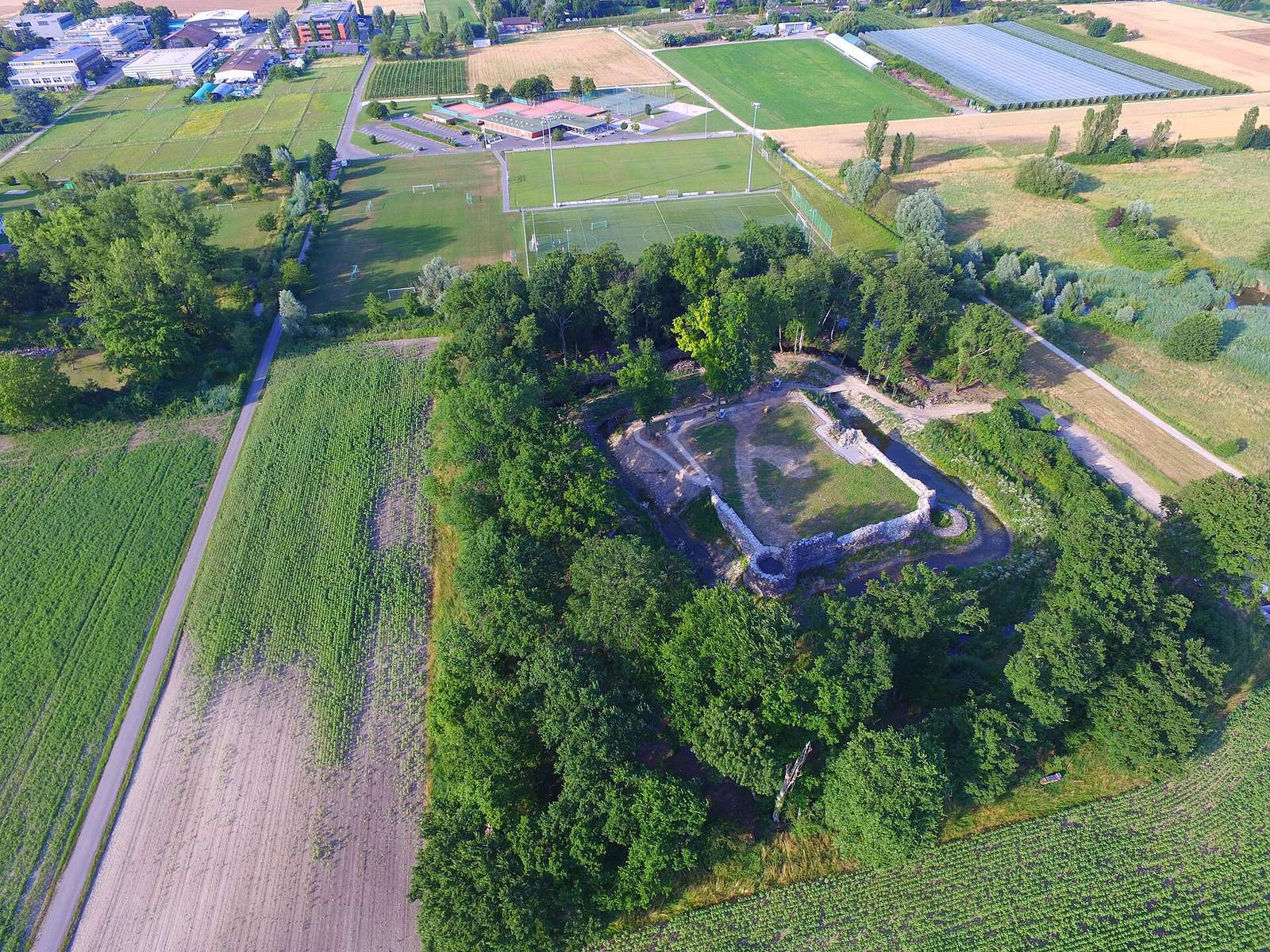
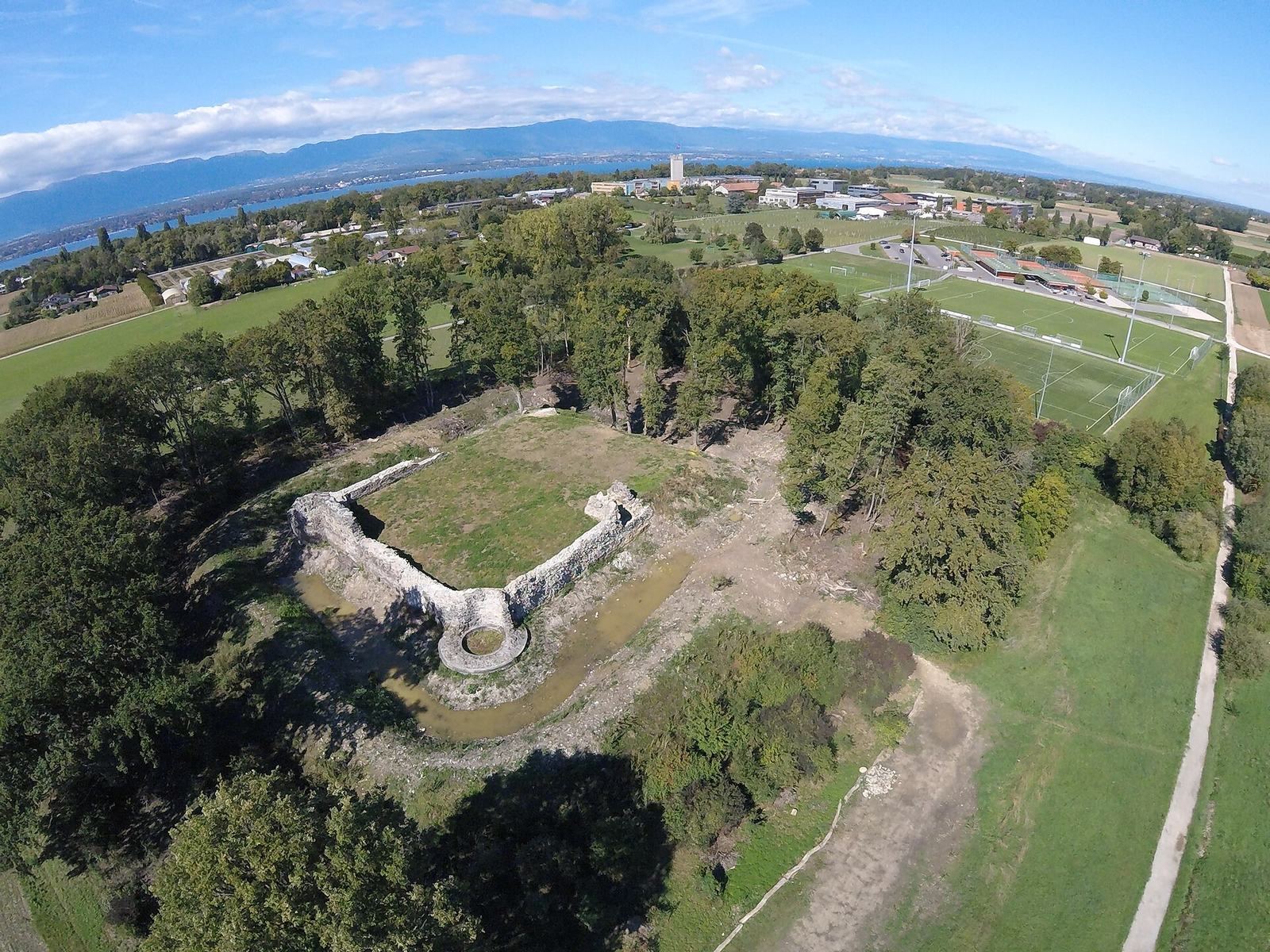
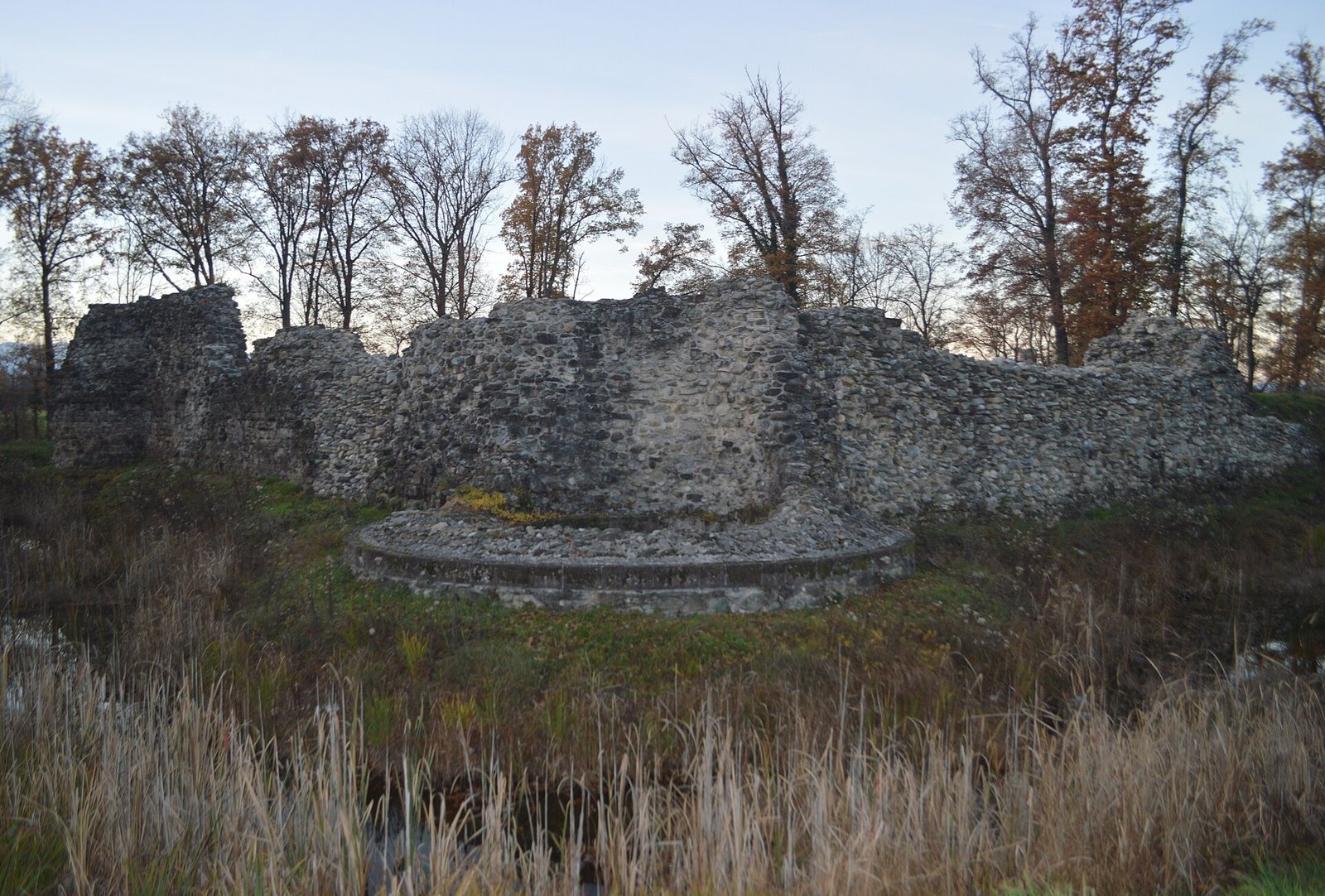
Rouelbeau stands on a marshy plain near the sources of the Seymaz. The castle occupied an artificial elevation formed from clay dug out of the surrounding water-filled ditches. The medieval stone enclosure had a rectangular plan measuring about 52 by 39 metres, with four circular corner towers and a rectangular entrance tower. The surviving masonry is built from rounded stones and molasse, a soft local sedimentary rock.
Stone enclosure and defenses
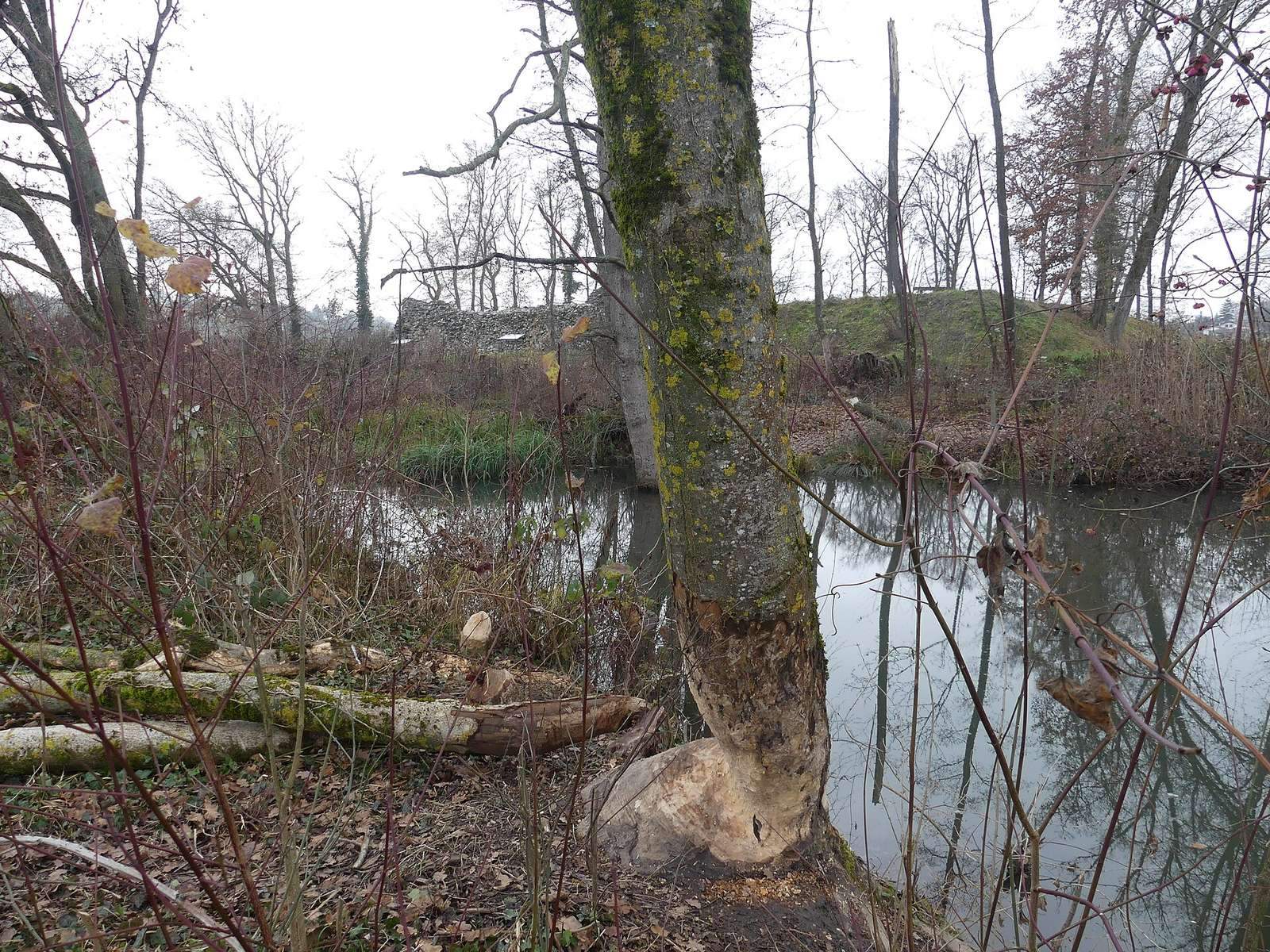
The four circular corner towers were each about 9 metres in diameter, with walls approximately 2.25 to 2.3 metres thick. Two large defensive ditches surrounded the fortress, and both remain visible, partly filled with water. Excavated clay was used to raise the castle mound. Today, substantial sections of the enclosure walls survive, together with the outline of the principal gate and the foundations of two of the later corner towers. These remains define the main defensive form of the stone castle.
Earlier wooden fortress
Archaeological work identified the earlier quadrangular wooden installation beneath or alongside the later masonry. It stood on the artificial mound behind a wooden palisade and two large moats. A paved or stone path connected the fortress with neighboring farms and hamlets. Most excavated areas were later covered with sand and then with soil from the excavations, protecting the evidence while retaining the interpreted sequence between the wooden and stone phases.
Archaeological finds
Excavations recovered a lead papal bull, a formal papal document authenticated by a lead seal, issued under Pope Innocent IV, who was pope from 1243 to 1254. Because the seal predates the fourteenth-century fortress, it may indicate that Rouelbeau served as a repository for archives connected with the Faucigny lordship, although that interpretation remains tentative. Other finds include fragments of a lead-glazed ceramic jug decorated with chevrons, several coins, and a ceramic signal horn.
Recording and interpretation
Three-dimensional drone photogrammetry and topographical recording produced an accurate digital model of the site and supported the creation of a bronze scale model placed at the ruins. An in situ three-dimensional application and information panels present the reconstructed appearance and successive building phases. The educational route passes through the interior and exterior of the remains and explains their surviving volumes and defensive arrangement.