Castle of Arnedillo: A Medieval Rock Fortress in La Rioja


Site at a Glance
- Rating
- 4.2
- Popularity
- Low
- Country
- Spain
- Primary era
- Medieval
- Eras represented
- Medieval
- Civilizations
- Crown of Castile
- Site type
- Military
- Remains
- Castle
On this page9 sections
History
The Castle of Arnedillo is a medieval rock fortress in Spain’s La Rioja, associated with the establishment of Christian authority in the Cidacos Valley from the tenth century onward. Its position may have helped control movement through the valley, while most of the surviving fabric dates from the thirteenth century. By the late twelfth century, the fortress had also become a visible expression of the lordship exercised by the Bishopric of Calahorra, the ecclesiastical authority that governed the diocese and held territorial power in Arnedillo.
From royal donation to episcopal lordship
Alfonso VIII, king of Castile, named Arnedillo and the castle dominating Lomiella in a donation made in 1170 to Rodrigo de Cascante, bishop of Calahorra. From the last third of the twelfth century until the nineteenth century, the Bishopric of Calahorra controlled the castle. Its officers were appointed by the bishops, who used the fortress as an instrument of seigneurial authority over the settlement.
A change in the administration of the lordship caused conflict in the early thirteenth century. Around 1223, Bishop Juan Pérez de Segovia exchanged Arnedillo and other properties with the cathedral chapter of Calahorra, the body of clergy responsible for the cathedral’s administration. The inhabitants resisted the arrangement and the authority of the bishop’s castle officer. Their opposition developed into repeated unrest, particularly in 1232, when residents protested at the palace and castle.
Ferdinand III, king of Castile and León, investigated the revolt through a monk from San Millán de la Cogolla, the mayor of Calahorra, and the mayor’s brother, who served the king. The people of Arnedillo then swore to recognize the authority of the bishop and the castle officer. They also paid homage to the council’s knights and a fine of 300 maravedíes, a medieval and early-modern Iberian monetary unit, for the damage caused during the disturbance.
Castle officers and contested control
The office responsible for governing and guarding the fortress was held by successive castle officers. A property-sale document from 1247 names Gil Domínguez in the position. In 1328, Pedro Ochoa de Ciuvarri tried to seize the castle with the support of Juan Alfonso, lord of Cameros, and his sons. The archdeacon of Calahorra, a senior cleric with authority in part of the diocese, held the legitimate office and recovered the fortress after the bishop intervened. Fortín, also called Fortún, Ochoa served as castle officer in 1428.
The appointment of Juan Fernández de Chaoz in 1545 followed a formal transfer of authority. He swore an oath with his right hand placed on a cross, received a staff of justice from the deputy mayor, and went to the castle, where the outgoing officer handed him the keys. The ceremony linked the physical custody of the fortress with the legal authority of the office.
Prison and episcopal administration
Under the Diocese of Calahorra, the castle also functioned as a prison. From the sixteenth century, its tower generally held rebellious monks. An inventory made in 1575 for castle officer Francisco de Xureta and prison judge Francisco Fernández listed keys for large iron doors, two gun barrels, iron shackles, stocks, and a chain.
Several prisoners are associated with this use. Juan Jiménez de Alfaro, archdeacon of Álava, was confined in the castle in 1524. In 1764, the priest Juan José Gómez, from the Gallinero de Cameros area, escaped after breaking the locks on his cell door. Juan Jerónimo González, the castle officer and lord of Arnedillo, pursued him and eventually recaptured him.
End of lordship and modern conservation
Episcopal authority over Arnedillo and the fortress was reaffirmed during successive eighteenth-century reigns. It ended in the nineteenth century, when the Cortes of Cádiz abolished episcopal lordships. The castle later became known as Castle Lombera, and the surrounding area began to serve as a cemetery, a use that continues today.
A palace stood near the castle from at least the thirteenth through the seventeenth century. It temporarily accommodated the bishop and other important visitors and was probably situated in the area now occupied by the cemetery. By the middle of the eighteenth century, it had apparently become ruinous, and no description of its building survives.
The municipality of Arnedillo now owns the castle. Deterioration during the twentieth and early twenty-first centuries created an urgent need for repairs. A restoration approved by the Government of La Rioja in 2020 was completed at the end of 2021, restoring the tower and part of the enclosing wall. The castle is protected as a Cultural-Interest Asset, a heritage designation used in Spain.
Remains
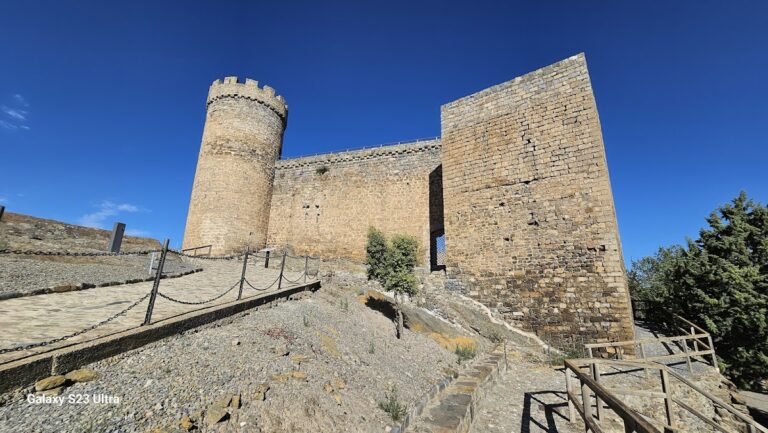
The surviving fortress occupies a rocky crag at about 654 metres above sea level. Its elevated position provided defensive security. The remains are organized around a square tower and sections of an enclosing curtain wall, a defensive wall surrounding a fortified area. Both are built with small dressed stone blocks and rubble masonry, creating a compact structure adapted to the rocky height.
The surviving tower
The tower has a regular square outline on the exterior, while its interior is irregular. It originally contained a ground floor and three upper levels. The former floor positions are marked by beam sockets, holes and recesses in the masonry that held the supporting timbers. The upper end of the tower is truncated, leaving its original termination unknown.
Narrow loopholes, or arrow slits, light the tower and allowed observation or the use of weapons. A larger square opening with a wooden lintel is set on the third floor. It once protected a wooden hoarding, a projecting timber defensive structure attached to a fortification. The hoarding has disappeared, but two rows of sockets for its embedded timbers remain visible in the wall.
The entrance faces west. A monolithic mitre arch, formed from a single stone arrangement with two large slabs on its inner side, frames the doorway. This treatment is uncommon among buildings in the Iberian Peninsula and may reflect a later alteration to the tower.
Enclosing curtain wall
Parts of the curtain wall survive beside the tower in the same combination of small dressed stone and rubble masonry. The longest surviving stretch follows the rocky escarpment, using the edge of the crag as part of the fortress boundary. A shorter section is attached to the tower and extends southward. The restored portion of this wall, together with the repaired tower, forms the principal surviving fabric of the castle.
Palace and cemetery area
The palace associated with the castle occupied an area probably corresponding to the present cemetery. It served as temporary accommodation for the bishop and other important visitors between at least the thirteenth and seventeenth centuries. Its ruinous condition by the mid-eighteenth century and the later cemetery use give this part of the site a history distinct from the surviving tower and curtain wall.