Sebezh Fortress: A Russian Frontier Stronghold in Sebezh


Site at a Glance
- Rating
- 4.8
- Popularity
- Low
- Country
- Russia
- Primary era
- Unclassified
- Eras represented
- Unclassified
- Civilizations
- Unclassified
- Site type
- Military
- Remains
- Fort
On this page9 sections
History
Sebezh Fortress was a Russian frontier stronghold in Sebezh, Russia, established in 1535 during the early modern period on the site of earlier fortifications. Sebezh had first appeared in a chronicle in 1414 as a Pskov prigorod, or subordinate town, when Grand Duke Vytautas of Lithuania captured and plundered it.
Foundation and the Siege of 1536
During the Starodub War, Russia reconquered the Sebezh district in 1535. The earlier fortress had already disappeared, so Prince Ivan Shuisky ordered a new wooden stronghold to be built on the ancient site. Ivan Buturlin directed the work, while the Italian architect Petrok Maly Friazin, who had come from Moscow, supervised its construction. Five hundred handgunners arrived from Pskov with a large baggage train.
The new fortress was named Ivan-city-on-Sebezh in honor of the Beheading of John the Baptist. In February 1536, it resisted a siege by Polish-Lithuanian forces commanded by King Sigismund I, the king of Poland and grand duke of Lithuania. Repeated assaults failed and inflicted heavy losses. During the attackers’ retreat across Sebezh Lake, the ice collapsed beneath them; the defenders then made a sortie and completed their defeat.
After the war, Sebezh remained part of the Russian state in 1537 and served as a frontier fortress. In the same year, following the successful defense, Elena Glinskaya, regent during the minority of her son Ivan IV, ordered the construction of a Church of the Holy Trinity inside the stronghold.
Repeated Changes of Possession
Sebezh changed hands repeatedly over the following centuries. During the Livonian War, a major conflict over territories in northeastern Europe, the fortress was captured in 1579 by the 50,000-strong army of King Stephen Báthory. Russia regained it in 1582, but Sebezh passed to the Polish-Lithuanian Commonwealth, the state formed by the union of Poland and Lithuania, in 1618.
Russian troops captured the town during the Smolensk War, after which a peace settlement ceded it to the Commonwealth again. Russia took Sebezh once more in 1654, but the Treaty of Perpetual Peace returned it to the Commonwealth in 1678. A report submitted to Tsar Alexei Mikhailovich in 1654 described the fortifications and noted that they had undergone no major changes during the Polish period, although the number of gates had been reduced by half.
Strengthening under Peter I
Russian forces captured Sebezh again during the Great Northern War in 1705, a conflict involving control of territories in northeastern Europe. In 1707, fearing an advance by enemy forces from Riga, Peter I ordered a stronger garrison to occupy the fortress and additional defenses to be constructed around it. Defensive ditches and a bastion, a projecting fortification designed to provide defensive fire along a wall and cover approaches, were built on the mountain later called Petrovskaya Mountain. Sebezh territory was finally incorporated into Russia in 1772, following the First Partition of Poland, the division of Polish-Lithuanian territory among neighboring powers.
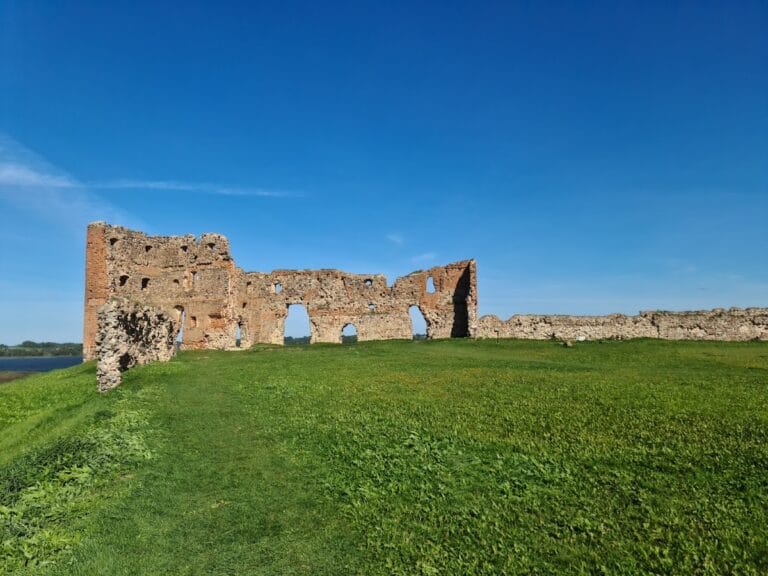
Sebezh Fortress is now a protected cultural-heritage monument of federal significance in Russia. The fortress itself is described as destroyed, while its historical layout and defensive features remain central to the interpretation of the site.
Remains
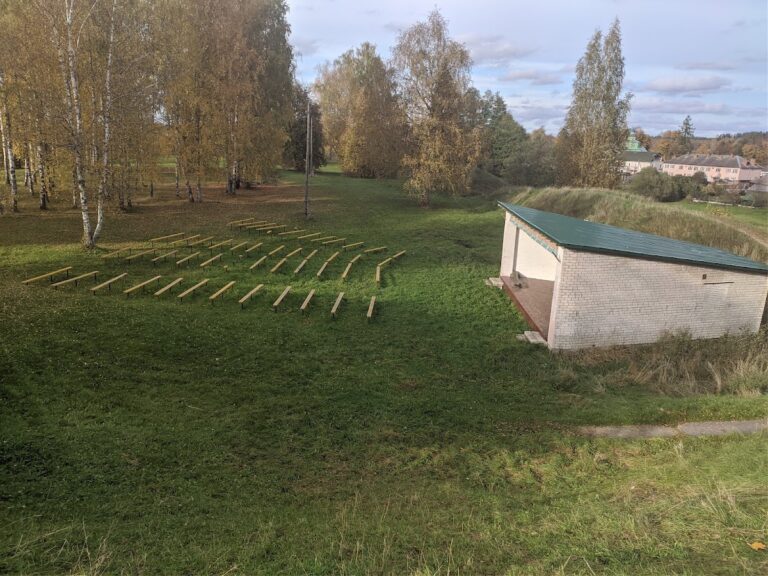
The fortifications occupied the Castle Peninsula, which projects into Sebezh Lake, using the peninsula’s natural landscape as part of the defense. The central stronghold stood at the tip, on the peninsula’s highest ground. A wooden wall followed an earth rampart approximately 350 meters long. A reconstructed plan represents the fortress as it stood at the end of the sixteenth century.
Central Stronghold and Outer Town
Detinets
The fortress core was a detinets, the fortified central stronghold of a medieval or early-modern Russian town. During the Polish period it was called the Castle. Within this small enclosure stood a storehouse with a cellar beneath it for gunpowder, lead, cannonballs, and other artillery supplies, together with twelve granaries. The Church of the Holy Trinity was also built inside the detinets in 1536.
Outer Town
A settlement developed outside the main enclosure and was surrounded by a wooden wall strengthened with towers in 1541. This outer town, comparable to a fortified posad, or settlement outside the main stronghold, measured 704 sazhen according to the 1654 report. The same report gave the Kremlin’s circumference as 78 sazhen, its rampart height as 16 sazhen, and the outer-town rampart height as 9 sazhen. It also recorded four gates in the outer town.
Defenses of Petrovskaya Mountain
The later defenses on Petrovskaya Mountain included ditches and a bastion built in 1707. The bastion blocked approaches from the northeast, while another bastion controlled access from the northwest. These works formed part of the strengthening ordered during Peter I’s government, when the fortress again served as a Russian military position.