Mingary Castle: A Medieval Stronghold on Ardnamurchan
Site at a Glance
- Rating
- 4.9
- Popularity
- Low
- Country
- United Kingdom
- Primary era
- Medieval
- External website
- Open
- Eras represented
- Medieval, Early Modern
- Civilizations
- Kingdom of Scotland
- Site type
- Military
- Remains
- Castle
On this page13 sections
History
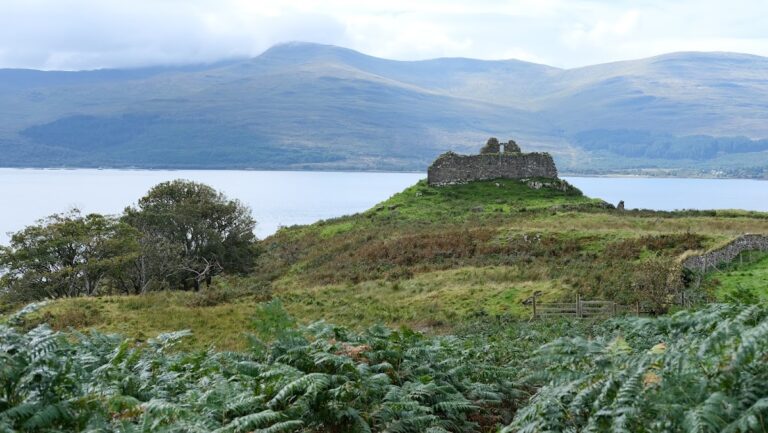
Mingary Castle is a medieval Scottish castle in the United Kingdom, near Kilchoan on the Ardnamurchan Peninsula. Its foundation date and founder are uncertain, but its origins are placed in the thirteenth or fourteenth century, possibly under the MacDougalls or the MacIains, the Ardnamurchan branch of the MacDonalds. Built on the southern coast of the peninsula, it commanded the entrance to the Sound of Mull, the route toward the Isle of Mull, and the sea passage to Loch Sunart.
The MacIains and the Scottish crown
Mingary became the seat of the MacIains of Ardnamurchan, who belonged to the wider MacDonald grouping associated with the Lords of the Isles, a powerful Gaelic lordship in the medieval western Highlands and islands. The first recorded event at the castle took place on 25 October 1493, when King James IV stayed there during his campaign against John of Islay, Lord of the Isles. James returned on 18 May 1495, and the MacIains helped him suppress a rebellion led by Donald MacDonald of Lochalsh.
Relations between the MacIains and the MacDonalds of Lochalsh later deteriorated. Donald MacDonald unsuccessfully besieged Mingary in 1515. His second assault, in 1517, captured the castle and partly destroyed it, after which the fortress was repaired. In 1519, James V granted Ardnamurchan and its castles to Colin Campbell, 3rd Earl of Argyll. The MacIains initially retained Mingary, but their control eventually ended when Archibald Campbell, 7th Earl of Argyll, transferred the castle in 1612 to his brother-in-law Donald Campbell of Barbreck-Lochow. Donald was authorised to recruit a garrison at the earl’s expense and expelled the MacIains.
Sieges and seventeenth-century warfare
Mingary was drawn into wider clan warfare in 1588, when the MacIains became involved in a feud between the MacDonalds of Dunnyvaig and the Glens and the MacLeans of Duart. Lachlan MacLean captured John, chief of the MacIains, and besieged the castle with help from soldiers of a Spanish Armada vessel. After three unsuccessful days, MacLean withdrew when neighbouring clans assembled a relief force that outnumbered his men.
The castle also faced another unsuccessful attempt by the MacDonalds to recover it in 1622. In 1644, during the English Civil War, Alasdair MacColla, also known as Colkitto, captured Mingary for Charles I. General David Leslie retook it for the Covenanters in 1647. The Covenanters were Scottish Protestant forces aligned with the National Covenant and opposed to aspects of royal religious policy during the seventeenth-century civil conflicts. Mingary returned to Campbell custody in 1651.
Alterations, garrison, and abandonment
During the late sixteenth century, the medieval fortress was adapted for firearms, including muskets. The northern curtain wall was heightened and strengthened, a new battlement was added, the seaward battlements were renewed, and projecting corner turrets were built. The southern entrance was constructed or substantially remodelled. Further changes affected the northwestern and western wall walks during the seventeenth century, and the main entrance may also have been remodelled.
In 1696, Archibald Campbell, 10th Earl of Argyll, granted Ardnamurchan, including Mingary, to Alexander Campbell of Lochnell. Alexander began further alterations in the early eighteenth century, including the construction of new buildings within the castle. Alexander Murray acquired the castle and its associated land in 1723. Following his death in 1743, English troops occupied Mingary during the second Jacobite rising, an attempt to restore the Stuart dynasty to the British throne. The garrison numbered 59 by January 1746, while Donald Campbell of Auchindoun administered the castle.
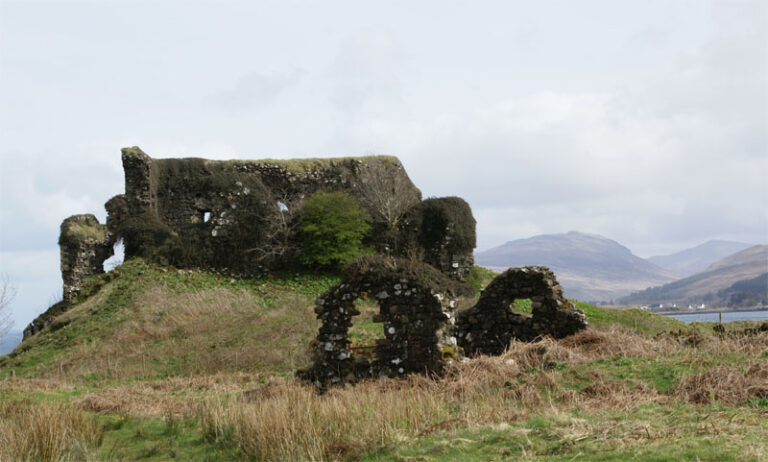
James Riddell acquired the whole of Ardnamurchan, including Mingary, around 1770, and his descendants owned the castle until 1848. The date of abandonment is uncertain, although the buildings were probably still habitable in 1838. After the castle was abandoned, valuable or reusable materials were removed, beginning its gradual decline.
Investigation and preservation
The Mingary Castle Preservation and Restoration Trust was established in 2013 at the initiative of owner Donald Houston. Archaeological excavation and emergency stabilisation began that year to investigate the castle’s uncertain early history and prevent further deterioration. Later restoration work sought to make the ruin safe and usable again, and access to the castle reopened in March 2016.
In 2006, the television programme Wreck Detectives investigated a shipwreck in the Sound of Mull directly below the castle. The wreck was dated to 1644. Mingary was designated a Historic Marine Protected Area in 2013, while the castle remains protected as a Category A listed building and a scheduled monument. A scheduled monument is protected under United Kingdom legislation because of its archaeological or historical importance, and Category A is Scotland’s designation for structures of national or international architectural or historic significance.
Remains
Fortification and setting
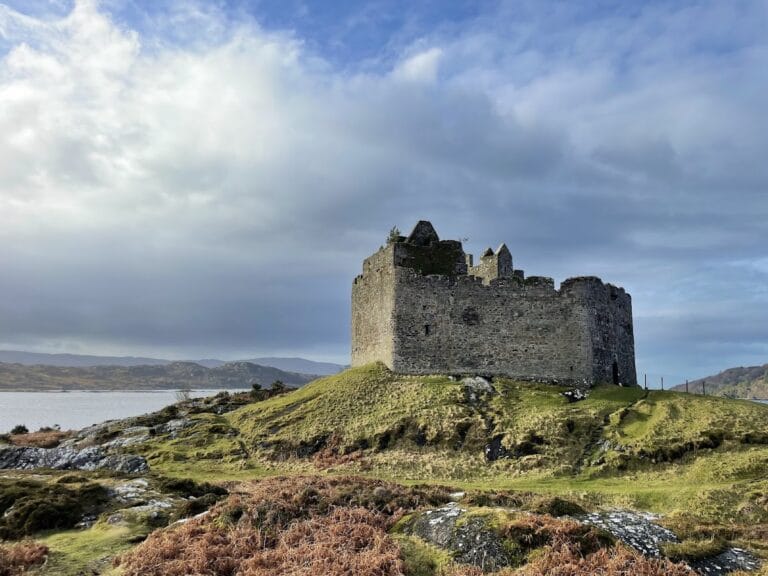
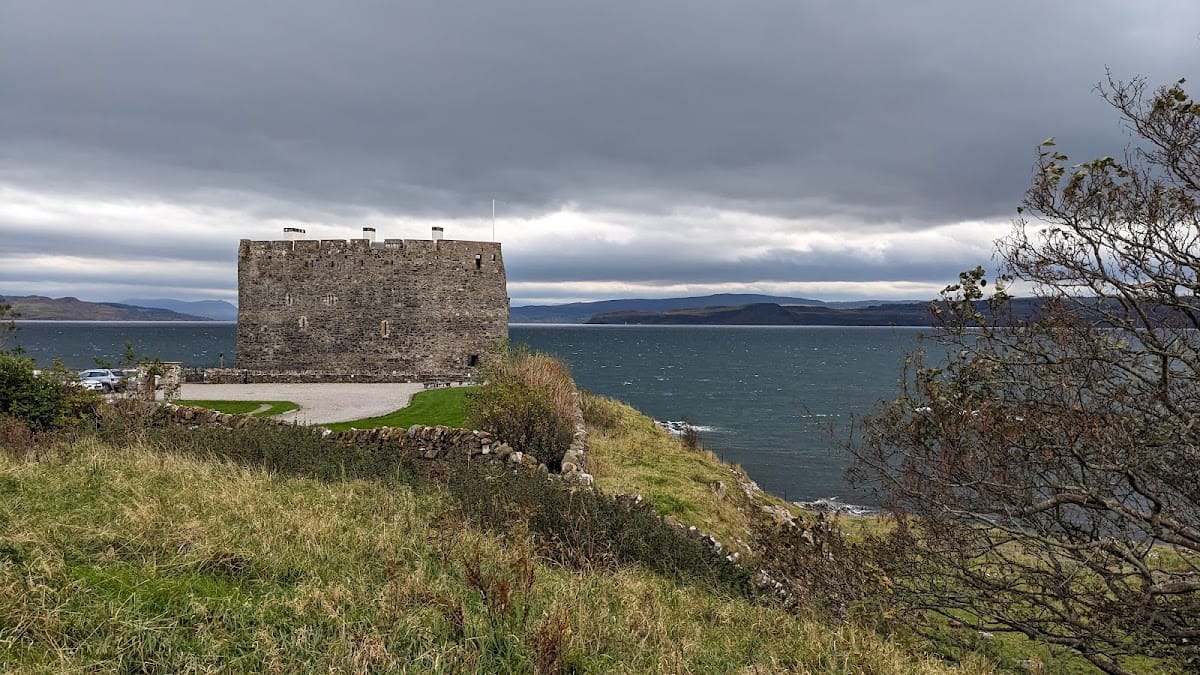
Mingary Castle occupies a rocky ridge about 1.5 kilometres southeast of Kilchoan, approximately 24 feet above the sea on the southern coast of Ardnamurchan. Water surrounds the rock on three sides. The compact enclosure follows the natural outcrop in an irregular hexagonal plan measuring about 19.7 by 17.9 metres. This position made Mingary the westernmost fortification on the British mainland.
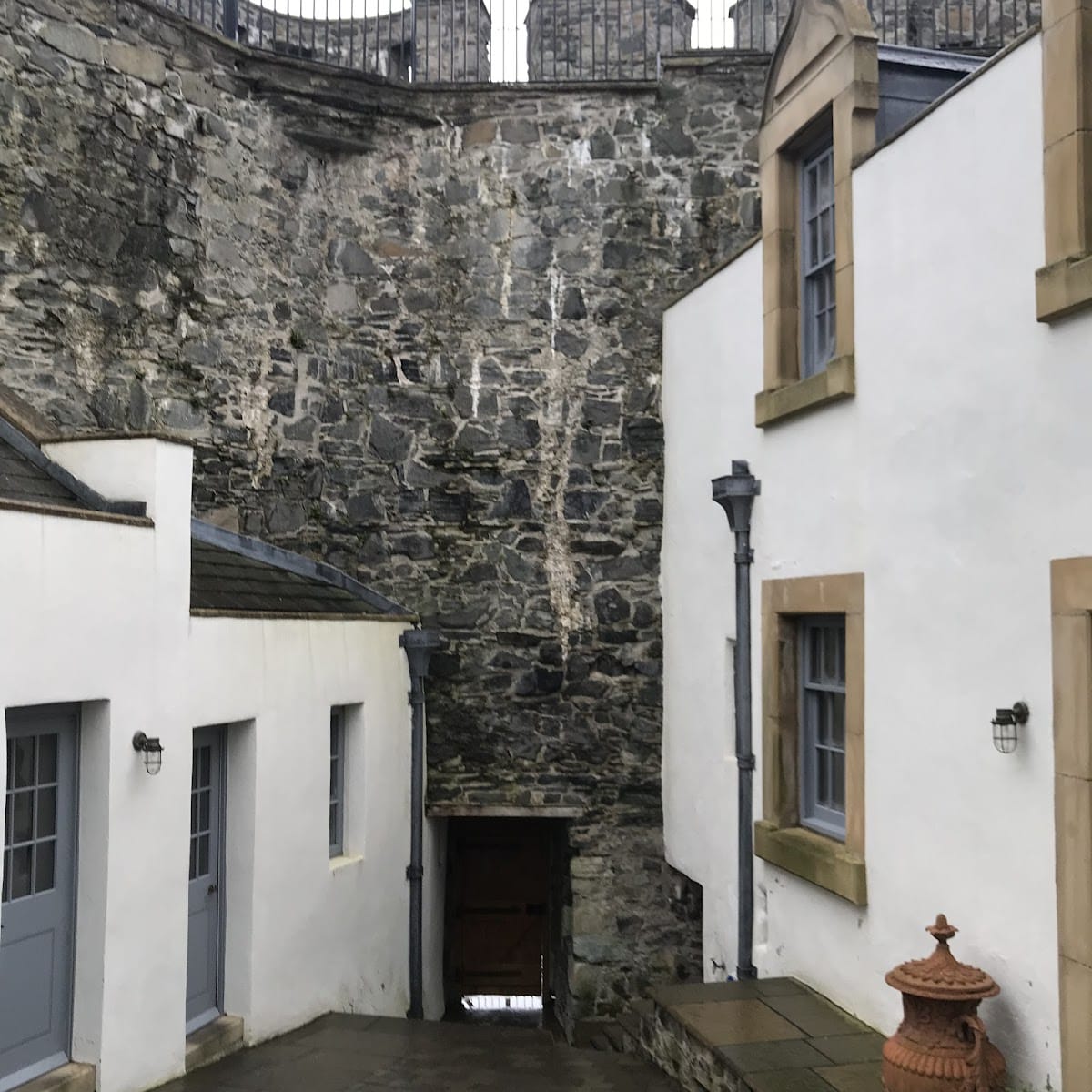
A sandstone curtain wall, the enclosing defensive wall of a castle, surrounds the site. Dressed-stone details are set into rubble masonry brought from the Inninmore quarry on the Morvern Peninsula. The wall retains parts of its wall walk, the protected passage along its top, and a crenellated parapet with alternating raised sections and openings for defence. On the seaward side it is about 1.8 metres thick and approximately 8.5 metres high. Near the main entrance on the landward side, it reaches up to 2.7 metres in thickness and 14 metres in height.
Entrances and northern defences
The northern landward side contains narrow slit windows and is protected by a neck ditch about 3 metres deep and 7.5 metres wide. A drawbridge once crossed the ditch. It was replaced by the present stone bridge in the eighteenth century and later reinstated during restoration work. The principal entrance lies at the northwestern corner of the enclosure.
A smaller entrance on the southern, seaward side is approached from the shore by a stair cut into the rock. It may be the older original entrance. Its narrow gate measures only 2 feet 10 inches, approximately 86 centimetres, across. Two projecting corner turrets defend this southern gate, one at the southwest corner and the other at the southeast. Both date from the late sixteenth century.
Buildings within the enclosure
Northern range
A three-storey building stands against the inner face of the northern curtain wall. Built in the early eighteenth century, it replaced an earlier hall. Each floor contained two rooms of different sizes, and the building carried a pitched roof. Its surviving masonry forms the principal internal building along the northern side of the courtyard.
Western building
The inner western curtain wall carries the ruin of a two-storey building constructed at the same time as the northern range. It may have served as the castle kitchen. Its position against the enclosing wall forms one side of the courtyard’s internal arrangement.
Southeastern building
Remains of a single-storey building occupy the southeastern side of the courtyard, opposite the western building. It was built later than the northern and western structures, but still during the eighteenth century.
Circulation and architectural comparison
A partly surviving stone stair in the northwestern corner of the courtyard led to the wall walk. The castle’s strong resemblance to Castle Tioram has prompted the suggestion that both fortifications were built by the same master builder.