Glengorm Castle: A Scots Baronial Country House on the Isle of Mull


Site at a Glance
- Rating
- 4.8
- Popularity
- Low
- Country
- United Kingdom
- Primary era
- Modern
- External website
- Open
- Eras represented
- Modern
- Civilizations
- British
- Site type
- Domestic
- Remains
- Castle
On this page6 sections
History
Glengorm Castle, also known as Castle Sorne, is a nineteenth-century country house in the United Kingdom, on the Isle of Mull near Tobermory. Designed by Kinnear and Peddie in the Scots Baronial style, it was commissioned in 1856 by James Forsyth of Quinish after he purchased the Mishnish estate. Scots Baronial architecture reinterpreted medieval Scottish castles and fortified houses through towers, turrets, and other historicist forms.
Estate Clearance and Construction
Forsyth cleared existing townships to create the setting for the new house, including the settlement of Sorne. A township was a rural community whose residents commonly held or worked small agricultural holdings, so the clearance displaced people while reorganizing the estate for another use. Many of those forced to leave moved to Tobermory in search of work.
The building was completed in 1860. A related tradition places its final completion shortly before Forsyth died in a riding accident in 1863. Local folklore portrays him as deeply unpopular because of the pressure placed on residents during the clearance. One story says that he took an elderly woman’s land title, ordered her away, and enclosed her land so she could not leave to obtain supplies. According to the tale, men brought provisions to her over the nearby cliffs.
Traditions and Later Use
Another tradition holds that an elderly woman cursed Forsyth never to live in the house. He died before he could do so. The name Glengorm is traditionally connected with Gleann Gorm, meaning “blue glen.” The “blue” is said to refer to smoke produced when houses containing seaweed and peat were burned during the clearance of surrounding settlements.
The property was later used as a guest house and wedding venue before becoming a family home. Glengorm Castle has been protected as a Category B listed building since 20 July 1971. In Scotland, this designation recognizes a building of considerable regional or local importance, or a major example of a particular period or type, and provides legal protection for its architectural and historic interest.
Remains
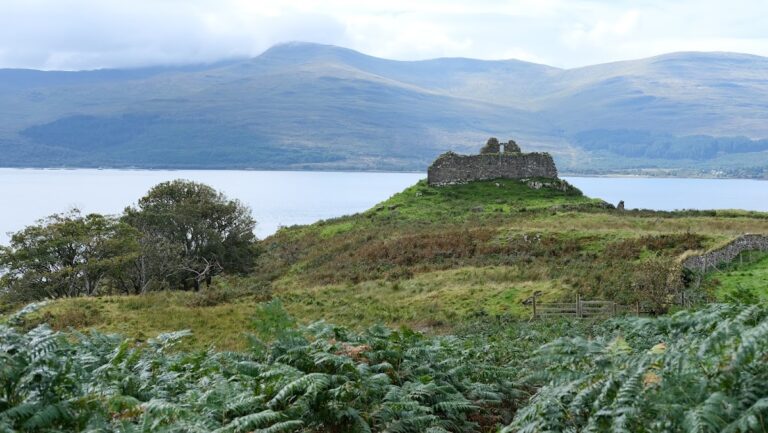
Glengorm Castle stands at Mishnish, about 6 kilometres northwest of Tobermory on the Isle of Mull. The house occupies a coastal promontory overlooking the Atlantic Ocean. Its Scots Baronial design gives the building the historicist character of a reinterpreted medieval Scottish castle, while the surrounding grounds include standing stones and a pond.
The House and Coastal Setting
The position of the house provides broad views from its northern side. Coll and the mainland of Great Britain are visible on most days, while clear conditions extend the view to Rùm, Canna, Barra, and Uist, including the Outer Hebrides.
Former Stable Block and Grounds
The associated stable block survives as part of the estate and contains a café and shop. The wider grounds retain standing stones and a pond, adding archaeological and landscape features to the setting of the country house.