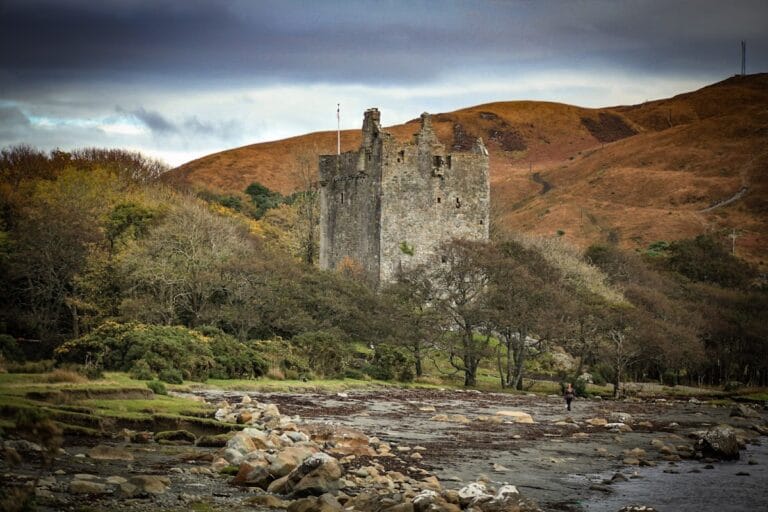
Aros Castle: A Medieval Stronghold on the Isle of Mull


Site at a Glance
- Rating
- 4
- Popularity
- Very Low
- Country
- United Kingdom
- Primary era
- Medieval
- Eras represented
- Medieval
- Civilizations
- Unclassified
- Site type
- Military
- Remains
- Castle
On this page6 sections
History
Aros Castle is a ruined medieval stronghold in the United Kingdom, near Salen on the Isle of Mull. Built in the thirteenth century probably by a MacDougall lord of Lorn, it formed part of a defensive network intended to control the Sound of Mull. The castle and its harbor became among the most important places on Mull.
MacDougall origins and the Lords of the Isles
The MacDougalls extended their territory to Mull after the death of Somerled, a twelfth-century Gaelic-Norse ruler who established a major lordship across the western Scottish islands and mainland. Their possession of Aros ended in the early fourteenth century when they supported the losing side in the conflict between Edward I of England and Robert the Bruce. Robert the Bruce, the Scottish king Robert I, confiscated their lands and granted Aros to Angus Og of Islay, a leading member of the MacDonald dynasty.
From the fourteenth century, Aros belonged to the MacDonalds, Lords of the Isles. These MacDonald rulers controlled a powerful Gaelic lordship based in the Hebrides and western Scotland, and Aros formed part of their political and military organization on the western seaboard. The castle was recorded as Dounarwyse Castle and served as an occasional base during the late fourteenth and fifteenth centuries. Donald, the second Lord of the Isles, and John, the fourth Lord of the Isles, both issued documents from Aros.
Royal intervention and later decline
In 1493, James IV of Scotland broke the power of the Lords of the Isles, and Aros passed to Clan MacLean of Duart. Their principal seat was nearby Duart Castle. In 1608, Andrew Stewart, Lord Ochiltree, used Aros as a base while suppressing a revolt by local leaders against James VI. A Scottish nobleman and royal representative, Stewart also entertained the island chiefs at Aros before having them taken prisoner.
During the 1670s, the Duke of Argyll conquered Mull, after which Aros passed to Clan Campbell. The castle mattered less to its new owners, partly because Tobermory provided a larger and better harbor. In 1688, Aros was described as “ruinous, old, useless and never of any strength.” Argyll’s troops nevertheless garrisoned it in 1690. The castle and harbor were not maintained, and Aros fell into ruin after about 1690.
Aros Castle has been protected as a Scheduled Monument since 26 March 1991. This legal status applies to the castle, its bailey, associated domestic buildings and settlement remains, and the small stone-built galley landing.
Remains
Promontory defenses and harbor
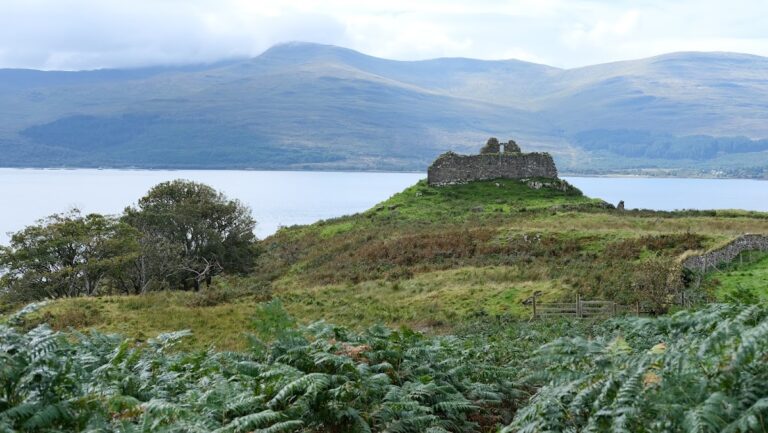
The castle occupies a rocky promontory beside the Sound of Mull, on the northern side of the mouth of the Aros River. The plateau drops almost vertically toward the water. On the flatter landward side, a rock-cut ditch and accompanying bank defended the approach, which crossed the ditch by a drawbridge. A curtain wall enclosed the plateau, with scattered sections surviving. The small harbor stood at the mouth of the Aros River, while a stone-built galley landing lay east of the bailey.
Hall-house and bailey buildings
The ruins include a rectangular thirteenth-century hall-house and a bailey, an enclosed courtyard containing subsidiary buildings. The enclosed area covered approximately 0.19 hectares. The hall-house was probably about 12 metres high, with two storeys beneath an attic, and some of its walls remain standing. Two buildings are securely contemporary with it and probably had two full storeys, with attic accommodation in part. Five smaller building remains may belong to a later phase. The former hall-house is heavily overgrown, while the other surviving walls are barely recognizable.