Sandown Castle: A Tudor Coastal Artillery Fort in Kent


Site at a Glance
- Rating
- 4.6
- Popularity
- Low
- Country
- United Kingdom
- Primary era
- Early Modern
- Eras represented
- Early Modern
- Civilizations
- British, English
- Site type
- Military
- Remains
- Castle
On this page9 sections
History
Sandown Castle is a Tudor coastal artillery fort in the United Kingdom, built by Henry VIII between April 1539 and autumn 1540 in a transitional style influenced by Italian methods of defence. It formed part of the Crown’s Device programme, a royal order for strengthening England’s coastline against invasion, and helped protect the Downs anchorage near Deal in east Kent.
Construction and coastal defence
The castle was built during a period of tension between England, France, and the Holy Roman Empire, a multi-state political entity in central Europe ruled in part by Emperor Charles V. After Henry VIII broke with Pope Paul III and annulled his marriage to Catherine of Aragon, France and the Empire formed an alliance against England in 1538, creating the threat of invasion.
Sandown, Deal, and Walmer castles were constructed to guard the Downs, a sheltered anchorage protected by the Goodwin Sands and linked to landing grounds near Deal Beach. The three stone forts, known collectively as the castles of the Downs, were supported by four earthwork forts and a defensive ditch and bank extending for 2.5 miles, or 4 kilometres. Their combined cost to the Crown was £27,092. Richard Benese served as surveyor, William Clement as master carpenter, and Christopher Dickenson as master mason.
Military use and the Civil Wars
The immediate invasion danger declined, but Sandown continued in military use. Surveys in 1616 and 1634 identified major repair needs, estimated at £437 and £1,243. An inspection in 1635 considered the castle reasonably sound but antiquated. In 1641, a proposal called for £8,000 to be spent on the three Downs castles, including £3,000 for additional sea defences.
Sandown played little part in the First English Civil War and was taken by Parliamentary forces in 1642. During the Second English Civil War of 1648–49, Royalist supporters of Charles I rebelled against Parliament, with support from Scottish forces. Sandown declared for the king and came under Royalist control after a wider uprising began in Kent. Parliament feared that the Royalist coastal fortresses and navy could allow foreign troops or military aid to land on the coast or reach the Scottish allies.
After Parliamentary forces defeated the wider Kentish insurgency at the Battle of Maidstone in early June 1648, Colonel Nathaniel Rich led the campaign against the Downs castles. Walmer surrendered on 12 July, Deal was attacked in late July, and artillery fire against Sandown began in August. Royalist forces tried to relieve the castle from the fleet on 10 August and again on 15 August, when 750 men landed with support from 50 soldiers from the garrison. Both attempts failed, and Sandown surrendered on 5 September 1648, several weeks after Deal.
Later garrison and royal custody
Parliament sent ammunition and gunpowder to Sandown in 1649. During the Interregnum, the period of republican rule between the execution of Charles I and the restoration of Charles II, additional earthworks were built between Sandown and Deal because of the threat of Dutch attack. The garrison consisted of a governor and 21 soldiers. After the restoration of Charles II in 1660, it was reduced to a captain and 18 men.
In 1664, the Crown detained the former Parliamentarian Colonel John Hutchinson at Sandown. His wife, Lucy Hutchinson, publicised his imprisonment and described the castle as ruinous and the conditions as inhumane. Hutchinson died there after several months, and his doctor attributed his physical decline to the conditions of confinement.
During the Glorious Revolution of 1688, the townspeople of Deal seized Sandown for William III, Prince of Orange, against his predecessor James II. The castle therefore remained connected to national political conflict even after its principal Tudor invasion purpose had changed.
Decline, demolition, and protection
The sea broke through the castle’s outer walls in 1785, and erosion continued along the coast. By 1793 the fort was considered unfit for habitation. It was repaired and regarrisoned during the French Revolutionary Wars, when two new artillery batteries were built to the north.
In the early nineteenth century, the developing coastguard service used the castle in efforts to suppress local smuggling. The War Office sold reusable materials from the fortification in 1863 for £564 and demolished its upper parts, leaving a level platform over the lower keep and bastions. Stone was taken to Walmer Castle for building work, while other masonry was reused in Deal Pier.
Coastal erosion destroyed one of the adjacent artillery batteries, while the other was adapted for coastguard use. In 1882, the Royal Engineers used explosives to remove approximately 600 tonnes of masonry for an officer’s house at Dover Castle. Further demolition in 1893 destroyed most of the remaining stonework, and guncotton, a highly explosive form of nitrated cotton, was used in 1894 to blow up the seaward bastions and keep.
Deal purchased the remaining ruins from the government for £35 so they could form part of the town’s sea defences. Between 1988 and 1989, the surviving masonry was encased in concrete to create a sea wall, although the remains remain vulnerable to coastal erosion. Sandown is protected under United Kingdom law as a scheduled monument, a nationally protected archaeological or historic site, with the designation recorded in 1960.
Remains
Central fort and artillery defences
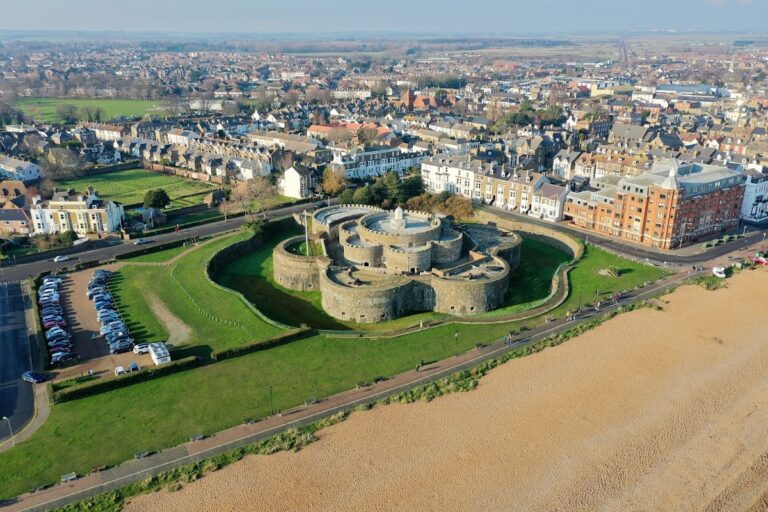
Sandown was a moated stone artillery castle measuring approximately 165 by 165 feet, or 50 by 50 metres, and covering about 0.59 acres, or 0.24 hectares. A central keep, approximately 83 feet, or 25 metres, across, stood within a surrounding curtain wall, the enclosing defensive wall linking the castle’s projecting positions. Four rounded bastions, also called lunettes, projected from the fort. The curved walls were about 15 feet, or 4.6 metres, thick, and the plan was nearly identical to that of Walmer Castle.
The fort had three artillery tiers. Its upper levels contained 39 firing positions, while the basement had 31 gunloops, small openings intended for handguns used in close defence. The artillery embrasures, openings in the walls through which guns were fired, were widely splayed to give the weapons room to operate and traverse. Internal vents were designed to remove smoke produced by firing.
Associated earthworks
Sandown formed part of a larger coastal defensive system. Four associated earthworks were known as the Great Turf, the Little Turf Bulwark, the Great White Bulwark of Clay, and the Walmer Bulwark. A ditch and bank extended for 2.5 miles, or 4 kilometres, linking the wider defences around the Downs anchorage.
Later batteries and surviving fabric
Two artillery batteries were added north of the castle during the French Revolutionary Wars. Continuing erosion destroyed one of them, while the other was converted for coastguard use. Demolition reduced the castle to a level platform across the lower parts of the keep and bastions. Stone was removed for use at Walmer Castle and Deal Pier, and approximately 600 tonnes was taken in 1882 for construction at Dover Castle.
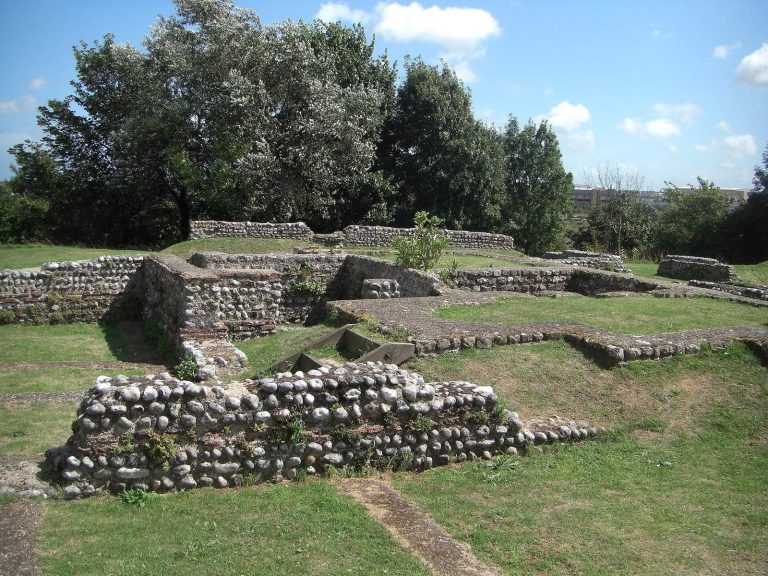
The surviving masonry was encased in concrete in 1988–89 to form part of a sea wall. Only limited ruins remain, and the surviving fabric continues to face erosion from the sea.