Burg Gemen: A Water Castle and Youth Educational Centre in Germany


Site at a Glance
- Rating
- 4.3
- Popularity
- Low
- Country
- Germany
- Primary era
- Medieval
- External website
- Open
- Eras represented
- Medieval, Early Modern, Modern
- Civilizations
- German, Holy Roman Empire, Kingdom of Prussia
- Site type
- Domestic
- Remains
- Castle
On this page11 sections
History
Burg Gemen is a historic water castle in Borken, Germany, whose origins lie in the farm of Gamin, first mentioned in 962 as a fief of the Vreden convent. The site was probably fortified as a motte, a defended residence built on a raised mound, during the ninth or tenth century. The first reliable reference to the castle itself dates from 1274. It later became the centre of the Lordship of Gemen and the seat of the influential von Gemen family.
Origins and the von Gemen lordship
The owner of Gamin in 962 was Mathilde, who traced her ancestry to Widukind, the Saxon leader remembered for resisting the Frankish conquest and for his later place in Saxon genealogy and legend. From 1100, Bernhardus appears as the first Vreden vogt, or secular administrator, to use Gemen as a family name.
From the twelfth century, the lords of Gemen repeatedly came into conflict with the prince-bishops of Münster. These bishops also held secular authority in the region, while the owners of Gemen sought to preserve their status as imperial immediates, territories subject directly to the Holy Roman Emperor rather than to a regional prince. To maintain that position, the castle’s lords formed shifting alliances with the counts and later dukes of Cleves, the archbishop of Cologne, and the imperial free city of Dortmund.
During the second half of the thirteenth century, advantageous marriages and successful feuds greatly enlarged the lordship. When Heinrich III von Gemen became head of the family in 1370, the family rose rapidly among Westphalia’s important noble houses. Heinrich acquired the castle from his feudal lord, converting it into allodial property, meaning hereditary family land rather than a feudal fief. He continued enlarging the complex until 1411. An inscription stone identifies Heinrich and his wife, Katharina von Bronkhorst, as the builders of this phase.
Heinrich’s son Johann II extended the family’s territory westward into Gelderland. After Heinrich IV died without a male heir in 1492, the castle and lordship passed through his daughter Cordula von Gemen to her husband, Count Johann IV of Holstein-Schaumburg and Sternberg.
Reformation and confessional conflict
Johann IV’s grandson, Jobst II von Holstein-Schaumburg-Gemen, introduced the Lutheran Reformation in Gemen from 1560. This established one of Westphalia’s oldest Protestant communities. Jobst’s support for the Dutch revolt against Catholic Spain brought a military response. In 1568, forces commanded by Fernando Alvarez de Toledo, Duke of Alba, besieged and plundered Gemen.
During the Thirty Years’ War, Jobst-Hermann, a grandson of Jobst II, succeeded in keeping the ancestral residence almost entirely unharmed. His death without marriage in 1635 led to a succession dispute. His aunt Agnes von Limburg-Styrum, the abbess of Vreden, prevailed and later transferred the inheritance to her nephew Hermann Otto I von Limburg-Styrum. Hermann Otto’s son Adolf Ernst made an unsuccessful attempt to restore Catholicism in Gemen.
Imperial immediacy and transformation into a residence
In 1694, Hermann Otto II von Limburg-Styrum won a long dispute with the Bishopric of Münster over territorial sovereignty in proceedings before the Imperial Chamber Court, the supreme judicial institution of the Holy Roman Empire. An agreement of 15 September 1700 made the Lordship of Gemen immediately subject to the emperor. Hermann Otto II then transformed the former defensive complex into a residential castle.
The lordship faced another succession crisis in the eighteenth century. In 1772, Damian August Philipp Karl, Prince-Bishop of Speyer, received Gemen as a feudal grant, but he relinquished it in 1775 in favour of Count Ferdinand Menrad von Limburg-Styrum-Illeraichen. Count Simon August von Lippe-Detmold also asserted succession rights through the Holstein-Schaumburg counts. His soldiers occupied the castle in a surprise attack while disguised as peasants. The Limburg family recovered it in January 1776, when the frozen moat made the complex accessible from every side.
From imperial territory to modern ownership
Alois Sebastian von Bömelberg zu Erolzheim inherited Burg Gemen and the lordship in 1800. On 12 July 1806, Gemen was mediatized, a process that ended the direct status of formerly immediate imperial territories and incorporated them into larger states. It consequently lost its imperial immediacy and became part of the Principality of Salm. After the Congress of Vienna, Gemen was assigned to Prussia in 1815.
Johann Ignatz Franz von Landsberg-Velen acquired the castle complex on 24 May 1822. King Friedrich Wilhelm IV of Prussia raised him to the rank of count on 15 October 1840, after which he used the title Count von Landsberg-Velen und Gemen. His descendants remain the owners of the castle.
Burg Gemen survived the First World War, the November Revolution, and the Second World War without significant damage, including damage from bombing and military operations. In 1946, at the initiative of Clemens August Graf von Galen, Bishop of Münster, the castle was leased to the Diocese of Münster. Since then, the complex has operated as Jugendburg Gemen, a youth educational centre. It contains more than 200 beds and more than 20 seminar rooms, and courses and religious-orientation days are held there under the representation of a castle chaplain.
Musical and cultural education has formed an important part of the centre’s work since 1946. This activity led to the foundation of the Werkgemeinschaft Musik im Bistum Münster. Since 1951, its principal annual event, the Choral and Instrumental Music Week, has brought together an average of about 120 participants from different generations for workshops. Burg Gemen is protected as a cultural monument in North Rhine-Westphalia.
Remains
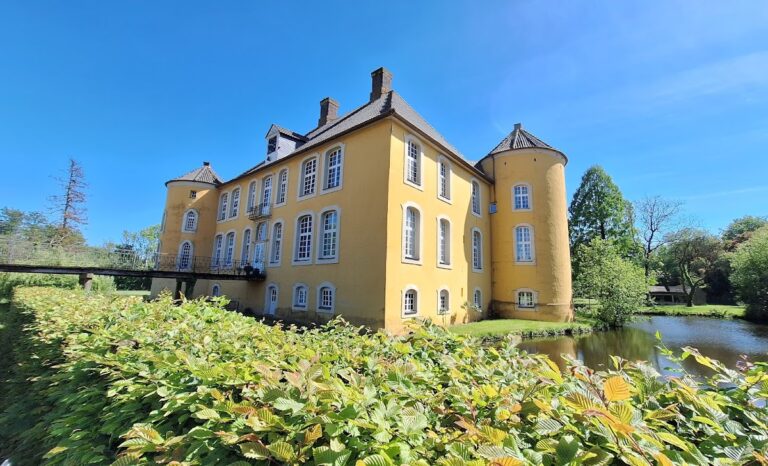
Burg Gemen is a water castle set in the Münsterland park landscape, in the valley of the Bocholter Aa and on land that was formerly extensive marshland. The river supplies the moats around the complex. Two artificial islands form its principal layout: the main castle occupies the northern island, while the southern island formerly held the outer bailey, the secondary enclosure for stores, stables, workshops, and other service functions.
Medieval fortress
By the middle of the thirteenth century, under Goswin von Gemen, the castle had developed into an almost circular ring fortress, whose continuous enclosing wall surrounded the main island. Its round bergfried, the principal defensive and refuge tower of a medieval German castle, had walls two metres thick. The foundations of the tower survive within the nearly circular ring wall. A residential building probably stood inside the enclosure, although its presence cannot be established with certainty. The complex is regarded as the successor to an earlier motte castle.
In the fourteenth century, a new ring wall almost doubled the area of the main castle and gave it a polygonal plan. The expanded enclosure included a small two-storey residential palace measuring 8 by 17.5 metres and probably a rectangular residential tower in the north. The form of the western buildings belonging to this earlier core can no longer be determined.
Present main castle
By 1411, Heinrich III had brought the castle to its present size. A new three-storey western palace contained a large hall and a vaulted cellar. The former bergfried was raised to four storeys and became the Ball Tower. A brick Battery Tower, also called the Chapel Tower, was constructed at the same time. A berm wall, a strengthened strip of defensive ground along the base of a fortification, reinforced the ring wall on the south, west, and north sides.
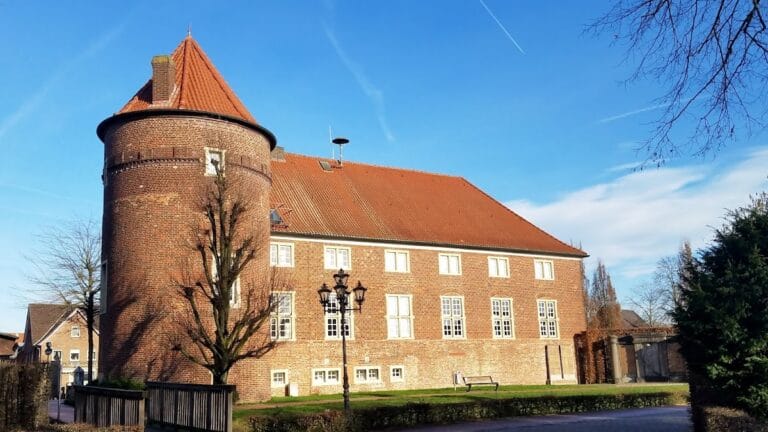
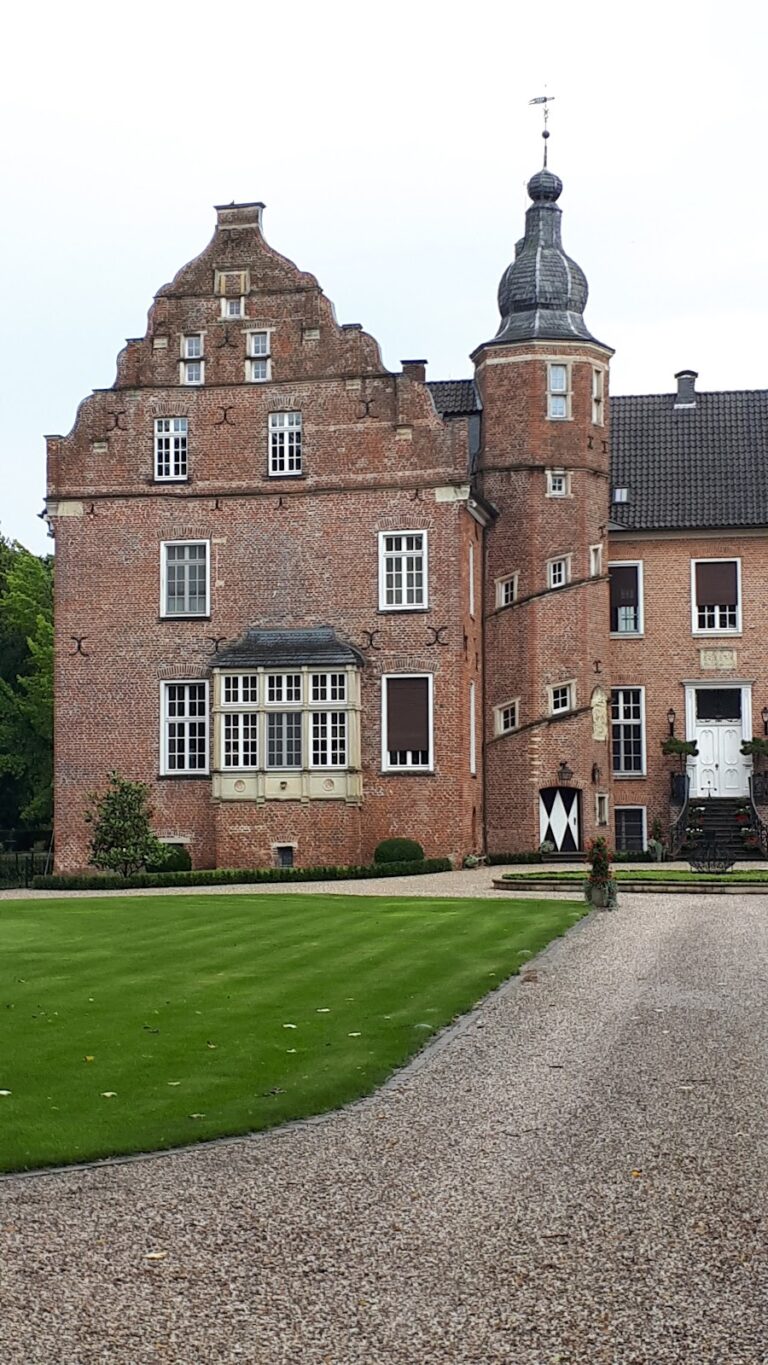
The present main castle has an irregular plan. Its principal palace occupies the western side and is a large three-storey building with a high roof. A tall round tower adjoins it on the north, while further three-storey wings extend along the north and east sides. Their end facades finish in stepped gables. A tower in the southern part contains the castle chapel, and the buildings enclose a small inner courtyard. The former principal approach was a single bridge from the south; a small wooden bridge now crosses the northern moat to the main castle.
Residential alterations
A clock tower was added in the courtyard during the sixteenth century, probably in 1571. In the seventeenth century, under Hermann Otto II von Limburg-Styrum, changes to the Gothic exterior gave the complex a slightly Baroque appearance. The portal of the northern wing was completely redesigned in a classical Roman style, with two lion statues flanking the staircase to the main entrance. In 1692, the exterior received yellowish stucco marked with white lines that imitated masonry joints.
Seventeenth-century interior work divided large rooms into smaller chambers, added fireplaces, and introduced stucco decoration. The Rittersaal, or Knights’ Hall, in the northern part of the western palace is the only large hall that remains.
Outer bailey and later buildings
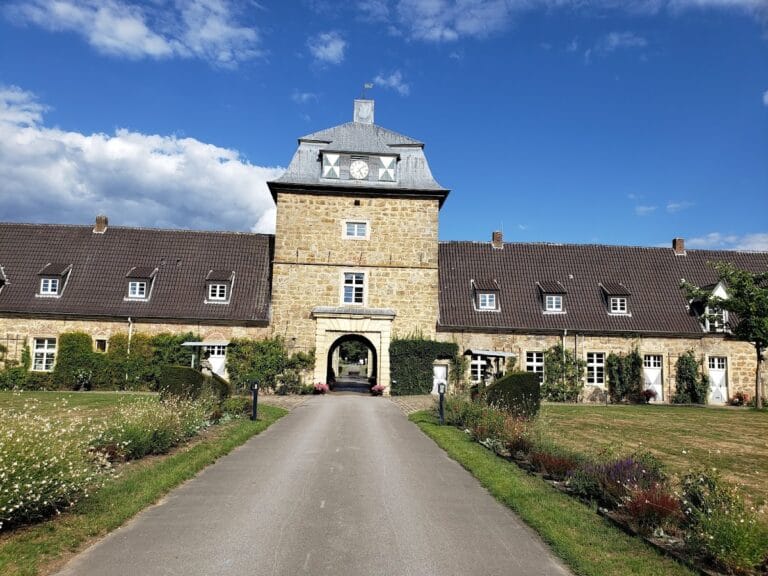
The southern island formerly served as the outer bailey. Its buildings included stores, stables, a bakery, a forge, and other service facilities. The former fortifications have been demolished, while several buildings survive. The outer bailey originally had a single bridge on its western side and now also has a bridge on the south.
A fire in 1865 destroyed the old outer-bailey buildings. They were rebuilt in Neo-Renaissance style, with the work continuing until 1882. The present representational entrance was created during the same rebuilding campaign. Nineteenth- and twentieth-century work otherwise consisted mainly of minor alterations, restoration, and modernization.
Chapels
In 1950, the Michaelskapelle, or Saint Michael’s Chapel, was installed on the ground floor of the eastern palace. Eucharistic celebrations take place in the Michaelskapelle and in the von Galen Chapel, linking the castle’s later educational use with its continuing religious functions.
Nearby sites