Burg Rhede: A High-Medieval Lowland Castle in Germany


Site at a Glance
- Rating
- 4.2
- Popularity
- Very Low
- Country
- Germany
- Primary era
- Modern
- Eras represented
- Modern
- Civilizations
- Kingdom of Prussia
- Site type
- Religious
- Remains
- Monastery
On this page7 sections
History
Burg Rhede, also known as Oldeborg, was a high-medieval lowland castle in Rhede, Germany, on the eastern edge of the town. Probably built in the mid-thirteenth century, it stood on the Rheder Bach opposite the later Schloss Rhede and served as the predecessor of that residence.
The Lords of Rethe and the First Castle
The Lords of Rethe held extensive property in and around Rhede by no later than the twelfth century. They appeared in documents as ministeriales of the Bishop of Münster. These were formally unfree servants who could nevertheless hold influential administrative and military responsibilities. Gerlach von Rethe, known as Bitter, probably built Burg Rhede in the mid-thirteenth century.
The castle remained connected to the authority of the Bishop of Münster. Around 1324, the bishop destroyed it, bringing its first known phase to an end.
Rebuilding and Destruction
Around 1370, the site passed to the Lords of Rhemen, who renewed the old castle seat. In 1379, it was listed among the bishop’s fiefs. A fief was a possession granted by a superior lord in return for service and loyalty, so the listing reflected the castle’s continuing relationship with the bishopric.
Citizens of Bocholt destroyed the rebuilt complex in 1388. Further damage in the years after 1392 is possible, although the surviving historical record does not establish the details. Any reconstruction required the consent of the Bishop of Münster and the cathedral chapter, the governing body of clergy attached to the cathedral.
Transfer to the Schloss Rhede Estate
Reconstruction took place in 1426 on the site of the present Schloss Rhede, across the Rheder Bach. Another rebuilding may have occurred around 1451, but the evidence for that phase remains uncertain. In 1507, the complex, by then called Oldeborg, was united with the recently acquired neighboring estate of Dörbröcking.
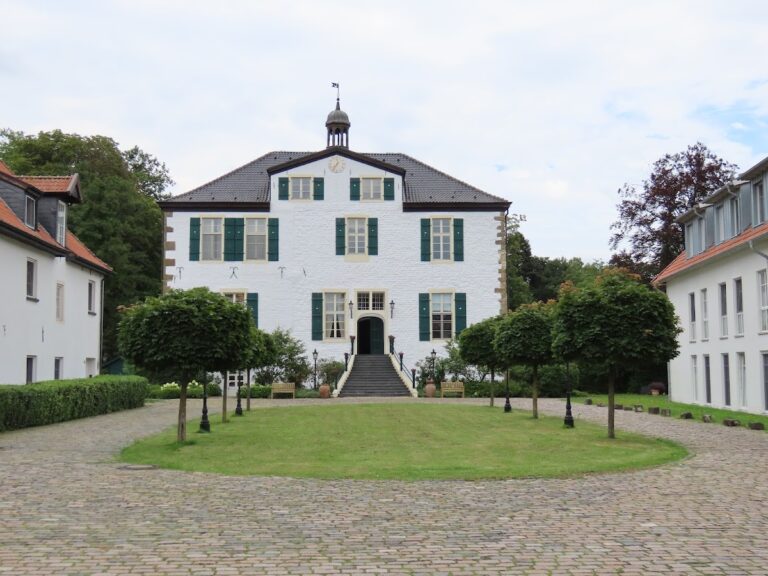
The ownership history of the estate followed that of Schloss Rhede until 1844. A representative residence was then built on the site, and the property changed hands frequently afterward. It entered ecclesiastical ownership in 1921. The St. Gudula monastery was established in its garden in 1924 and 1925, incorporating the existing residence as its south wing. In 1983, the monastery was converted into the Catholic adult-education institution Akademie Klausenhof.
Remains
Castle Site and Setting
Burg Rhede was a lowland fortification, meaning that it occupied relatively level terrain rather than a prominent natural height. Its description as standing “on the mountain” may indicate a motte, a medieval fortification centered on a raised artificial mound and commonly accompanied by a ditch. The castle stood on the Rheder Bach, opposite Schloss Rhede.
The Rheinisch-Westphalian original cadastral survey shows an oval castle area with traces of a surrounding ditch and a rectangular building. These features provide the main surviving indications of the medieval layout. Later construction completely transformed the area, and the visible buildings belong to subsequent phases of the site’s history.
Later Residence and Monastery
The nineteenth-century representative residence now forms the south wing of the St. Gudula monastery. Its incorporation into the monastery reflects the physical transformation of the former castle area after 1844, when the medieval site was replaced by later residential and ecclesiastical buildings.