Burg Grimmenstein: A Medieval Hilltop Castle in Austria


Site at a Glance
- Rating
- 4.5
- Popularity
- Low
- Country
- Austria
- Primary era
- Modern
- Eras represented
- Medieval, Modern
- Civilizations
- Duchy of Austria, Holy Roman Empire
- Site type
- Military
- Remains
- Castle
On this page9 sections
History
Burg Grimmenstein is a medieval hilltop castle in Grimmenstein, Austria, established as a fortress in the twelfth century and first mentioned in 1144. Its position formed part of a defensive network in Lower Austria, and the castle later passed through noble, ducal, ecclesiastical, and imperial ownership before declining into a ruin and undergoing extensive reconstruction.
Foundation and the von Grimmenstein family
The hill was chosen for its defensive position, with steep slopes on three sides making approach difficult. In the thirteenth century, Grimmenstein belonged to a chain of castles and monasteries intended to help guard against Hungarian incursions from the east. Some researchers have proposed that fortifications may have stood on the site as early as the ninth century, although the first documented reference dates from 1144.
The earliest known owner was Alber von Grimmenstein, who appears in records between 1144 and 1158 as a vassal of Count Ekbert III von Formbach-Pitten. His son, also called Alber, joined the Fifth Crusade, a Christian military expedition to the eastern Mediterranean and Egypt that lasted from 1217 to 1221. He is mentioned in connection with the siege of Damietta in 1218, when the crusaders attacked the Egyptian city during the early campaigns of the expedition.
Many male members of the family bore the name Alber. Several held the office of pincerna, a high-ranking court official responsible for serving or overseeing drink, at the courts of the dukes of Styria. The von Grimmenstein family probably died out in 1309. Hademar von Falkenberg was then recorded as the castle’s owner, after which Grimmenstein became ducal property.
Ducal administration and decline
From at least the reign of Duke Albrecht III, burgraves administered Grimmenstein. During the fourteenth and fifteenth centuries, the castle was used as pledged property, meaning that control of it could be transferred as security for a financial obligation. In 1444, Emperor Frederick III sold Grimmenstein, beginning a succession of ownership changes.
By this period, the fortress had lost much of its military importance. Its difficult access and limited comfort also made it unsuitable as a noble residence, and the castle began to fall into decline. After 1470, Frederick III transferred Grimmenstein to the Order of Saint George in an attempt to prevent its complete destruction. Activity resumed in part, and the stone defenses were repaired.
Ecclesiastical and imperial ownership
In 1522, the grand master of the order transferred Grimmenstein to the Diocese of Wiener Neustadt. The castle returned to imperial ownership ten years later. Hans Leroch, the castellan, was the last person known to have lived there for an extended period.
In 1547, Christoph Urschenbeck received responsibility for maintaining Grimmenstein and Wartenstein. His son, Georg Bernhard Freiherr von Urschenbeck, later acquired both fortresses, but they deteriorated without repair. Baron Casimir von Petrovich purchased Grimmenstein in 1693, and his heirs sold it to the Counts of Stella-Caracciolo in 1720. The family retained Grimmenstein and Wartenstein until 1848. The Caracciolo marquises lived in Italy, and no member of the family is recorded as having visited the Austrian property.
Ruin and reconstruction
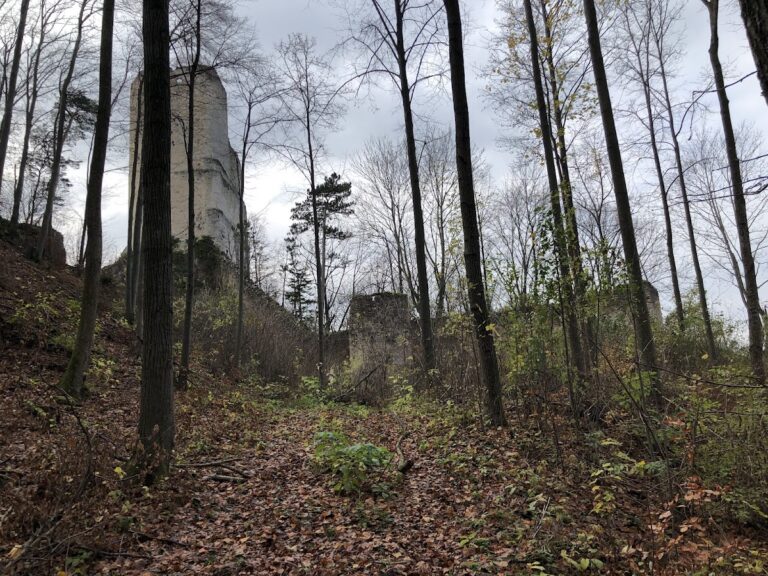
By the beginning of the nineteenth century, Grimmenstein had become a ruin. Local farmers took building materials from the neglected structure and used it as a quarry, contributing substantially to its destruction. The nearby village had previously been called Am Treitl until the twentieth century, when it adopted the name Grimmenstein.
The castle remained in ruins until 1961, when Johann Rigler, a builder from Neunkirchen, purchased it and began a gradual restoration. Under his direction, a three-storey residence in medieval style and a museum area were created. In the early twenty-first century, the property was acquired by Markus Albero Grimmenstein, a descendant of former owners. From July 2014, he continued restoration and reconstruction, financing the work himself without public funds or subsidies. Burg Grimmenstein is listed as a protected monument in Austria.
Remains
Hilltop setting and medieval defenses
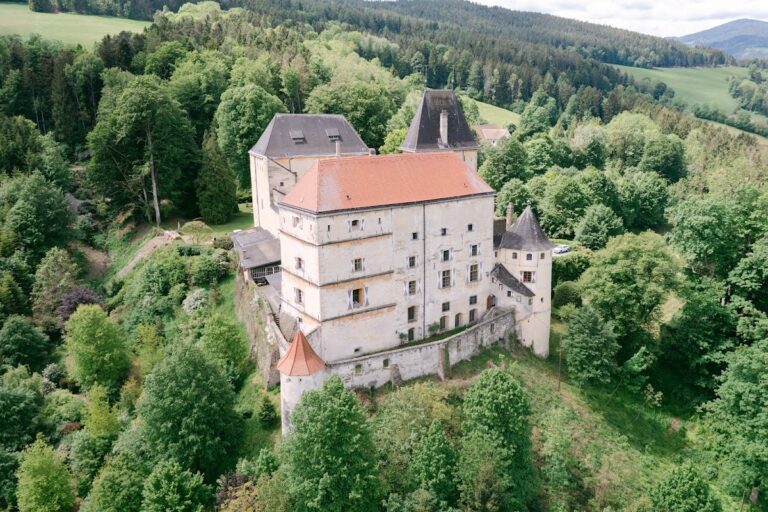
Grimmenstein is a hilltop castle built on a rocky outcrop on the southeast slope of the Kulmriegel in the Pittental. It stands about 100 metres below the Kulmriegel summit, at approximately 660 metres above sea level, while the summit reaches 758 metres. Dense forest surrounds the outcrop. The castle is one of three former defensive installations on the Kulmriegel, which dominates the Pittental. The other two were Hochgrimmenstein on the summit and Hintergrimmenstein southwest of the Kulmriegel, at the end of the Kunzgraben.
The thirteenth-century castle was arranged around a small rectangle measuring about 25 by 30 metres. The only side with a gentler approach was protected by a deep ditch cut directly into the rock and crossed by a drawbridge. The main defense on this side was a powerful enclosing shield wall, designed to protect the castle’s most vulnerable approach. The former drawbridge has since been replaced by a fixed bridge leading into the complex.
Walls and surviving medieval fabric
The exterior walls are slightly convex because they follow the shape of the underlying rock. They are about 2.7 metres thick at the base and about 1.3 metres higher up. Only the lower part of the early castle’s northern wall survives from the medieval structure. It was reused as the foundation for later additions, and its masonry combines older stones with blocks laid during much later rebuilding.
Since the nineteenth century, the castle has sometimes also been called Vordergrimmenstein. This later designation does not occur in old documents, which instead record the names Grimmenstein, Windberg, and Künberg for the three respective locations on the Kulmriegel.
Reconstructed residence and museum
The present complex is largely a newly created reconstruction rather than an intact survival of the medieval castle. Its design follows thirteenth-century building traditions and includes oriel-like projections, crenellated walls, and specialized niches. Modern materials, including concrete, were also used, while the broad floor plan of the former residence was retained.
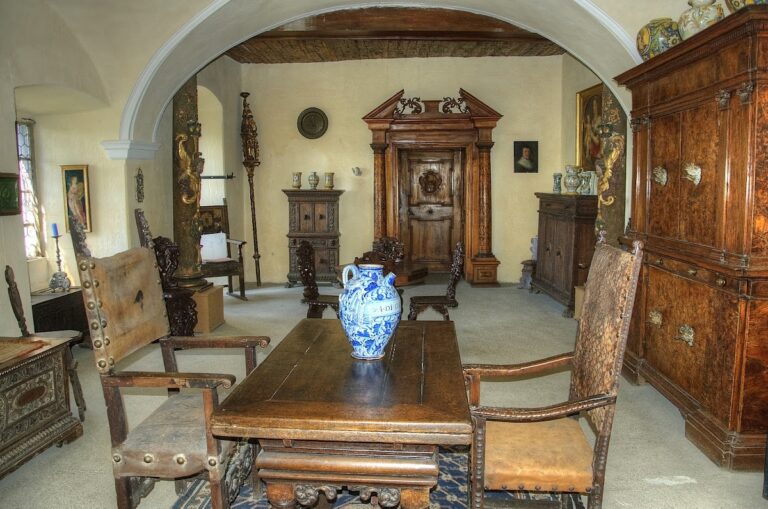
The restored residence contains living quarters and a knight’s hall. A museum area presents an exhibition on the Middle Ages, including historic coats of arms and knightly armour. The reconstruction is neoromantic, meaning that it uses medieval-looking forms and imagery while belonging to a later architectural period rather than preserving an unchanged medieval building.