Hrušov Castle: A Medieval Route-Guarding Fortress in Slovakia

Site at a Glance
- Rating
- 4.9
- Popularity
- Low
- Country
- Slovakia
- Primary era
- Medieval
- Eras represented
- Medieval, Early Modern
- Civilizations
- Hungarian
- Site type
- Military
- Remains
- Castle
On this page9 sections
History
Hrušov Castle is a Gothic medieval fortress in Slovakia, situated within the municipality of Hostie in the Zlaté Moravce District. Built in the thirteenth century, probably after the Mongol invasions of Central Europe, it served as a residence, defensive stronghold, and guardian of the trade route linking the Požitavie and Ponitrie regions. Its first documentary mention dates to 1253.
Foundation and Royal Administration
The circumstances of the castle’s foundation are uncertain, but its position above the road from Tekov toward Skýcov and Ponitrie gave it a clear strategic purpose. In the historic Tekov, also called Bars, region of the Kingdom of Hungary, Hrušov controlled an important route while combining military protection with residential functions.
From 1321 to 1344, Hrušov belonged to the Levický family before becoming royal property. In 1347, King Louis I the Great granted it to Master Mikuláš, son of Július of Topoľčany, and to Mikuláš’s brother Ondrej. The grant described the castle as Castrum Nostrum Hurusov. It later returned to royal administration, with castellans, officials responsible for administering and defending castles, overseeing it.
Frequent Changes of Ownership
Hrušov changed hands repeatedly during the fourteenth and fifteenth centuries. Its holders and administrators included Bede Vörös, Miklós Perényi, Domonkos Nagy, Leusták Ilsvai, members of the Forgách, Kanizsai, Csetneki, and Bebek families, Mihály Szerdahelyi, Gergely Lábatlani, the Both brothers of Bajna, the Verebélyi brothers, Pál Holy of Radna, Ambrus Sárkány of Ákosház, and Lőrincz Hrussói of Zábláthi. This rapid succession of owners became one of the castle’s notable features.
The castle’s governors also repeatedly raided estates belonging to the Monastery of Saint Benedict. On 4 July 1352, King Louis ordered that the monastery estate of Knezsicz not be seized and that water from the mill on the Zsitva River not be diverted. The dispute continued in later decades. In 1468, the monastery’s abbot protested the occupation of Knezsicz, Maholány, Lehota, and Zsikava.
Around 1396, Leusták Ilsvai received Hrušov from the Crown, but it reverted to King Sigismund when Ilsvai could not produce a valid deed of donation. In 1403, Sigismund granted the castle to a member of the Forgách family, then főispán, or chief county official, of Nyitra. The grant required the provision of 300 mercenary cavalrymen for the castle of Esztergom.
In 1408, Archbishop János Kanizsai and his brothers sold Hrušov for 6,000 forints to György and Péter, the sons of Leusták Ilsvai. In 1424, the king exchanged Saskő Castle for Hrušov with the Csetneki family, which descended from the Bebeks. By the following year, the castle belonged to a son of János Bebek of Pelsőcz. János Kistapolcsányi occupied it in 1447, but the palatine, one of the highest-ranking officials in medieval Hungary, ordered him to return it to the Bebek family.
Further transfers followed. An agreement of 1486 involving György and Pál Bebek of Pelsőczi and Imre Szapolyai transferred Hrušov to Pál Szölcséni. In 1476, the castle had been held by Mihály Szerdahelyi, from whom King Matthias I demanded proof of ownership. In 1486, Matthias granted it to Gergely Lábatlani. The Both brothers, András and János of Bajna, sold Hrušov in 1492 to Simon, Pál, and György Verebélyi and György’s son János. György Verebélyi then sold it in 1502 to Pál Holy of Radna and Ambrus Sárkány of Ákosház, who resold it in 1504 to Lőrincz Hrussói of Zábláthi, captain of Bajmóc and Trencsén, and his children.
The estates attached to Hrušov in the agreements of 1486 and 1504 included Knezsicz, Maholyán or Maholány, Puszta-Lehota, Nagy-Lehota, Lewes, Boroch, Keresztúr, Zsikava, Kenóghi, Skóghi, Szolcsány, Zsitva-Keresztúr, Kosztolány, Lehota, Lehotka, Hostheolcz, Szkiczó, Ebedecz, Barócz, and Lamathyncz.
Later Fortification and Destruction
Hrušov later became part of the Kistapolcsány estate, successively associated with the Keglević family and Princes Charles-Louis and Joseph. It was again royal property in the mid-sixteenth century before being granted to the Topoľčiansky family. In 1616, after the earlier noble owners from Topoľčianky had died out, the entire castle complex was sold to Ladislav Pethe.
During the second half of the seventeenth century, Count Ladislav Rákóczi directed renovations and improvements to the castle’s defenses. Its military role ended after the defeat in 1708 of the forces of Prince Francis II Rákóczi, who led the major anti-Habsburg uprising in the Kingdom of Hungary from 1703 to 1711. The Imperial Army ravaged and destroyed Hrušov as a stronghold occupied by the Kuruc insurgents, after which the castle was abandoned and deteriorated into ruins.
Conservation and renovation took place from 1928 to 1930 under Engineer K. Kühna of the State Heritage Institute in Prague. President Tomáš Garrigue Masaryk, the first president of Czechoslovakia, supported the work and visited the castle several times while staying at his country residence in Topoľčianky. Further consolidation and renovation followed at the beginning of the twenty-first century.
Remains
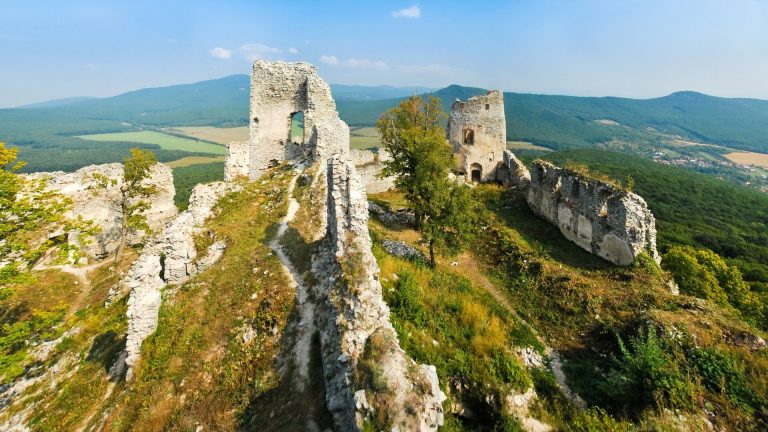
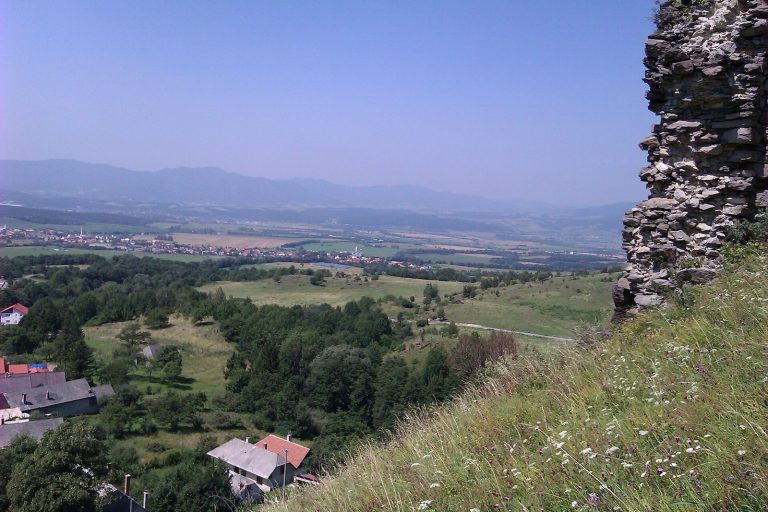
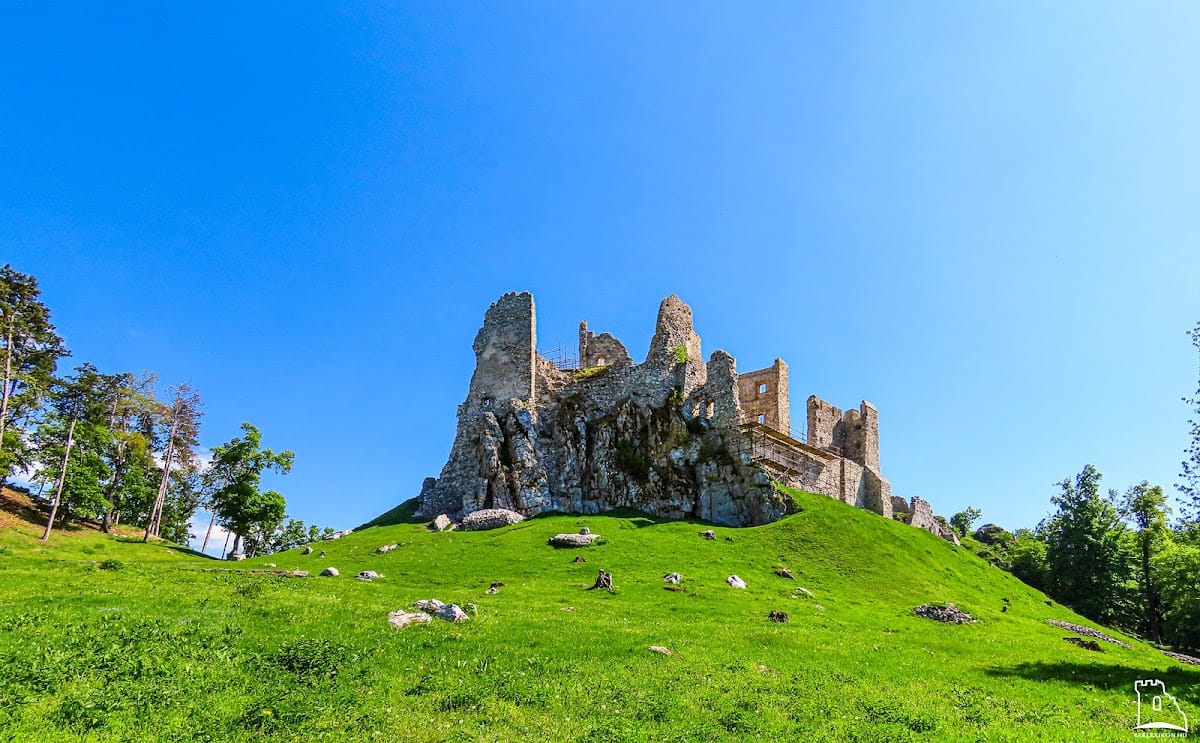
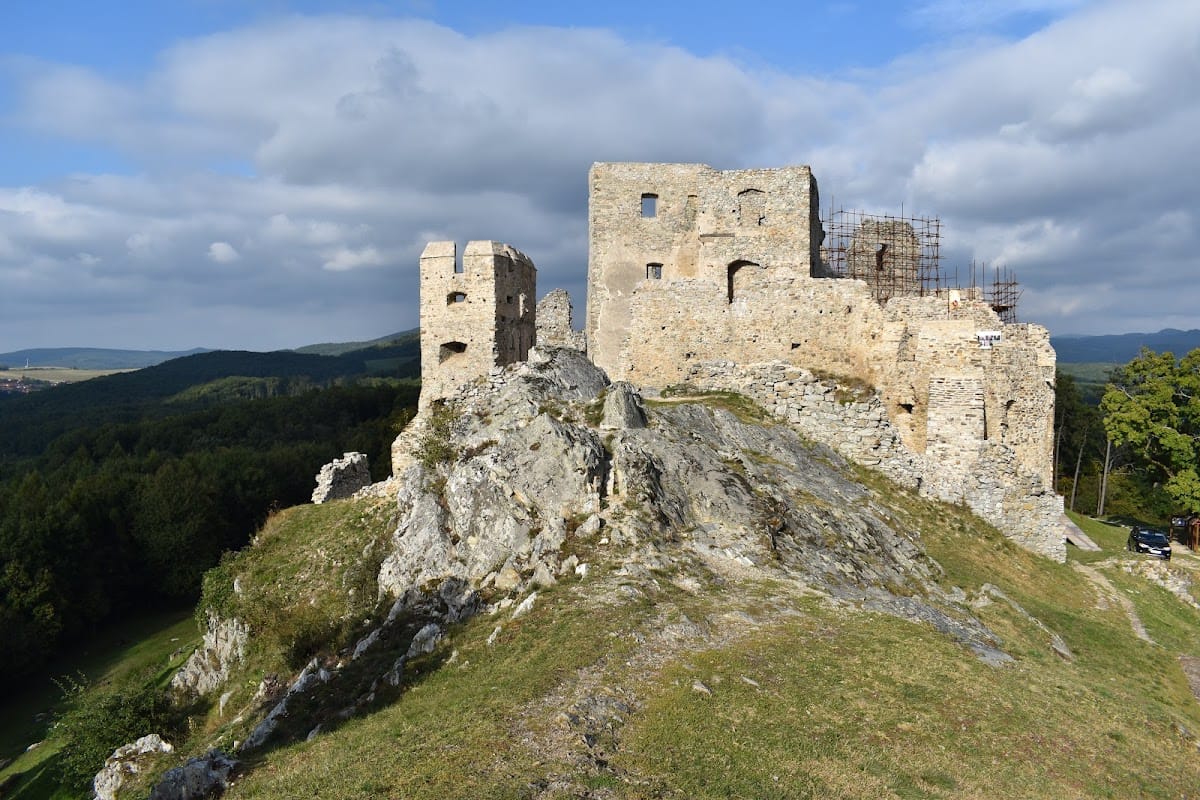
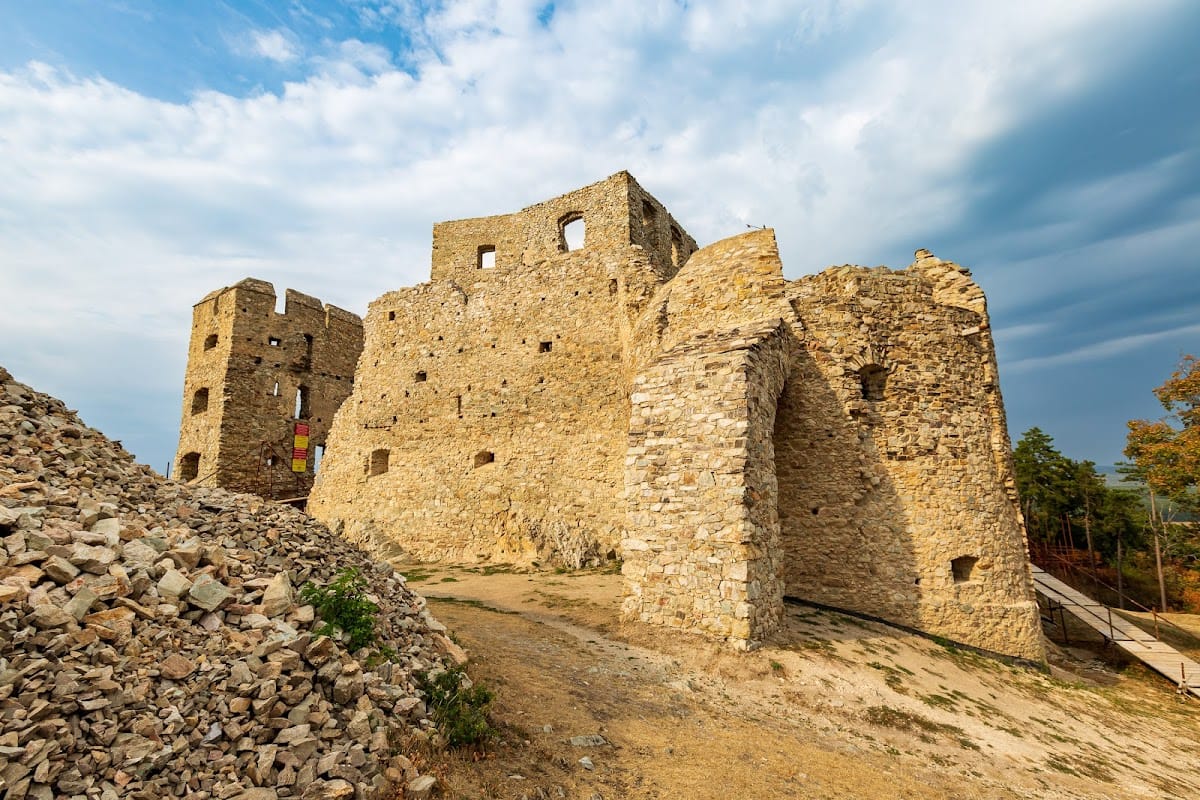
Hrušov Castle stands on Skalka, a quartzite hill approximately 482 metres above sea level in the Tribeč Mountains. The surviving Gothic complex is organized around a residential core and a first bailey, an enclosed outer area. Its preserved towers and bastions, projecting defensive structures, form the principal elements of the remaining fortifications.
Castle Core and Outer Defenses
Residential Core
The upper part of Hrušov retains the castle’s residential core, reflecting the original combination of habitation and defense. The core forms part of the surviving plan on the quartzite hill and is integrated with the surrounding fortified structures.
First Bailey
The first bailey forms the outer part of the preserved castle plan. Its enclosed arrangement connected the residential area with the defensive system and helped organize the approach to the upper castle. Towers and bastions remain prominent within the fortifications.
Entrance Tower and Artillery Defenses
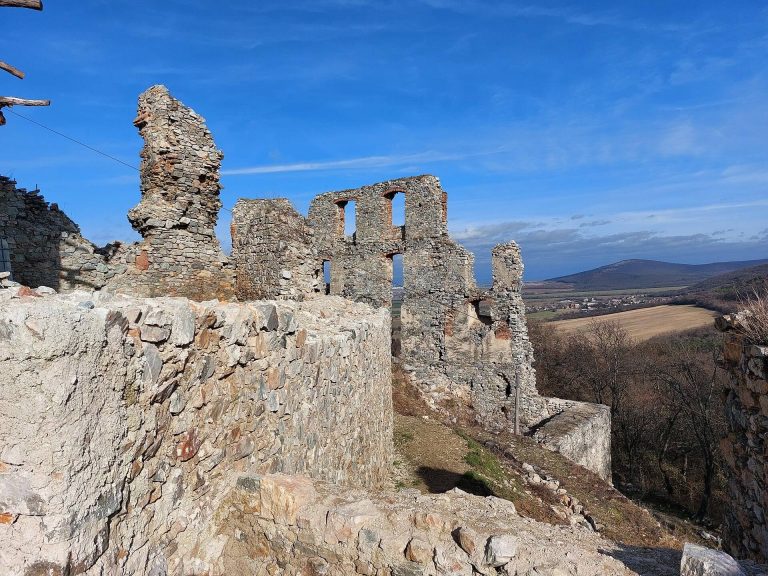
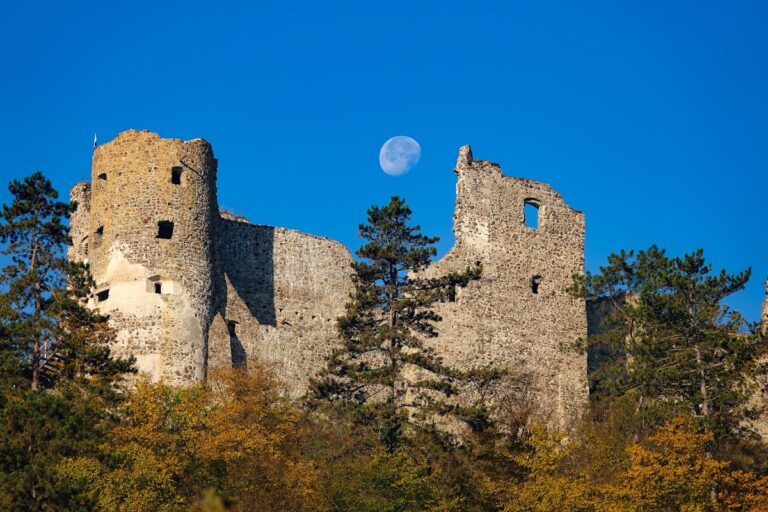
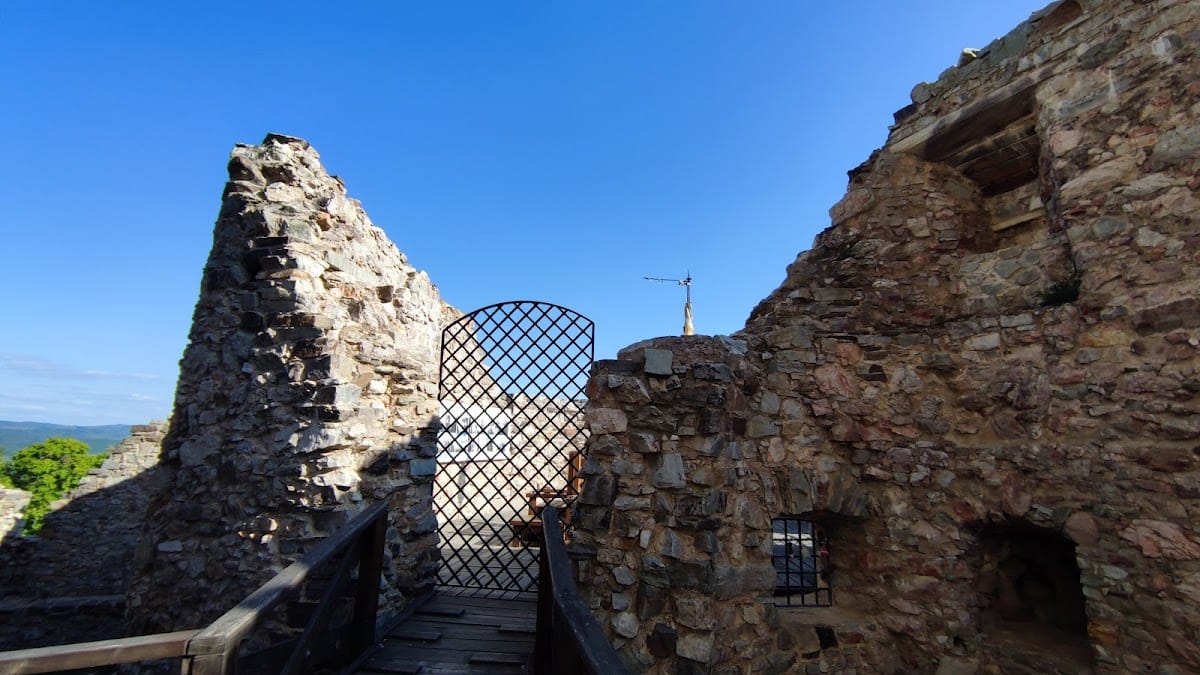
A tower beside the entrance to the former second bailey contains the entrance to the upper castle. Rectangular windows pierce the tower, while loopholes, narrow openings for observation or firing, occur in the fortifications. The second bailey was originally constructed as an artillery fortification, adding a later defensive element to the castle complex.
Hrušov was also associated with Živánska Tower in the cadastral territory of Jedľové Kostoľany. Together with its elevated position above the road between Topoľčianky and Skýcov, this defensive arrangement reflects the castle’s long-standing role in controlling movement between the Požitavie and Ponitrie regions.