Castello di Montegufoni: A Medieval Walled Castle in Tuscany


Site at a Glance
- Rating
- 4.4
- Popularity
- Low
- Country
- Italy
- Primary era
- Medieval
- External website
- Open
- Eras represented
- Medieval, Early Modern, Modern
- Civilizations
- Grand Duchy of Tuscany, Italian, Republic of Florence
- Site type
- Military
- Remains
- Castle
On this page13 sections
History
Castello di Montegufoni is a historic castle in Italy, near Montespertoli in Tuscany, whose origins probably lie in the tenth or eleventh century. It stands along the ancient Via Volterrana, a route associated with Charlemagne and other emperors travelling toward Florence or Rome through Volterra and Siena. After Florence subdued Volterra in 1472, the road gained strategic value for the movement of minerals and salt.
Origins and Acciaioli expansion
The foundation date of Montegufoni is unknown. The first castle was probably built by the Ormanni, a noble family identified as its earliest lords. Florentine forces attacked it in 1135 in an effort to destroy the stronghold, which then remained in ruins until the thirteenth century.
During the thirteenth century, ownership passed to Gugliarello Acciaioli. The Acciaioli were a powerful Florentine banking and political family, and their wealth enabled the expansion of Montegufoni. By the end of that century, the property had become a walled complex with a central castle and seven smaller buildings. An inscription described these structures as the “seven old villas of the ancestral castle of Montegufoni.”
Niccolò Acciaiuoli was born at Montegufoni in 1310, in a room later turned into a chapel. He went on to become Grand Seneschal of Naples, a senior royal official responsible for major court and administrative functions, and was a close friend of Boccaccio and Petrarch. In 1348, Louis of Taranto, king of Naples, took refuge at the castle with his prime minister after being driven from his kingdom during his conflict with the king of Hungary. He held a banquet with Bishop Angelo Acciaioli in the Banquet Hall, later known as the Theatre.
The ducal court and later restorations
Donato Acciaioli built the castle’s dominant tower in 1386. He had served as Duke of Athens, Senator of Rome, and gonfaloniere of the Republic of Florence, the latter being a leading civic office in the Florentine government. After his banishment from Florence in 1396, his cardinal brother prevented the confiscation of his property, including Montegufoni. Donato’s three sons lived at the Court of Athens, the ducal court of the medieval Latin-ruled principality centred on Athens. Agnolo di Jacopo later returned to Montegufoni with his son, Duke Francesco, and a cousin, probably giving rise to the name “Court of the Dukes.”
In 1546, another Donato Acciaioli restored the tower and built the armory, which later became known as the Gallery. Montegufoni was also a meeting place for Florentine artists, and Cosimo II de’ Medici was invited there in 1612. Around 1650, Donato Acciaioli and his wife, Anna Maria Altoviti, restored the entire castle and joined the seven formerly separate buildings. The estate remained a gathering place for Florentine high society during the seventeenth and eighteenth centuries, before the Acciaioli family’s financial decline led to its sale to the Baracchi family.
The Sitwells and the twentieth century
Sir George Sitwell purchased the neglected castle in 1909 for his son, Sir Osbert Sitwell. The Sitwells enriched and embellished the property, and in 1922 commissioned Gino Severini to decorate it. During the Second World War, Montegufoni sheltered 261 works of art from theft or damage. They included Domenico Ghirlandaio’s Adoration of the Magi, Sandro Botticelli’s Primavera and Trebbio Altarpiece, and Giotto’s Ognissanti Madonna. Giovanni Poggi, a Fine Arts official and director of the Uffizi, Cesare Fasola, and local citizens helped arrange the concealment. After the war, the works were returned to the Uffizi Gallery in Florence.
The Sitwells made Montegufoni a cultural centre frequented especially by American and English artists and writers. Sir Osbert Sitwell, by then a celebrated British author, settled there permanently in 1966 and died at the castle in 1969 after suffering from Parkinson’s disease. Sir Reresby Sitwell sold Montegufoni to Sergio Posarelli in 1972. Posarelli restored the castle and converted it into a holiday residence. After his death in 2013, ownership passed to his three children, Cosimo, Guido, and Lisa Posarelli. The castle is now divided into apartments and is used mainly for accommodation, ceremonies, receptions, weddings, and conferences.
Remains
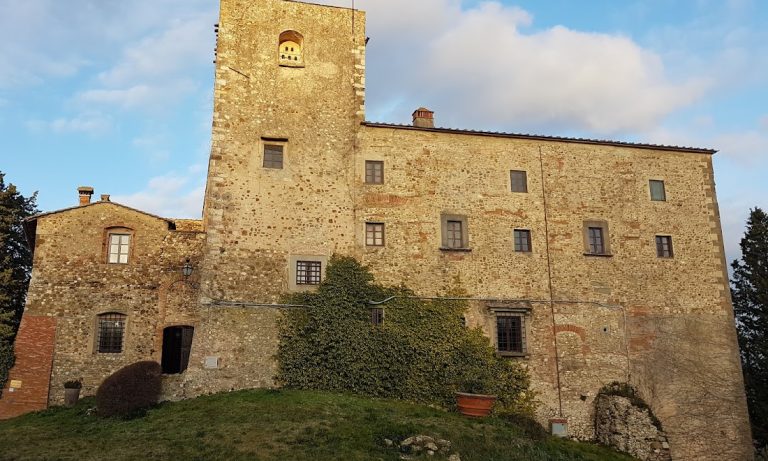
Castello di Montegufoni retains the layout of a central castle and seven smaller buildings enclosed by perimeter walls. The smaller structures originally stood separately and were joined during the restoration of about 1650. The surviving complex includes the dominant tower, courtyards, former ceremonial rooms, a chapel, the Church of San Lorenzo, decorated interiors, terraces, and a grotto with fresco fragments.
Fortified complex and principal rooms
Central castle and connected buildings
The castle’s present form reflects the connection of the seven former villas around the central building. Their arrangement creates the area known as the Courtyard of the Dukes, which lies among structures that were once independent. The former Banquet Hall, now called the Theatre, overlooks this courtyard and preserves the memory of the courtly functions associated with the complex.
The tower
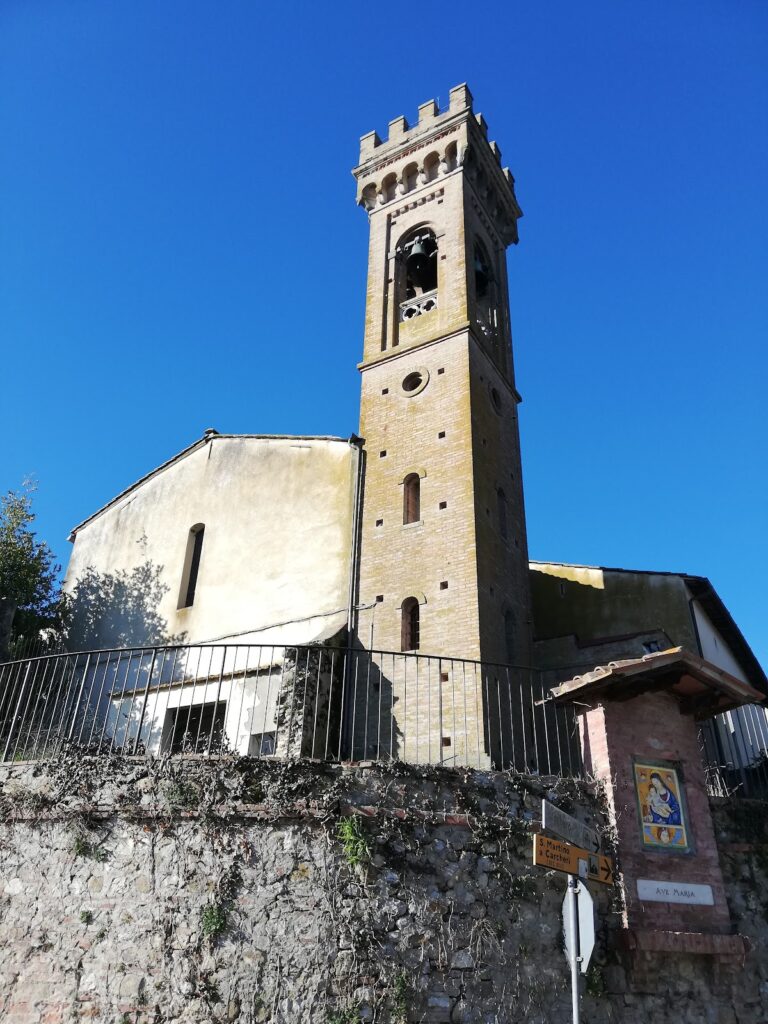
The tower erected by Donato Acciaioli in 1386 still dominates the castle. Its restoration in 1546 followed the model of Arnolfo’s Tower at Florence’s Palazzo Vecchio, the tall civic tower named after the architect Arnolfo di Cambio.
The chapel and the Church of San Lorenzo
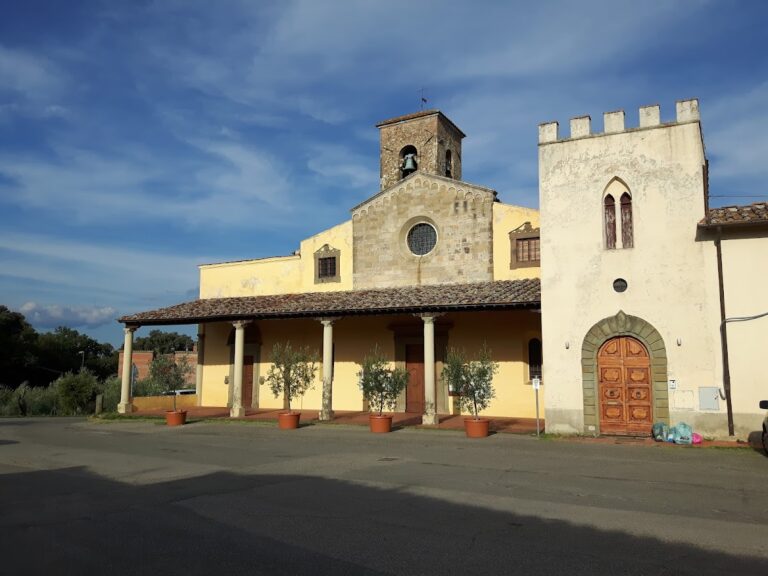
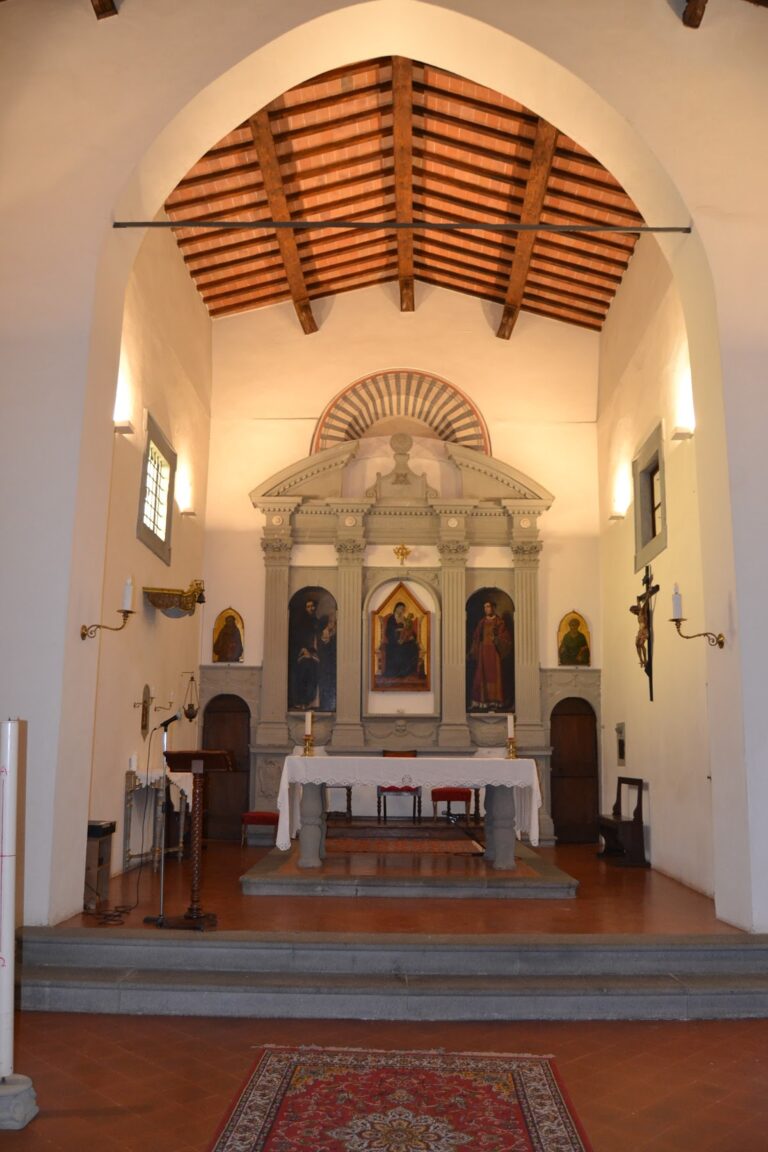
The room where Niccolò Acciaiuoli was born in 1310 was later converted into a chapel. The Church of San Lorenzo contains a fresco by Giovanni Domenico Ferretti, a Florentine-school Rococo painter. Rococo was an eighteenth-century European style known for light ornament and graceful decorative forms. The church also preserves a painted crucifix by Taddeo Gaddi.
Decorative features and grounds
The Gallery and Room of Masks
The armory built in 1546 is now known as the Gallery. In 1922, Gino Severini decorated the Room of Masks with masks and harlequins. Elsewhere in the castle, his frescoes include an owl and a scene from the Commedia dell’Arte, an Italian theatrical tradition built around improvised performances and recurring masked characters.
The grotto and terraces
A grotto beneath the first terrace contains surviving fragments of frescoes. The grounds include several flowered terraces, potted lemon trees, fig trees, olive plantings, and vineyards in the immediate surroundings.
The Madonna and Child
A Madonna and Child made by the workshop of Lippo di Benivieni during the Trecento, the Italian term for the fourteenth century, is preserved at the Museum of Sacred Art in Montespertoli. Its association with Montegufoni forms part of the castle’s religious and artistic history.