Castel Belasi: A Medieval Castle and Aristocratic Residence in Trentino


Site at a Glance
- Rating
- 4.5
- Popularity
- Low
- Country
- Italy
- Primary era
- Medieval
- External website
- Open
- Eras represented
- Medieval, Early Modern
- Civilizations
- Holy Roman Empire
- Site type
- Domestic
- Remains
- Castle
On this page11 sections
History
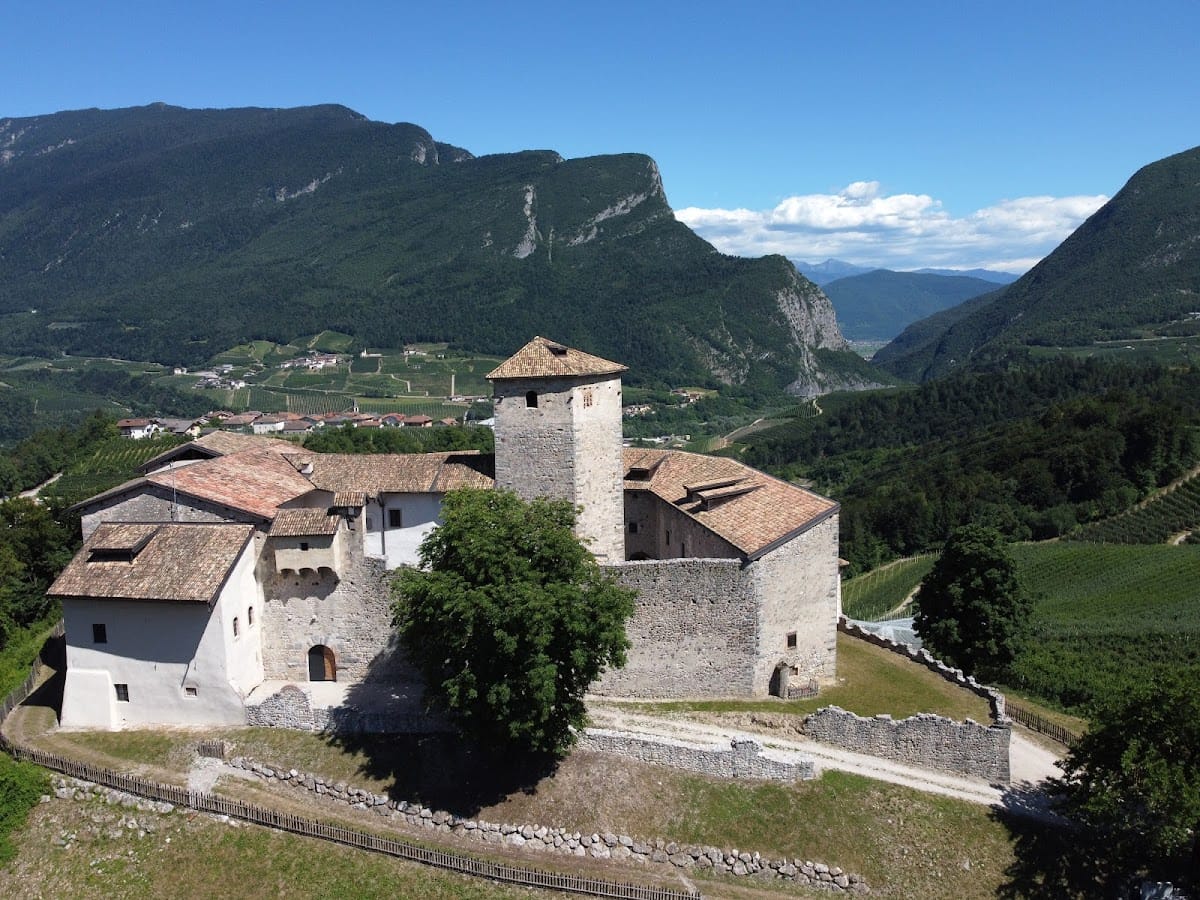
Castel Belasi is a medieval castle in Italy, at Segonzone, a hamlet of Campodenno in Trentino. Its construction is now placed probably in the second half of the thirteenth century, later than the twelfth-century date once proposed. The Counts of Tyrol, the ruling dynasty of the County of Tyrol, are believed to have founded the fortress to control access to Val di Non after occupying the valley during their conflict with the prince-bishops of Trento, ecclesiastical rulers who also held territorial and political authority in the region.
Origins and early rule
The castle was probably established after the Rubein-Ragogna family arrived from the Burgraviate of Merano. The Counts of Tyrol entrusted it to their loyal captain Ulrico di Ragogna. Earlier interpretations connected the site with an original Belasi family, supposedly vassals of the Counts of Appiano, and with an Adelpreto de Bellago mentioned in 1189. More recent research identifies that Adelpreto with Plag near Appiano and rejects both his association with the castle and the existence of a twelfth-century Belasi family.
The name Belasi is otherwise understood as the name of the hill on which the castle stands, rather than the name of an early castellan. In February 1368, Corrado Khuen, son of Egenone of Termeno, acquired Castel Belasi from Simone Rubein, the nephew of Ulrico di Ragogna. The deed does not state a purchase price, possibly because Corrado was owed a debt. Another unconfirmed hypothesis proposes that Corrado’s eldest son, Arnoldo, married Elisabetta di Belasi, described as the last descendant of the Rubein family.
The Khuen-Belasi family
Corrado’s acquisition connected the castle with the Khuen family, which adopted the name Khuen-Belasi. Between the fifteenth and sixteenth centuries, the family became one of the region’s wealthiest and most powerful noble houses. Its branches extended from Trentino to Croatia, and it maintained connections with the courts of Vienna and Salzburg. During this period, the medieval fortification was reshaped into an imposing aristocratic residence.
The castle also formed the center of extensive rural rights and landed property. Families in Lover, Segonzone, Campodenno, and Dercolo had to deliver tithes from their harvests to Belasi, while the castellans enlarged the estate with fields, vineyards, meadows, and woodland. Rival Spaur lords captured and occupied the fortress between 1415 and 1420. In 1525, peasants taking part in the regional Peasant War sacked the castle’s granaries.
From noble estate to restored monument
In the eighteenth century, the Khuen-Belasi family received the title Counts of the Holy Roman Empire, a rank within the political order that encompassed much of central Europe until 1806. By then Castel Belasi had lost its military role, but it remained the center of a large agricultural estate with stables, hay barns, and storehouses. The residence continued to be embellished even as its defensive purpose declined.
The Napoleonic Wars and the abolition of noble privileges contributed to the castle’s decline during the nineteenth century. It was largely abandoned and used mainly as a summer residence while its owners pursued political and military careers in Austria and Bavaria. The family lived at Belasi permanently for several decades between the First and Second World Wars, but the castle was definitively abandoned in the 1950s. Its furnishings were removed, and by the end of the 1990s the fortress had deteriorated severely.
In 2000, the municipality of Campodenno acquired the castle complex, including the nearby Church of Saints Philip and James, and began a complete restoration. The first work addressed unstable geological conditions on the hill that threatened the structures, followed by the securing of roofs, consolidation of masonry and floors, and architectural restoration. The work was completed in time for the castle to open to visitors in 2019. Castel Belasi now houses the Contemporary Art Center for Ecological Thought, which promotes ecological practices and dialogue between art and science in collaboration with Muse, and it hosts seasonal exhibitions and cultural events. The castle is associated with the Khuen-Belasi family and is protected as Italian national heritage.
Remains
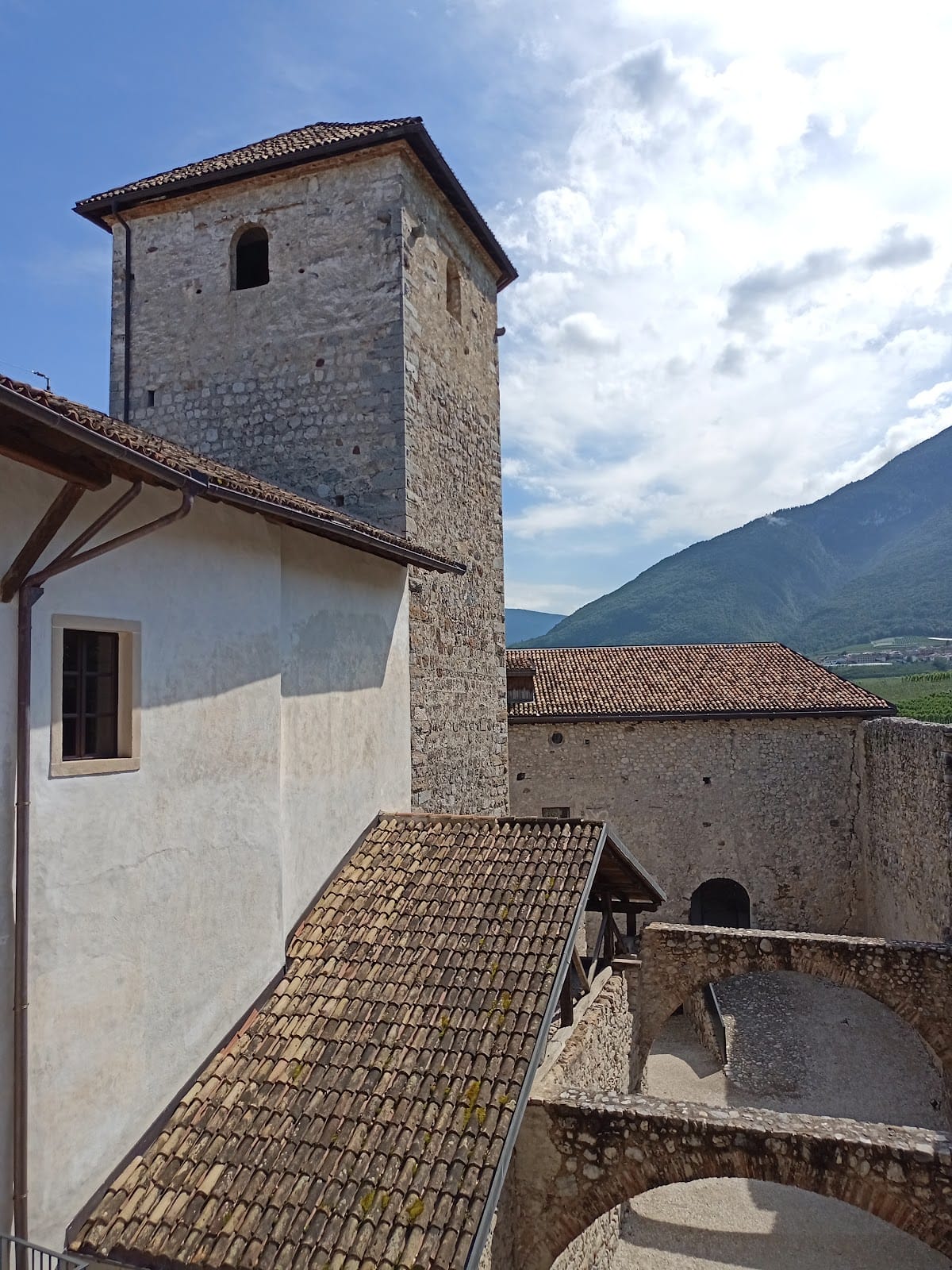
Castel Belasi occupies a gently sloping hill at about 465 metres above sea level, amid woodland and orchards. Built largely of rubble stone, the complex retains substantially intact structures arranged around extensive internal courtyards. A massive pentagonal keep and a high curtain wall form the principal defensive framework, while buildings from several periods are attached to the enclosing walls.
Defensive and agricultural structures
Keep and curtain walls
The pentagonal keep is the castle’s principal fortified tower, rising within the defensive enclosure beside the high curtain wall. Two bartizans, projecting fortified lookout structures, stand on the curtain wall at the two entrances. On the southern side of the hill, two smaller curtain walls are joined by a ravelin, an outwork placed before a fortification to help protect an entrance. Together, these elements define the castle’s defensive perimeter and its approaches.
Agricultural buildings
The internal complex also preserves the physical setting of the estate’s agricultural activities. Large stables, hay barns, and storehouses were built against the curtain wall, occupying parts of the extensive courtyards alongside structures from other periods.
Palace decoration and chapel
Frescoed rooms
The residential palace contains wall paintings from the fifteenth and sixteenth centuries. Earlier decorative paintings, rediscovered during restoration on a first-floor corridor wall, show a late-medieval castle tournament with coats of arms, heraldic crests, and musicians. The Music and Fruit Room has mid-sixteenth-century decoration in which draped balustrades carry musical instruments, fruit, and vegetables. An adjoining room contains a refined fresco of the Judgment of Paris, attributed to the German painter Bartlmä Dill Riemenschneider and dated to the middle of the sixteenth century.
The slightly later Metamorphoses Room contains scenes from Ovid’s Metamorphoses, a Roman poet’s collection of mythological stories centered on transformations and frequently used in Renaissance art. On the facade of the central palace, a large Khuen-Belasi coat of arms is surmounted by the arms of Archduke Ferdinand II of Austria, the sixteenth-century Habsburg ruler of Tyrol, dated to the 1560s.
Family chapel
The family chapel stands in the western courtyard against the walls of the central palace and is dedicated to Martin of Tours, a fourth-century Christian bishop and major Western European saint. Its frescoes were produced in several phases between the fifteenth and sixteenth centuries. A window connects the chapel with a first-floor palace room, allowing the counts to hear religious services when illness prevented them from entering the chapel.