Castle of Zorita de los Canes-Alcazaba de Zorita: A Medieval Fortress and Calatravan Stronghold


Site at a Glance
- Rating
- 4.2
- Popularity
- Low
- Country
- Spain
- Primary era
- Medieval
- External website
- Open
- Eras represented
- Medieval, Early Modern
- Civilizations
- Crown of Castile, Crusader, Order of Calatrava, Spanish, Umayyad
- Site type
- Military
- Remains
- Castle
On this page9 sections
History
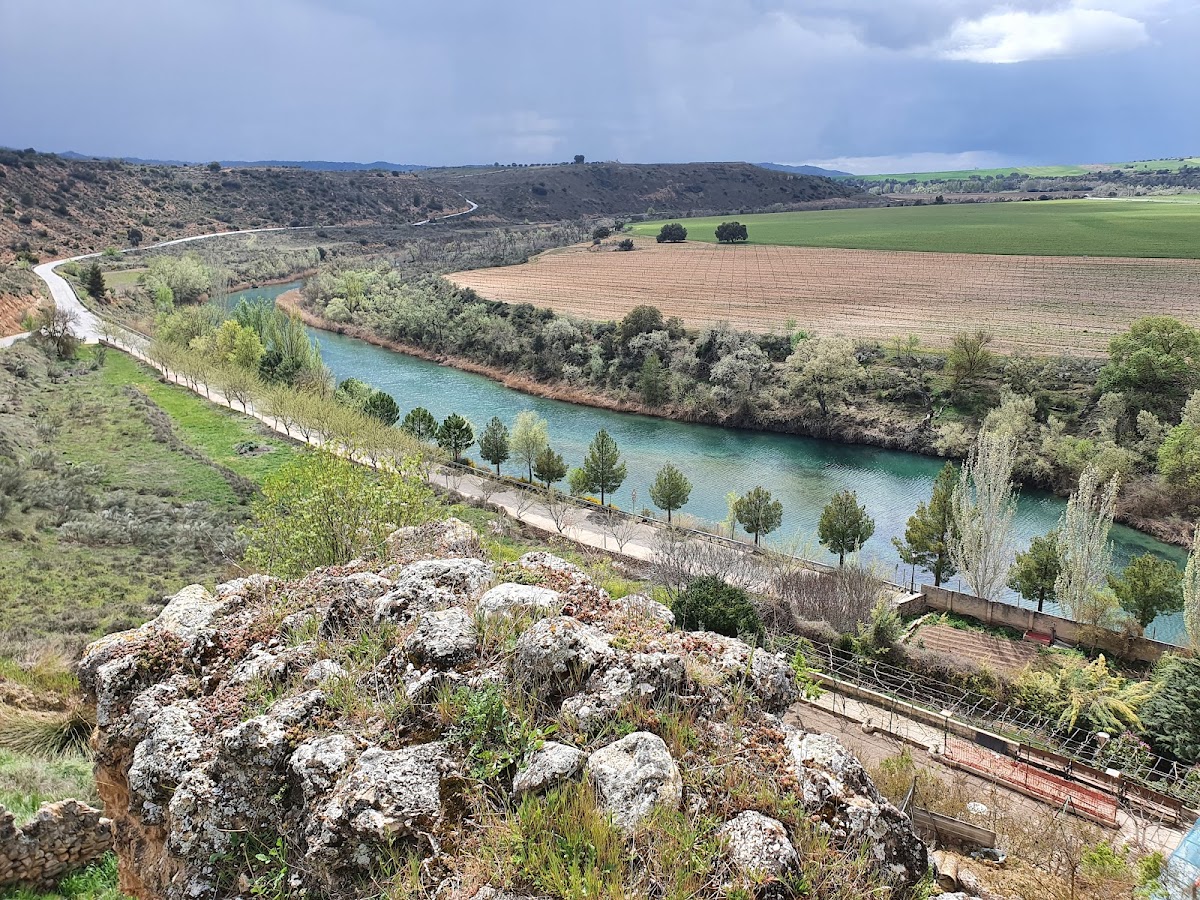
The Castle of Zorita de los Canes-Alcazaba de Zorita is a fortress in Zorita de los Canes, Spain, founded by order of Muhammad I, emir of Córdoba, in 852. Built on a rocky hill at the beginning of his rule, it defended a crossing of the Tagus through Santaver, an administrative district of al-Andalus. The sandstone beneath the site created structural difficulties from the outset, and a reform followed in 853. The surviving complex preserves later Islamic, Castilian, Templar, and Calatravan phases.
Islamic Foundation and Rebellions
Zorita soon became more than a frontier fortress. Its citadel served as a center for rebellions against the emirate of Córdoba. In 886, Umar ibn Hafsun used it as the starting point for a raid on Toledo. Abd al-Rahman III employed the citadel during his campaign of 924 to recover Santaver, and Zorita remained connected with opposition to the caliphate in the years that followed.
During the mid-eleventh century, Al-Mamun of Toledo ceded Guadalajara and much of La Alcarria, including Zorita, to Alfonso VI of León and Castile. The transfer supported Alfonso’s claim to the Castilian throne against his brother Sancho II. Zorita entered Castilian control after Alfonso became king in 1072. In 1097, Alfonso appointed the military leader Álvar Fáñez as governor, but Almoravid forces, belonging to an Islamic dynasty that ruled parts of North Africa and al-Andalus, defeated him in 1110 and recovered the citadel.
Templar and Early Calatravan Control
The Knights Templar conquered the fortress for the Kingdom of Castile in 1124. This medieval military religious order then faced continuing pressure from Almohad forces, whose dynasty succeeded the Almoravids in parts of North Africa and al-Andalus. In 1174, Alfonso VIII of Castile transferred Zorita’s citadel to the Order of Calatrava, a military religious order founded in the Iberian Peninsula to defend Christian territories and organize frontier fortresses.
The Calatravans used Zorita as a stronghold against incursions from Andalusia. In 1180, Alfonso VIII granted the town a charter that included the right of pontazgo, a toll or right of passage connected with a bridge or route. The grant linked Zorita’s protected position beneath the castle with the movement of people and goods through the area.
Refuge, Reorganization, and Conflict
The Order of Calatrava suffered a major defeat at the Battle of Alarcos in 1195, an encounter that weakened the Christian military forces facing the Almohads. Afterward, Zorita became the order’s principal refuge and center for reorganization. The Calatravans strengthened the citadel with additional walls and dependencies, including an internal church. Its monastic buildings made Zorita the order’s center during the early thirteenth century. This role continued until the Castilian victory at the Battle of Las Navas de Tolosa in 1212, after which the order administered its territories again from Calatrava la Nueva.
Further conflict within the Order of Calatrava damaged the fortress in the fourteenth century. A power struggle pitted the order’s master, Garci López de Padilla, against the commanders of Zorita, don Alemán and Núñez de Prado, who received support from Ferdinand IV of Castile. After Padilla died in 1334, and during the reign of Alfonso XI, royal troops besieged the castle and overthrew its governor, Gonzalo Pérez. The fighting inflicted severe damage on the citadel.
Another division within the order erupted in 1443, when as many as three candidates claimed the office of master. Juan Ramírez de Guzmán, the order’s major commander, took control of the castle and used it as a base for governing the parts of La Alcarria held by the Calatravans. Pedro Girón defeated him two years later, ending that phase of control.
Decline and Preservation
The Order of Calatrava increasingly favored the growing town of Almonacid de Zorita in the late fifteenth century, while Pastrana expanded during the sixteenth century. These changes contributed to Zorita’s decline. In 1565, Ruy Gómez de Silva, the 1st Prince of Éboli, purchased Zorita and its castle. He did not use the castle as a residence because it was no longer suitable for occupation. The complex thereafter remained unused, neglected, and progressively ruined.
The castle was declared a Historic-Artistic Monument on 3 June 1931 and is registered as a Spanish Cultural Heritage monument under reference RI-51-0000611. The municipality of Zorita de los Canes is identified as its owner.
Remains
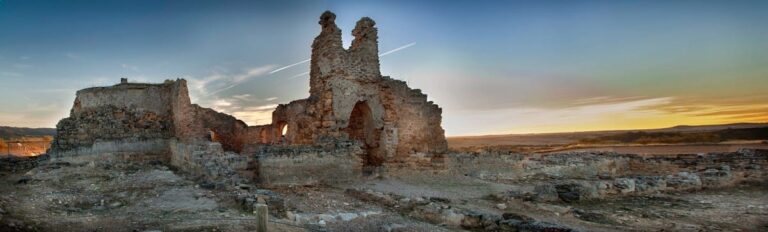
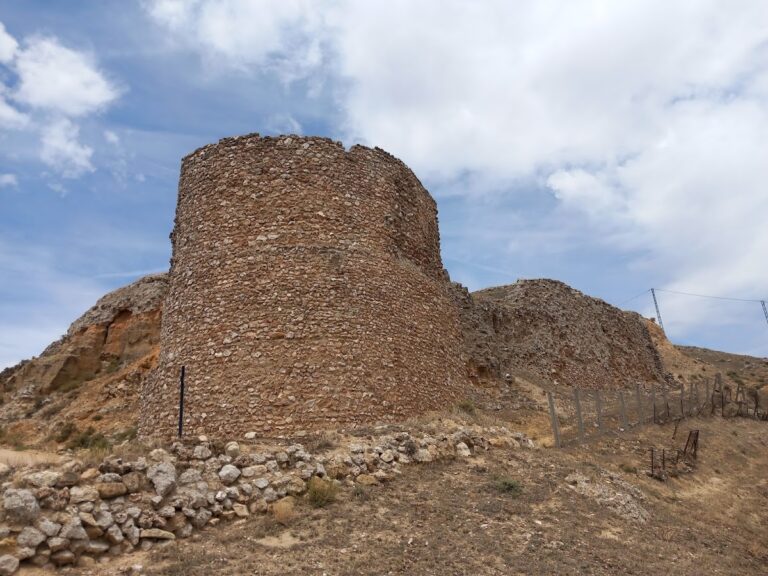
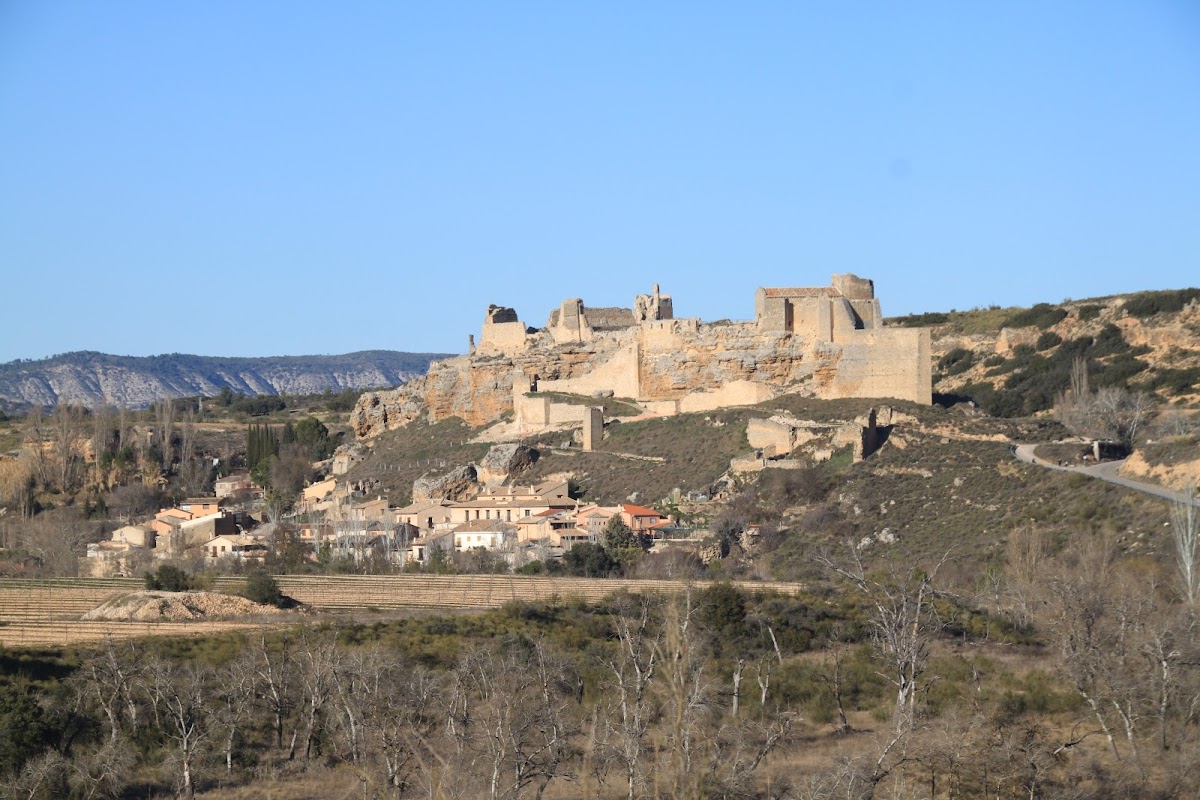
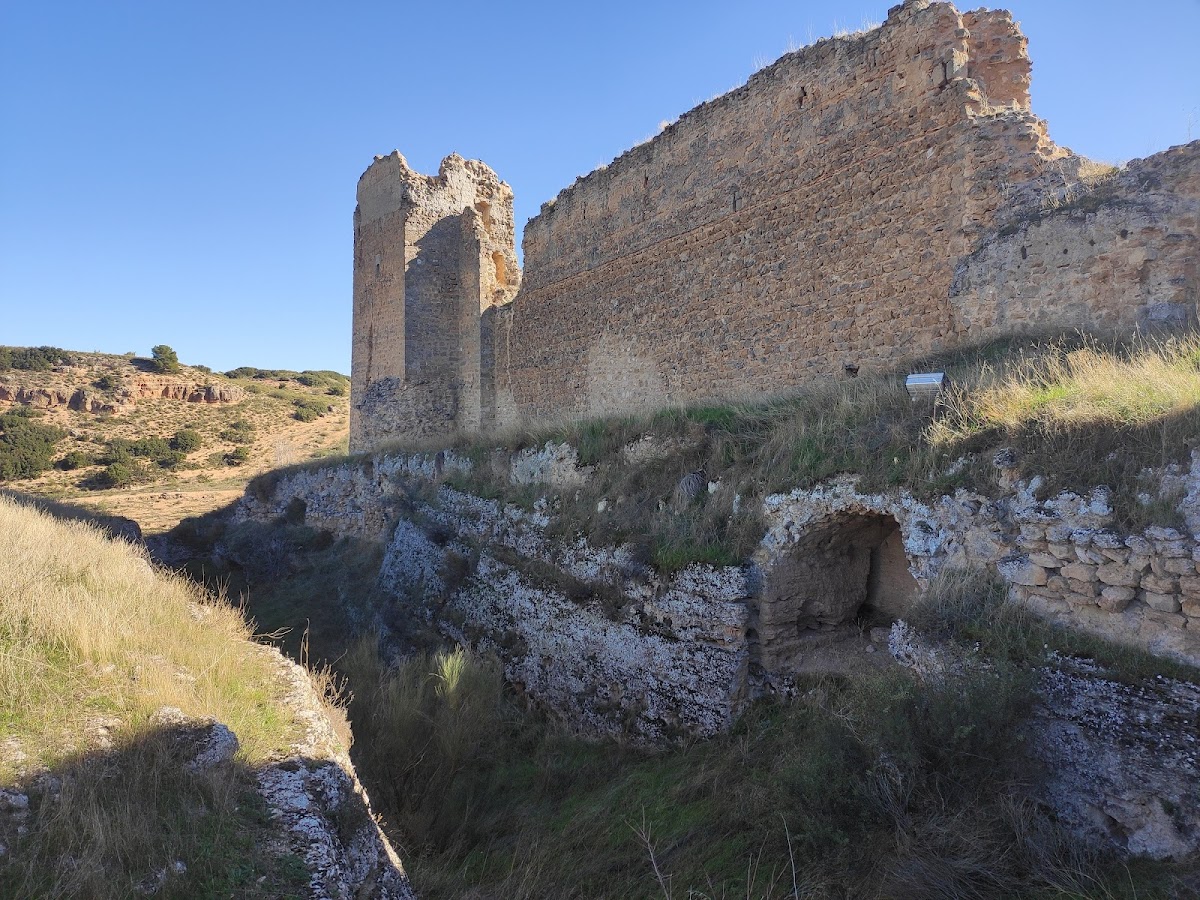
The ruins occupy an elongated rocky hill above Zorita de los Canes. The town lies to the north and the road to Almonacid de Zorita runs to the south. Because the southern side is more exposed, it received heavier fortification. The complex is arranged in three principal sectors: an albacar, or outer fortified enclosure for protecting people, livestock, or supplies; a walled military enclosure; and an inner religious enclosure containing a thirteenth-century Romanesque church with a crypt. Small ashlar blocks, carefully cut and dressed stone from nearby quarries, appear in the successive building phases. The castle survives as ruins.
Walls, Approaches, and Defensive Works
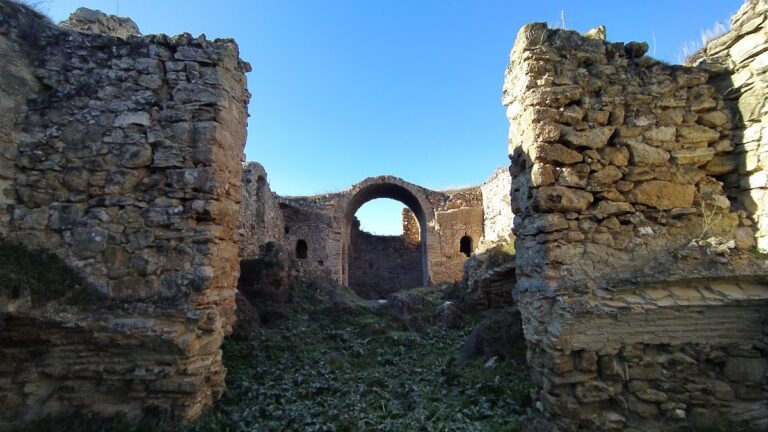
The southern wall and the northern gate belong to the oldest surviving parts of the layout, while most of the remaining fortifications date from the twelfth and thirteenth centuries. The southern approach leads to an albarrana tower, a projecting defensive tower linked to a fortification by a wall or passage, built in 1328. A second approach climbs westward from the town in a zigzag course and reaches the principal entrance. This entrance combines a Gothic arch with a surviving Caliphal-period horseshoe arch, a feature associated with the earliest construction phase and the reform of 853. The Torre del Espolón forms part of the fortified enclosure.
Religious Enclosure and Associated Features
The inner religious enclosure contains the thirteenth-century Romanesque church, a medieval building in the style characterized by massive construction and rounded arches. Its crypt is a chamber below the church used for burial or worship. In the southern part of the enclosure are remains of a cemetery used by the Knights of Calatrava. A cistern in the northern part communicated with the entire citadel, forming part of the installations that supported life within the fortress.
Sala del Moro
Near the church stands the room known as the Sala del Moro. It has a circular plan and a hemispherical form dating from the thirteenth century. An anthropomorphic head carving is set into the crown of the chamber. The room was built with high-quality, carefully dressed ashlar and was altered in the sixteenth century, after the castle had ceased to be suitable as a residence.