Borgeby Castle: A Viking Fortress and Medieval Archiepiscopal Castle in Sweden


Site at a Glance
- Rating
- 4.3
- Popularity
- Low
- Country
- Sweden
- Primary era
- Medieval
- External website
- Open
- Eras represented
- Medieval, Early Modern, Modern
- Civilizations
- Danish, Swedish
- Site type
- Military
- Remains
- Castle
On this page13 sections
History
Borgeby Castle is a historic castle in Sweden that began around 980 as a Viking-period circular fortress associated with Harald Bluetooth, the tenth-century Danish king linked with the consolidation of the Danish realm and the construction of planned fortresses. It stood beside the Lödde River and later developed into a medieval stronghold, an archiepiscopal estate, and an aristocratic residence.
Viking origins
The first fortress at Borgeby was a Trelleborg, a planned Viking circular fortress with substantial earthwork defenses. It was traditionally connected with Harald Bluetooth. Toke Gormsen, whom Harald installed to rule Scania from Borgeby, later became king of Denmark and died in 986. Unlike several other fortresses of this type, Borgeby remained occupied after Harald’s reign.
Activity continued into the late Viking Age and the eleventh century. A coin scale belongs to the later Viking period, while coins minted at Borgeby in the mid-eleventh century indicate that the settlement retained an active economic and administrative role.
Archiepiscopal rule and medieval rebuilding
From the Middle Ages until the Danish Reformation of 1536, the religious transformation that brought Lutheranism to Denmark and transferred many church properties into secular hands, Borgeby was one of the castles of the Archbishops of Lund. These senior church leaders combined religious authority with regional administrative responsibilities. A fourteenth-century testament by Archbishop Karl Eriksson shows that horses were bred at the estate during that period.
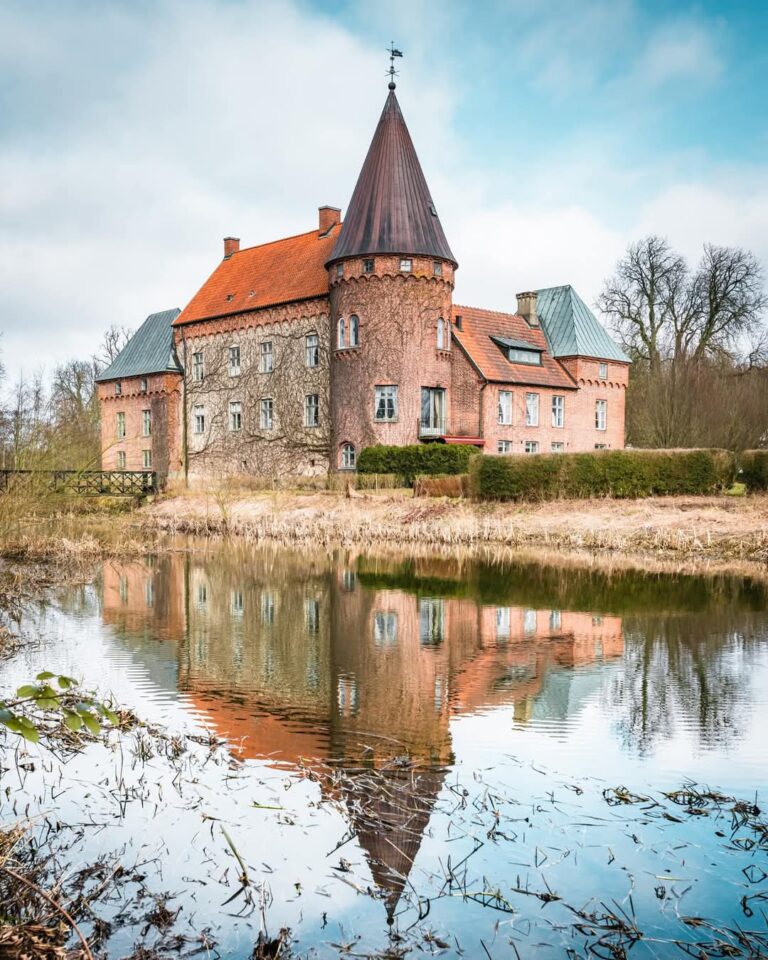
The earlier fortress was transformed into a more concentrated medieval castle. A stone defensive tower was built at its center in the early twelfth century, and a substantial brick castle occupied about one quarter of the former Viking enclosure during the thirteenth century. The Swedish army under Karl Knutsson Bonde, also known as Charles VIII, burned Borgeby in 1452. The archbishop’s chapel and a large tower, probably the archbishop’s private residence, were built afterward.
From Reformation estate to modern ownership
After the Reformation, Christian III of Denmark pawned Borgeby in 1540 to Jørgen Kock, the burgomaster of Malmö. The estate then passed through several aristocratic families. Hans Spiegel, a chamber servant to King Frederick II, built the present main building during the 1550s. Archaeological evidence also points to a possible sixteenth-century fire, perhaps connected with the peasant revolt of 1525, although no documentary confirmation survives.
During the Scanian War, the 1675–1679 conflict between Denmark-Norway and Sweden over Scania and nearby territories, Danish forces burned Borgeby on 7 May 1678 while General Arensdorff retreated toward Landskrona. Only the walls remained, but the castle was restored soon afterward.
Lars Pehrsson purchased Borgeby in 1886 from Count Raoul Wachtmeister for 232,500 kronor, together with a promissory note. A popular story claims that Pehrsson arrived at the cash auction in a hay wagon, but that episode is treated as a legend. His daughter Hanna Larsdotter married the artist and writer Ernst Norlind. After their son Staffan died in 1978, a foundation was established under Hanna Norlind’s will to own and manage the estate.
A Norlind Museum, including Ernst Norlind’s studio and gallery, was established at the castle in 1988. Lomma Municipality became the owner in 2007, and Borgeby Slott AB acquired the castle in 2012. The foundation’s remaining holdings and responsibilities were wound up in December 2020. Borgeby was designated an individually protected historic building in Sweden on 9 December 1996.
Modern archaeological work followed aerial photographs that revealed ploughed-out traces of the ring rampart. Borgeby was proposed as a Viking fortress in 1974, excavations began in 1984 and continued into the early 1990s, and work on the rampart in 1998 confirmed its place among Harald Bluetooth’s Trelleborg fortresses.
Remains
Viking fortress earthworks
The Viking enclosure was circular, with an inner diameter of approximately 150 metres and a rampart about 15 metres wide. Its defenses included a substantial moat, probably V-shaped, and the construction appears to have proceeded through several phases. Excavations investigated the ring rampart and exposed cultural layers and building remains within the later castle courtyard. The finds include a late Viking-Age coin scale and coins minted at Borgeby in the mid-eleventh century.
Medieval castle buildings
Brick enclosure and gate tower
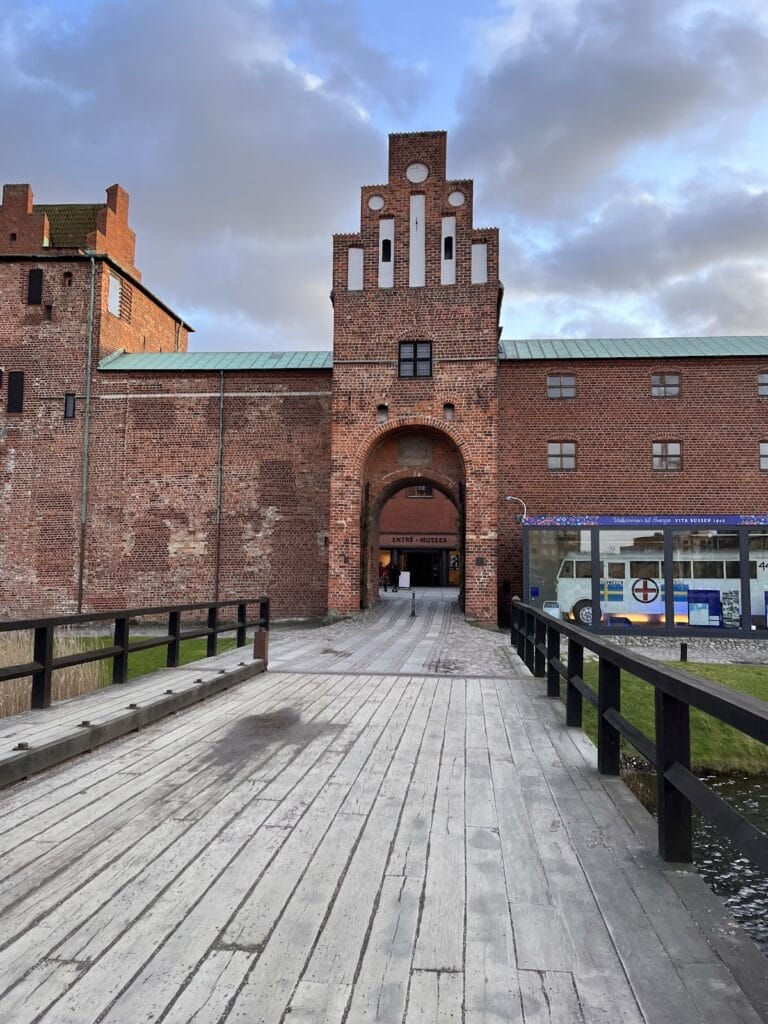
The medieval castle occupied roughly one quarter of the earlier fortress. A brick wall about 10 to 11 metres high enclosed it, and a strong moat surrounded the castle. The thirteenth-century expansion added several brick buildings, including the surviving gate-tower building. The present gate appears to date from the sixteenth century while incorporating older elements.
Archbishop’s chapel and residence tower
The archbishop’s chapel was constructed after the destruction of 1452 and survives as part of the castle complex. The large tower probably served as the archbishop’s private residence and also remains. Its present appearance reflects a restoration undertaken in 1870 by the architect Helgo Zettervall, whose nineteenth-century work involved substantial reconstruction and the destruction of much medieval masonry.
Börjes Tower
Börjes Tower is a separate tower probably built in the fifteenth century. It became freestanding when the eastern wing was demolished in 1860 and was restored in 1870. Its basement contains cross vaults.
Later estate buildings and setting
Main building
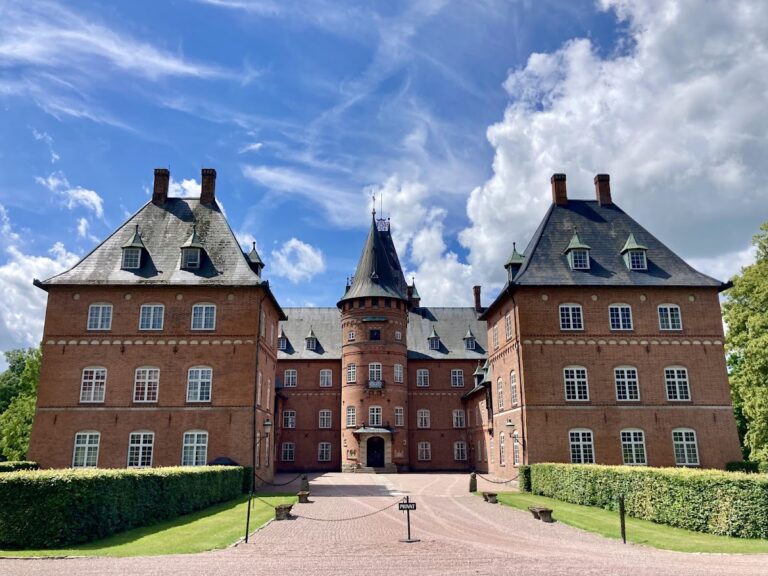
The present main building was constructed by Hans Spiegel in the 1550s. It forms the principal later residence within a complex that also retains elements from the medieval and sixteenth-century castle.
Stable buildings
The brick-built stable buildings date from 1744. They belong to the later agricultural phase of the estate, whose medieval operation included horse breeding.
Borgeby Castle stands beside the Lödde River in Borgeby, between Lund and Landskrona. Borgeby Church lies immediately east of the castle. The medieval peasant settlement stood outside the castle area, approximately 2 kilometres to the south.